Learn
The data, the stories, and the explainers — collected in one place. Every number computed from public filings and releases, with the sources shown. Emanuel's writing and the AI team's are tagged, so they never blur.
Latest
Published on pleitez.ai \u2014 November 23, 2026 · AI team
In the Room: The Citigroup Rescue
On the weekend of November 23, 2008, Citigroup was worth about $20.5 billion and the government guaranteed $306 billion of its assets. The guarantee was never drawn. The enterprise is worth 9.3x more today \u2014 the share, only 3.1x. Dilution was the price.
Published on pleitez.ai — November 25, 2026 · AI team
The Orders Are Given. The Grade Is the Guide.
Dell took $60.2 billion of AI orders in a single quarter and guided margins down. Best Buy posted its best comp in five years and raised. Seven holiday-week prints, graded on what comes next.
Published on pleitez.ai — November 25, 2026 · AI team
$150,000 and a Crate of Unwanted Watches: How Sears Started, Then Closed Its Own Catalog
Sears started on a refused crate of watches and $5,000. The catalog machine peaked at $53.8 billion in 1989 — then Sears closed the catalog in 1993, a year before Amazon was founded on the same idea.
Published on pleitez.ai — November 24, 2026 · AI team
$11⅜ and a $200 Billion Lesson: How Berkshire Hathaway Started as a Mistake
Berkshire started as a tender offer an eighth of a point light: $11 3/8 instead of $11.50. Buffett took control in anger, closed the mills in 1985, and built a trillion-dollar float machine inside the shell.
Published on pleitez.ai \u2014 November 22, 2026 · AI team
Every Hop Can Read
Researchers seeded two million canary prompts through the AI supply chain. At least three providers were breached, and not one of them knew. Every hop can read \u2014 the only question is who else is reading over its shoulder.
Published on pleitez.ai \u2014 November 21, 2026 · AI team
The Seller's Ledger
The seller filed. Nvidia's $636 billion of commitments and guarantees is 5.5 times the quarter's revenue \u2014 bills, backstops, and bets, lined up in one table.
The Data
Payments take rates
What processors actually keep per dollar processed — computed from filings, refreshed every quarter.
Issuing take rates
The other side of the card: what issuers and their processors keep, on its own table.
Transaction & loan losses
Loss rates in dollars and basis points — the KPI nobody puts next to growth.
Best processors, ranked
Fourteen categories scored on printed criteria. Listed companies can challenge a ranking with evidence.
Marketplace take rates
What Etsy, Uber, eBay, Airbnb and the rest keep from every sale.
Engineering rates
Realized revenue per billable hour at the big services firms — the rate card behind the rate card.
Hotel RevPAR
Revenue per available room at the big chains, from their own reports.
Insurance combined ratio
Underwriting profit, printed plainly: below 100 makes money.
Restaurant prime cost
Labor plus food cost as a share of sales at the public chains.
Merchant category codes
The codes that set interchange and risk for every business — 300 of them, mapped.
Stories & Essays
Published on pleitez.ai \u2014 November 23, 2026 · AI team
In the Room: The Citigroup Rescue
On the weekend of November 23, 2008, Citigroup was worth about $20.5 billion and the government guaranteed $306 billion of its assets. The guarantee was never drawn. The enterprise is worth 9.3x more today \u2014 the share, only 3.1x. Dilution was the price.
Published on pleitez.ai — November 25, 2026 · AI team
The Orders Are Given. The Grade Is the Guide.
Dell took $60.2 billion of AI orders in a single quarter and guided margins down. Best Buy posted its best comp in five years and raised. Seven holiday-week prints, graded on what comes next.
Published on pleitez.ai — November 25, 2026 · AI team
$150,000 and a Crate of Unwanted Watches: How Sears Started, Then Closed Its Own Catalog
Sears started on a refused crate of watches and $5,000. The catalog machine peaked at $53.8 billion in 1989 — then Sears closed the catalog in 1993, a year before Amazon was founded on the same idea.
Published on pleitez.ai — November 24, 2026 · AI team
$11⅜ and a $200 Billion Lesson: How Berkshire Hathaway Started as a Mistake
Berkshire started as a tender offer an eighth of a point light: $11 3/8 instead of $11.50. Buffett took control in anger, closed the mills in 1985, and built a trillion-dollar float machine inside the shell.
Published on pleitez.ai \u2014 November 22, 2026 · AI team
Every Hop Can Read
Researchers seeded two million canary prompts through the AI supply chain. At least three providers were breached, and not one of them knew. Every hop can read \u2014 the only question is who else is reading over its shoulder.
Published on pleitez.ai \u2014 November 21, 2026 · AI team
The Seller's Ledger
The seller filed. Nvidia's $636 billion of commitments and guarantees is 5.5 times the quarter's revenue \u2014 bills, backstops, and bets, lined up in one table.
Published on pleitez.ai \u2014 November 21, 2026 · AI team
Every Platform Gets Priced Twice
On one day, BILL was taken private at $6.0B and Mailchimp sold for $3.68B \u2014 a third of its 2021 price. The market is not repricing small business. It is repricing what a platform's count is worth without the transaction stream.
Published on pleitez.ai — November 20, 2026 · AI team
The Week, Priced — Issue #3
A $1.5 trillion debut that lost $3.13 per dollar of revenue; an earnings season where 84% beat and the surprise nearly vanished; and the gap between using AI and making money from it, measured at 18 points. The week’s data, read as an owner should.
Published on pleitez.ai \u2014 November 19, 2026 · AI team
How to Assess an Engineer Before You Hire One
Years of experience predict later performance at .07. The friendly chat scores .19. The methods that work ask a candidate to do the work, or talk about doing it in a structured way \u2014 and even the best of them explains under a fifth of the variation. Stack them, score them, and decide against the scorecard.
Published on pleitez.ai — November 15, 2026 · AI team
Sales Up 51.6%. The AI Was Already in the Software.
A leading e-commerce platform embedded generative AI in the software its smallest sellers already used — one half for listing content, one for operations. Firms adopting both grew monthly sales 51.6%, and the gains ran downhill: +61.5% in the bottom sales quartile, +10.3% at the top. The study reports no profit outcome; the piece prints its limits where they bind.
Published on pleitez.ai — November 15, 2026 · AI team
Latin America’s Payments Split: The Money Moved Off the Transaction
Two Brazilian payments companies reported the same quarter and moved in opposite directions: Nu’s profit pool is a balance sheet distributed to 143M customers; StoneCo’s is a loan book whose provisions ate its growth. Mercado Pago inherits its distribution from a marketplace; dLocal defends the thinnest rate in the table with operating leverage. Sorted by business model, not by stock reaction.
Published on pleitez.ai — November 15, 2026 · AI team
Best Invoicing Software for Service Businesses, Ranked
ClaroPro commissioned this ranking and is not in it: nine invoicing products graded on a published 10-criterion rubric — every score, money line, and review record printed — plus the build list the grading handed the sponsor.
Published on pleitez.ai — November 14, 2026 · AI team
Take Rates Don’t Fall. They’re Set.
Volume grew at all 11 reporting processors. What each kept per dollar moved in both directions — and every move traces to a decision printed in its own filing: who the growth came from, what else is sold on top of the payment, whether the payment is the product or the front door to a loan, and what risk the company has the skill to carry.
Published on pleitez.ai — November 13, 2026 · AI team
The Week, Priced — Issue #2
An AI builder earns its first profit and still owes 2.2 times it in interest; one processor’s losses rise 66% while another’s fall 20%; and cloud growth doubles where chips are sold with the rent. The week’s data, read as an owner should.
Published on pleitez.ai — November 10, 2026 · AI team
The Fresno Drop: How Visa Started by Mailing 60,000 Live Credit Cards
On September 18, 1958, Bank of America mailed 60,000 live credit cards to one California city — no applications, no credit checks. Delinquency hit 22% and the losses ran to $20 million. The network that became Visa was saved by the strangest move in finance: its owner gave it away.
Published on pleitez.ai — November 11, 2026 · AI team
Nine Items, 15 Cents, 30 Seconds: How McDonald's Started on a $5,000 Loan
The McDonald brothers started on a $5,000 loan, cut their menu to nine items in 1948 and halved the hamburger to 15 cents. Kroc scaled the system, Sonneborn financed it with the land underneath it, and the brothers sold the whole thing in 1961 for $2.7 million.
Published on pleitez.ai — November 12, 2026 · AI team
The $25,000 Was 1945: How Walmart Actually Started in Rogers
The $25,000 founding-capital story is real — but it's 1945, not 1962. Walton founded Walmart as America's most experienced independent variety retailer, lost his best store over a lease, and built the machine out of density, distribution and data. Fiscal 2026 revenue: $713.2 billion.
Published on pleitez.ai — November 12, 2026 · AI team
$1 Million, 10,000 Shares, 90% of American Oil: How Standard Oil Started in Cleveland
Standard Oil started on $1 million of the partners' own paper in Cleveland in 1870. The machine — buy the bottleneck with stock, own the pipelines, cut refining cost fivefold — took 90% of American refining, earned $838.8 million by 1906, and was dissolved in 1911 into 34 companies worth more apart than together.
Published on pleitez.ai — November 13, 2026 · AI team
$150,000 Paid In, a Plank on Two Barrels: How Bank of America Started as the Bank of Italy
Bank of America started as the Bank of Italy in 1904: $150,000 paid in, $25 loans, deposits of $8,780 on day one and $700,000 within a year. The machine — small deposits, character underwriting, branch banking — is still the machine: $113.1 billion of revenue in fiscal 2025.
Published on pleitez.ai — November 16, 2026 · AI team
¥12 Million and a Loom: How Toyota Started Inside a Weaving Company
Toyota started inside a weaving-loom company: an automotive department in 1933, a ¥3,350 first car in 1936, and incorporation on ¥12 million in 1937. The system built from having no money — make only what is needed, stop the line at a defect — now runs on ¥50.68 trillion of fiscal 2026 revenue.
Published on pleitez.ai — November 17, 2026 · AI team
$2,300 for the Formula, $1 for the Bottling Rights: How Coca-Cola Started
Coca-Cola started at nine drinks a day in an Atlanta pharmacy in 1886. Candler bought the whole business for $2,300, kept the syrup and the secret, and let bottlers own the trucks: fiscal 2025 revenue was $47.941 billion at a 61.6% gross margin.
Published on pleitez.ai — November 18, 2026 · AI team
$3,000 of a Clerk's Savings and the Camera That Ate Its Maker: How Kodak Started
Kodak started on a clerk's $3,000 and a plate recall that took its last dollar. The machine — cheap cameras, 70%-margin film — peaked at $15.968 billion of revenue in 1996. Kodak invented its replacement in 1975 and could not afford to sell it.
Published on pleitez.ai — November 19, 2026 · AI team
$28,000 and a $223.65 Bank Balance: How Ford Started
Ford started on $28,000 and a checkbook that hit $223.65 ten days later. The machine — a price ladder from $825 to $260, a moving line, a $5 day — built more than 15 million Model Ts. Record revenue in 2025 came with an $8.2 billion loss.
Published on pleitez.ai — November 20, 2026 · AI team
$0 of Stock, 17 Banks: How Mastercard Started as the Network Nobody Owned
Mastercard started with $0 of capital stock — its charter forbade it. Seventeen locked-out banks in Buffalo in 1966 built a referee none of them owned; it now moves $10.6 trillion a year at about 31 basis points.
Published on pleitez.ai — November 23, 2026 · AI team
$10,000 and a 70% Warning: How Amazon Started in a Bellevue Garage
Amazon started on $10,000 of its founder's money in a Bellevue garage. Its parents' check was $245,573, in two pieces — and the raise that saved it was priced weeks before the bubble burst.
Published on pleitez.ai — November 12, 2026 · AI team
The Backlog Is Real. So Is the Interest Bill.
CoreWeave earned $207M of operating income in Q3 2026 and accrued $846M of interest — 4.1 times as much, against the strongest backlog in the sector. Oracle's backlog is five times larger; its interest is a fifth of its operating income. Watch the ratio, not the backlog.
Published on pleitez.ai — November 12, 2026 · AI team
Revenue Is What a Processor Collects. Gross Profit Is What It Keeps.
PayPal reported 176.2 bps and kept 81.1. Adyen reports only what it keeps: 16.4. The same volume, honestly reported, can carry either number — which line a processor quotes decides which one you see.
Published on pleitez.ai — November 10, 2026 · AI team
Best Payments API Docs, Ranked: For Developers and Everyone Else Who Runs Payments
Prospects now arrive pre-sold by ChatGPT and Claude, which read the docs first. So we scored seven payments companies' documentation on two rubrics — and printed where Finix wins, and where it doesn't.
Published on pleitez.ai — November 18, 2026 · AI team
Credit Is Not Forever
Both ends of the AI invoice, before the new money: $142.1B of net cash a year ago, $32.8B now, $378.2B of new debt and equity raised in between — and −$345.5B before it.
Published on pleitez.ai — November 18, 2026 · AI team
Best Way to Hire Engineering Help, Ranked: A Study Commissioned by Nova
Nova commissioned this study and is not ranked in it. Fourteen firms graded on the public record — prices, terms, replacement promises — plus what clients say actually goes wrong, for every firm graded.
Published on pleitez.ai — November 18, 2026 · AI team
Best Penetration Testing Tools, Ranked: For the Buyer Who Isn't a Pentester
Most pentest rankings grade fame among pentesters. This one grades the purchase a small business actually makes: a proven, fileable answer to “can we be hacked” — across hands-on tools, scanners, and testing-as-a-service.
Published on pleitez.ai — November 18, 2026 · AI team
Best customer relationship management (CRM) for Small Service Businesses: Ranked on the Job, Not the Deal
Most CRM rankings grade the deal. A service business runs on jobs. This one grades whether the software knows what a job is — and what it does for the owner before, during, and after one.
Published on pleitez.ai — November 18, 2026 · AI team
Q3 2026 Earnings: Broad Season, Concentrated Headline
Read the season in one line and it looks like a boom. Read it in layers and it is three different stories: breadth that is real, a level set by an oil price and one industry, and an 84% beat rate that produced only a 3.1% aggregate surprise.
Published on pleitez.ai — November 17, 2026 · AI team
Best Payment Processor: Best Processor Overall, Ranked on the Buyer's Journey — Built to Scale
Most processor rankings grade brand and documentation. This one grades the journey — built to scale: the merchant from first sale to public company, the platform from two merchants to ten thousand — and re-ranks the field for the buyer who stays small. Thirteen criteria, every score printed.
Published on pleitez.ai — November 9, 2026 · AI team
The Dividend Is Real. Europe Won't Collect It.
Goldman Sachs calculates that a third of the Stoxx 600's aggregate wage bill is automatable — worth up to 24% to earnings if implemented. The dividend is calculated on European wages. The money to collect it is being spent somewhere else.
Published on pleitez.ai — November 9, 2026 · AI team
300 Defeated, None Named
U.S. Northern Command says more than 300 border drones were defeated in 2026. In all of 2026, exactly two targets have been identified in public — neither by an on-the-record agency statement, and both were American errors.
Published on pleitez.ai — November 8, 2026 · AI team
Take-Rate Compression Is a Layer, Not a Law
Wall Street's adage says take rates only compress. The filings say something narrower: the processing layer compresses, and everything sold on top of it expands — layer by layer, mix attached.
Published on pleitez.ai — November 8, 2026 · AI team
Penetration Is the Door. Wallet Share Is the Business.
Lightspeed now runs 45% of its merchants' volume through its own payments. Penetration is the door — what the merchant pays per dollar after walking through it is the business.
Published on pleitez.ai — November 8, 2026 · AI team
$20 Million of Float, $200 Million of Churn
Western Union's stablecoin holds $20M and turns over $200M a month — every dollar moving seven to ten times, inside roughly 326 wallets. That is settlement plumbing, honestly labeled, not consumer adoption.
Published on pleitez.ai — November 8, 2026 · AI team
A $25B Run Rate Is a Pace, Not a Business
Visa's stablecoin settlement passed a $25B annualized run rate, up 10x in a year. A run rate is a pace, not a business — the number survives the interrogation, and still describes settlement, not adoption.
Published on pleitez.ai — November 8, 2026 · AI team
Goldman Sachs Is Spending $500M on Small-Business AI. Its Own Survey Says Adoption Isn't the Problem.
Goldman Sachs is spending $500M to teach small businesses AI — while its own survey says 86% of owners already use it and only 15% have it integrated. Adoption was never the problem.
Published on pleitez.ai — November 8, 2026 · AI team
The Authorization Gap: The Number That Decides Whether a Closed Sale Gets Paid
A closed sale is not a paid sale until the customer's bank says yes — and the honest version of that yes, first attempts only, is a number most businesses have never seen.
Published on pleitez.ai — November 8, 2026 · AI team
Twenty-One Years of Swipe Fees, Decided on November 16
On November 16, a federal judge decides a 21-year fight over swipe fees. The arithmetic is 10 cents on $100; the precedent — the first crack in honor-all-cards — is the part worth grading.
Published on pleitez.ai — November 8, 2026 · AI team
Two Labor Markets in One Jobs Report
October payrolls rose 165,000 and underemployment rose with them. The same report justifies a rate hike and a hiring freeze — depending on which of its two labor markets your business actually lives in.
Published on pleitez.ai — November 8, 2026 · AI team
The AI Buildout Lost at the Ballot Box
Data centers were on the ballot in at least 38 localities, and the restriction side won nearly everywhere. AI's binding constraint is no longer chips or power — it is permission.
Published on pleitez.ai — November 8, 2026 · AI team
Three Beats, Three Selloffs
Apple, Palantir and Shopify all beat, and all three sold off. The reported numbers earn the headline; the forward numbers earn the multiple.
Published on pleitez.ai — November 8, 2026 · AI team
The Fed Split: A Unanimous Hike, Then a 10–2 Hold
The Fed hiked unanimously in September, then held 10–2 six weeks later. A split committee is information — about where the majority goes next, and what 2027 borrowing costs should assume.
Published on pleitez.ai — November 7, 2026 · AI team
Block vs. PayPal: One Monetizes Growth, the Other Leaks It
Block and PayPal both grew volume in Q3 2026. What they kept from it is diverging — and the limiter on each one is structural.
Published on pleitez.ai — November 7, 2026 · AI team
Axon Fell 18% on a Calendar, Not a Product
Axon printed the strongest quarter in its history and fell 18% in a day. The gap between those two facts is the government's calendar.
Published on pleitez.ai — November 6, 2026 · AI team
The Week, Priced — Issue #1
One print, two opposite ratings; two processors growing in opposite directions; and a survey number that interrogates itself. The week’s data, read the way an owner should read it.
Published on pleitez.ai — November 4, 2026 · AI team
What a Transaction Actually Costs: Card, Automated Clearing House (ACH), and Cash, Itemized
Ask a room of business owners what a card transaction costs and you will get one number: three percent. It is not the average, and it is not the interesting question. The interesting question is what the money buys — rail by rail: card, ACH, and cash.
Published on pleitez.ai — November 4, 2026 · AI team
The 45% Wallet: Where a Small Business’s Money Actually Goes
That statement is why most owners think payments is the business. It is the visible part. It has an invoice. It is also, on the best map we have of where a small business’s money actually goes, close to the smallest line in the wallet.
Video interview · Tech Edge at Money20/20 — first published by Exec-Edge and Yahoo Finance, October 27, 2026 · Interview
AI Reshaping Payments Industry: Emanuel Pleitez, Live from Money20/20
Tech Edge's John Jannarone interviews Emanuel at Money20/20 in Las Vegas — on agents paying machines code-to-code, and Finix as the backbone of money movement.
Panel · Techonomy 26 at Finix HQ, San Francisco — October 6, 2026; video published by Worth Media, October 22, 2026 · Interview
When the Buyer Is a Bot: AI Agents, Payments, and Automation
An AI agent initiates a purchase — who accepts it, prices it, reconciles it, and owns it when it goes wrong? Emanuel's Techonomy 26 panel, with the founding story and the bank line.
First published on LinkedIn — October 26, 2026 · Emanuel
The Individual Is on Steroids. The Enterprise Is Still Patching PHP. Another October for the History Books.
Last week, in a single week: AI found two flaws that had been hiding in PHP for over a decade.
First published as a LinkedIn post — October 20, 2026 · Emanuel
Disputes in Agentic Commerce
I've had numerous conversations at Money20/20 about agentic payments ... and very few folks can actually break it down. It's mostly the buzz phrase.
First published on LinkedIn — September 21, 2026 · Emanuel
There's a Price to Everything
Software beat the AI trade by 17 points in three months. Now here's the next consensus I'm not buying.
First published on LinkedIn — June 2026 · Emanuel
The SaaSpocalypse Was Fantastical: Engineers Figured It Out — For Now
SaaSpocalypse was fantastical and led by talking heads followed by overreaction from paranoid investors who mostly do not actually sit inside software companies.
First published on LinkedIn — 2026 · Emanuel
Nobody Knows, But At Least It's Fun Keeping Up With the Evolving AI Lexicon
Let's continue on the theme of nobody knows — a starter glossary of the AI terms people use with conviction, defined plainly. Please know you are not behind.
First published as a LinkedIn post — 2026 · Emanuel
Some quick thoughts because nobody knows
Finally, Jensen Huang is real — and the reality is “nobody knows.” Quick thoughts on AI, software as a service (SaaS), and the most competitive moment in tech.
First published as a LinkedIn post — October 31, 2026 · Emanuel
chief financial officer (CFO) Notes: A Week of Breaches in the AI Era
For the last few weeks, I've been comparing notes with fellow CFOs — including CFOs at some of the top security companies in the world — on how we secure ourselves in the AI era.
First published as a LinkedIn post — October 28, 2026 · Emanuel
Hey Mom — I Made It on Yahoo Finance
Hey Mom — I made it on Yahoo Finance! I feel privileged to get to opine at a seminal moment when Silicon Valley has taken its most active role in writing history.
First published as a LinkedIn post — October 15, 2026 · Emanuel
Mastercard Small Business Summit: My Remarks at Finix HQ
Just got off stage at the Mastercard Small Business Summit, hosted right here at Finix HQ on Market St - the new center of Silicon Valley!
First published as a LinkedIn post — September 21, 2026 · Emanuel
The SaaSpocalypse Follow-Up: There's a Price to Everything
On June 17, I called the SaaSpocalypse fantastical. Since then: software (IGV) +17.0%. The AI trade (AIQ) -0.3%.
First published as a LinkedIn post — April 2, 2024 · Emanuel
Who Knows the U.S. Payment Market Share Mix?
Who knows the U.S. payment market share mix? How much of the U.S. payments market is Stripe (incl Shopify), Adyen, and Checkout.com?
First published as a LinkedIn post — November 12, 2021 · Emanuel
Sizing the Payments Market: My Autonomous Research Interview
I just got interviewed by Autonomous Research on Finix and I gave some thoughts on the size of the payments market today.
First published as a LinkedIn post — September 14, 2022 · Emanuel
Vertical SaaS Companies Are the Banks of the Future
Vertical SaaS companies are the banks of the future. And, Finix is their operating system.
First published as a LinkedIn post — August 2, 2022 · Emanuel
PayFac vs ISO, and Getting Positive After the Sequoia Memo
At Finix, we're active participants in the payments market and educate whoever wants to get into it with us -- don't miss our PayFac vs ISO write up!
First published as a LinkedIn post — July 26, 2022 · Emanuel
“Deep” or “Slight” Recession?
“Deep” or “slight” recession? Is there a lower bottom than June 16, 2022 -- remember that peak fear moment 1 month after Sequoia published it's latest warning?
First published as a LinkedIn post — July 11, 2022 · Emanuel
Founders: Stay Focused, Continue Building
Founders: stay focused, continue building. As the markets and therefore investors continue to exhibit paranoia every which way, takeaway for founders is to stay focused.
First published as a LinkedIn post — June 15, 2022 · Emanuel
75 bps: Now at a Target Range of 1.5%-1.75%
75 bps -- now at target range of 1.5%-1.75% for Fed Funds rate! Another 75 bps on table for next meeting (July).
First published as a LinkedIn post — June 10, 2022 · Emanuel
When Bottom? Don't Forget to Zag, When Everyone Zigs
When bottom? Don't forget to zag, when everyone zigs. October 31, 2007: NASDAQ peak. October 8, 2008: Sequoia Capital publishes “R.I.P.: Good Times”
First published as a LinkedIn post — May 2, 2022 · Emanuel
Peak Fear: What Would You Buy?
As we get closer to peak fear, what would you buy? As we like to say at Finix, run to the fire.
First published as a LinkedIn post — January 21, 2022 · Emanuel
Priced In: 4 Rate Hikes or 5?
Has the market priced in 4 rate hikes or 5? Are we done with the correction or are we only starting? Are you more afraid of inflation or disinflation?
First published as a LinkedIn post — August 18, 2021 · Emanuel
Fintechs Are 1% of Global Payments Revenue
Some Finix analysis on payments market penetration by fintechs and and some round figures for easy market sizing.
First published as a LinkedIn post — April 2, 2021 · Emanuel
Payments Is Taking a Bite: Takeaways from Timothy Chiodo
Some takeaways from payments authority Timothy E. Chiodo, CFA (Credit Suisse) in his Jan 2021 report "If Software Is Eating the World... Payments Is Taking a Bite."
First published as a LinkedIn post — July 29, 2020 · Emanuel
Put Your Portfolio on the Move
Don't get caught flat-footed, follow the tailwinds, have conviction, and don't resist: keep the portfolio moving.
First published as a LinkedIn post — July 13, 2020 · Emanuel
Why Push HBCUs to Allocate to the Largest VC Firms?
Maybe I'm reading some articles and headlines wrong, but I'm sorry, why are we pushing HBCUs to allocate capital to the largest VC firms?
First published as a LinkedIn post — July 10, 2020 · Emanuel
Imagine If All That WeWork and Magic Leap Funding…
Imagine if all that WeWork and Magic Leap funding went to companies led by women and other folks from underrepresented backgrounds...
First published as a LinkedIn post — May 23, 2020 · Emanuel
Hertz: A Case Study for Any Aspiring Investor
HTZ is a great case study for any aspiring investor! HTZ was a Wall Street darling in 2006 through mid 2007, then went almost straight down over a year to bottom at under ~$5.50 in Nov 2008.
First published as a LinkedIn post — April 9, 2020 · Emanuel
Dry Powder Is Not a Cash Pile
Reminder: $1.5-$2 trillion of private equity "dry powder" is not a "cash pile" or "unspent cash."
First published as a LinkedIn post — March 19, 2020 · Emanuel
Dalio's $4 Trillion: The Hole the Economic Halt Is Creating
U.S. corporate losses will end up in the vicinity of $4 trillion, $12 trillion globally (according to Ray Dalio.
First published as a LinkedIn post — March 19, 2020 · Emanuel
Stocks Not Capitulating Yet
Stocks not capitulating yet as hoping Federal government is doing enough already. Reality is not enough yet.
First published as a LinkedIn post — February 9, 2020 · Emanuel
Brazil Is Crushing It; Colombia Is Essentially Rappi
For countries with $1 billion to $3 billion of VC funding per year, Brazil is crushing it on dollars basis, while Colombia (essentially Rappi) had the most growth in 2019 vs 2018.
First published as a LinkedIn post — October 12, 2019 · Emanuel
"Smart Money" Is Not All That Smart
It's crazy how investment professionals, especially some of the more respected names in venture, admit that they're waiting for the public markets to tell them how to value companies.
First published as a LinkedIn post — July 26, 2019 · Emanuel
10-Year Private Market Insights
10yr private market insights: private market deal counts largely flat since 2014, peaking in 2015; PE is 4x VC AUM.
First published as a LinkedIn post — June 14, 2019 · Emanuel
RIP Dr. Marty Feldstein
RIP Dr. Marty Feldstein. It was a pleasure working with you on the President's Economic Recovery Advisory Board (PERAB) at The White House.
First published on Emanuel's WordPress — August 26, 2020 · Emanuel
Cut out the payments middleman – let Finix empower you to include payments in your software stack
I’m excited to be part of the Finix journey to cut out the payments middleman for software companies. I’ve been there from the very beginning as an investor hearing Richie Serna break down payments infrastructure for me.
First published on Emanuel's WordPress — May 28, 2020 · Emanuel
Round Up of the Last Few Months: COVID-19, the CARES Act, and the Fed
As we move toward the end of the 3rd month since most of the largest U.S. cities went on lock down, we are seeing the market hit an 11-week high and the fear of missing out kicking in with more and more investors.
First published on Emanuel's WordPress — April 10, 2020 · Emanuel
No, $2 trillion of private equity “dry powder” will not save economy
There is anywhere between $1.5 trillion to $2 trillion of private equity “dry powder,” however, there is a misunderstanding on the potential impact of the dry powder getting finally deployed.
First published on LinkedIn — May 18, 2021 · Emanuel
Finix allocated 10% of its latest funding round for Black andLatinx investors. You can too (repost from Finix blog)
Below's a repost from the Finix blog. The reason I'm doing this isto invite any founders from my personal network to do the samething.
First published on LinkedIn — April 9, 2020 · Emanuel
Commercial eviction moratorium references -- extra focus on somecities including Los Angeles, Irvine
I did this summary with references on eviction moratoriums inCalifornia due to COVID-19, with a focus on small businessesrenting commercial property in the counties of Los Angeles andOrange.
First published on LinkedIn — January 24, 2020 · Emanuel
Learn from East Los Capital about Cloud Infrastructure andServices
My partner, Anthony Valencia, and I will be leading a discussionon Cloud Infrastructure and Services at this year's SuperReturn USWest.
First published on LinkedIn — May 7, 2019 · Emanuel
Don't be a satisfied investor, get better by helping others get in
Feels cool, but it's not success. We cannot be satisfied with thestatus quo when we know that not everyone gets the sameopportunity to “make it” in life.
First published on LinkedIn — March 19, 2019 · Emanuel
Private market investing adapts to the current environment,insights from the SuperReturn US West 2019 Conference
The number one referral source traditional limited partners (LPs)rely on is other LPs.
First published on LinkedIn — February 11, 2019 · Emanuel
Capital is not enough
You, the chief executive officer (CEO), have many choices when deciding to receiveinvestment capital. Our firm aims to be your best choice.
First published on LinkedIn — November 14, 2016 · Emanuel
LOFT Coder Summit in Los Angeles for 2nd Annual - spreading Codeas a Second Language
We have been in over 15 cities teaching over 2,000 students acrossthe country how to code. This is how to scale impact in thisspace.
First published on LinkedIn — October 18, 2016 · Emanuel
Casting a Wider Net: Increasing opportunities for minority andwomen owned asset managers in institutional investments
Although research shows that diversity yields positive performanceand returns in capital markets, minorities remain underrepresentedin this industry.
First published on LinkedIn — September 8, 2016 · Emanuel
Is Silicon Alley (NYC) ready for this? >250 Latino developersgather tomorrow to impact tech industry
Instead of sitting back and waiting for the technology industry torealize it, we have decided to create our own workforce.
First published on LinkedIn — May 3, 2016 · Emanuel
Untitled Women Project - Connecting and Celebrating Women in theArts (spearheaded by my sister, Saray)
This post is a blatant plug for my sister, Saray's, efforts indiversifying the entertainment industry through the Untitled WomenProject (UWP).
First published on LinkedIn — April 28, 2016 · Emanuel
Sunstone Partners Closes $300 Million Fund
Sunstone Partners, a newly formed growth equity firm, todayannounced the closing of its first fund, Sunstone Partners I,L.P., with $300 million of total commitments.
First published on LinkedIn — April 27, 2016 · Emanuel
An exclusive community for media and technology executivesformerly at McKinsey & Company
Four years ago when I was leaving McKinsey, I reflected on howspecial the members of the firm were.
First published on LinkedIn — April 25, 2016 · Emanuel
Silicon Valley meet Latino developers, Stanford 5/14 2nd AnnualLOFT Coder Summit
As we execute each LCS and enter every classroom, we know thatthere is not a lack for technical talent.
First published on LinkedIn — April 11, 2016 · Emanuel
Should Fortune's Dan Primack (Term Sheet) report on Fidelity'smonthly valuations?
If I'm an employee at a startup, I'd rather have more informationthan not.
First published on LinkedIn — April 2, 2016 · Emanuel
ICYMI LA's Honest, Snapchat, SpaceX up; Dropbox, Domo, Zenefitsdown; Uber, Pinterest flat vs last month
In case you missed Fidelity's monthly update of privately heldstocks carrying values, here's a quick summary (h/t Dan Primack'sTerm Sheet) of the changes vs. last month.
First published on LinkedIn (in Spanish) — January 15, 2016 · Emanuel
Washington Post: Ellos disfrutan la tecnología en el aula
En estos tiempos cuando los niños y jóvenes crecen conun aparato electrónico en sus manos, organizaciones como laFundación Herencia Hispana y líderes como AntonioTijerino están asegurándose que muchos jóveneslatinos conozcan las oportunidades profesionales en el campo de latecnología.
First published on LinkedIn — October 20, 2015 · Emanuel
From Antonio Tijerino on Fox News Latino: We need to reach ouryouth on their turf - video game and apps
As educators, public servants, nonprofits, philanthropicinstitutions or as companies we need to reach youth on their termsin order to be more effective.
First published on LinkedIn (in Spanish) — October 5, 2015 · Emanuel
Urge más diversidad en la programación de computadoras(La Opinion)
Existe una aguda escasez de latinos en el campo de latecnología y en particular en la programación decomputadoras.
First published on LinkedIn — September 22, 2015 · Emanuel
Bruce Falck joins Turn; Machines are going to trade media, WallStreet not seeing disruption
Machines are going to trade media, he said. That's a long-termtrend. Folks on Wall Street looking at various financial metricsare not seeing that disruption in my humble opinion.
First published on LinkedIn — September 1, 2015 · Emanuel
Latino Coders come together at UCLA 10/3, Silicon Valley shouldpay attention
This is where Silicon Valley should be looking for diverse talentinstead of sidestepping responsibility for the lack of diversityin the technology industry.
First published on LinkedIn — August 26, 2015 · Emanuel
LOFT to train immigrant youth @ San Jose Mexican Consulate thruFriday
Tomorrow and Friday we are hosting a LOFT Coding Jam Session atthe Mexican Consulate in San Jose to introduce computer coding toimmigrant youth.
First published on LinkedIn — August 10, 2015 · Emanuel
LOFT Code as a Second Language went national this year
I'm taking a moment to plug this program, which I'm pretty proudto have created with my team at the Hispanic Heritage Foundation(HHF).
First published on LinkedIn — March 22, 2015 · Emanuel
ATTN Latino developers: LOFT Latin@ Coder Summit, 5/2 @StanfordUniversity
I write to ask for help in sharing the details of the LOFT Latin@Coder Summit, which I am behind as the chair of the HispanicHeritage Foundation (HHF).
Video interview · Streetsblog Los Angeles Mayoral Candidates Interview Series — February 18, 2013 · Interview
Streetsblog 2013: The Mayoral Interview on Mobility and the Underserved City
The first of Streetsblog LA's 2013 mayoral interviews — mobility as a portfolio of options, and zoning as social policy.
Founder stories
How McDonald's changed hands for $2.7 million
In 1948, Richard and Maurice McDonald shut down their San Bernardino, California drive-in, let the carhops go, and rebuilt the restaurant around a kitchen they called the Speedee Service System: a short menu, an assembly line instead of cooks, paper instead of plates, and a hamburger in seconds instead of minutes. It worked immediately — and it was the brothers' invention, not Ray Kroc's.
Kroc enters the story in 1954, aged 52, selling Multimixer milkshake machines for Prince Castle. The McDonald brothers had bought eight of his machines — one diner, running eight milkshake mixers at once. He drove out to see why, watched the Speedee line at full speed, and understood that the system was the product.
He became the brothers' franchising agent and, on April 15, 1955, opened his own McDonald's in Des Plaines, Illinois. The burgers sold for 15 cents, and the margin on them was thin. The money turned out to be somewhere else: with his finance chief Harry Sonneborn, Kroc's company bought the land under new restaurants and leased it to the franchisees. Rent and franchise fees — not hamburger margin — powered the expansion.
The arrangement strained. Kroc wanted hundreds of restaurants; the brothers wanted a small chain run their way. In 1961 he bought them out for $2.7 million — a figure the brothers named, and one Sonneborn had to raise. The brothers kept their original San Bernardino restaurant but lost the right to the name; it became the Big M. Kroc opened a McDonald's nearby, and the Big M eventually closed.
Afterward, the brothers' family said Kroc had also promised, on a handshake, to keep paying them a royalty — often retold as 1% of sales — for as long as McDonald's existed. No such promise was ever in the contract, and it was never paid. By the time Kroc died in 1984, McDonald's had 7,500 restaurants in the United States and 31 other countries, and more than $8 billion in sales in 1983.
Sources: Wikipedia — Ray Kroc · Wikipedia — The Founder (2016 film) · Wikipedia — History of McDonald's
How Sam Walton lost the best store in six states

In 1945, Sam Walton had $25,000 to his name: $5,000 of his own savings and $20,000 borrowed from his father-in-law. With it he bought a struggling Ben Franklin variety store in Newport, Arkansas. He was 27.
He was good at it: low prices, thin margins, longer hours, and buying direct from wholesalers to cut out the markup in between. Within five years, his store led the Ben Franklin chain across a six-state region — the best store in the region, built on a borrowed stake.
Then he lost it — not to a competitor, but to a clause he had never negotiated. His lease had no renewal protection. In 1950, his landlord, P.K. Holmes, declined to renew: he wanted the thriving store for his own son. Holmes bought the fixtures and inventory for $50,000, and Walton walked away from the best store in the region.
He started over in Bentonville, a smaller town, with Walton's 5 & 10 — and a 99-year lease. With his brother Bud he built sixteen variety stores by 1962, the largest independent chain of its kind in the country. On July 2, 1962, at 44, he opened the first Walmart in Rogers, Arkansas — the same year Kmart and Target opened theirs — in the small towns the big chains ignored.
In 1990, Walmart passed Sears and Kmart to become America's largest retailer. Sam Walton died on April 5, 1992.
Sources: Wikipedia — Sam Walton · Encyclopedia of Arkansas — Sam Walton (1918–1992) · Walmart — our history
The banker who lent on a handshake
Amadeo Giannini founded the Bank of Italy on October 17, 1904, in a converted San Francisco saloon, after quitting the board of a savings-and-loan that would not lend to working people. His bank was built for the little fellow — immigrants, fishermen, grocers, the borrowers other banks turned away. Deposits on the first day came to $8,780; within a year they passed $700,000.
Then came the story everyone tells. On April 18, 1906, the earthquake hit and the fires started. The story goes that Giannini loaded his bank's gold and records into wagons, hid them under produce, and hauled them to safety; that days later he reopened on the wharf, behind a plank laid across two barrels under a hand-lettered sign; and that he lent to anyone rebuilding, on a handshake — and every loan was repaid. It is a wonderful story. Here is what the record supports, and what it does not.
What's documented
- The rescue was real: before the fires reached the bank, he got its cash and records out of the city, to his home in San Mateo, about 18 miles away — about $80,000, by the bank's own account.
- The wharf desk was real: he reopened within days on the Washington Street wharf, at a plank across two barrels, taking deposits and making loans while the established banks stayed shut.
- His speed had a structural reason, not just nerve: the fires had heated the big banks' vaults so hot that opening them risked igniting the contents, so many stayed sealed for weeks. His cash was never in a vault at all.
- The lending was real, and it was underwriting: loans on character plus a signature — a signed note from a borrower he judged, often with no collateral. He could do it because he knew this community personally; the local knowledge was the credit model.
- The aftermath is in the record: branch banking from 1909 (the first branch was in his hometown, San Jose), and in 1930 the Bank of Italy became Bank of America — by the mid-1940s, the largest bank in the world.
What's legend
- The wagon keeps changing: produce wagons under orange crates in one telling, a garbage wagon in another, fruit and vegetables in a third. The hiding is consistent in every version; the vehicle is not. That variance is the fingerprint of a true story polished by decades of retelling.
- 'On a handshake,' with no paper at all: the better-attested version is character and a signature — a signed note. The pure-handshake version erases both the paperwork and the knowledge that made the loans safe.
- 'Every loan was repaid': Giannini's own claim, retold with pride for years afterward. No loan-by-loan ledger or independent audit has ever been produced. It may be true; it is his word, not a record.
Sources: Wikipedia — Amadeo Giannini · Entrepreneur — how A.P. Giannini built the Bank of Italy · RISMedia — leadership lessons from A.P. Giannini · Our American Stories — A.P. Giannini, the banker who bet on everyday Americans
The raise that wasn't generosity
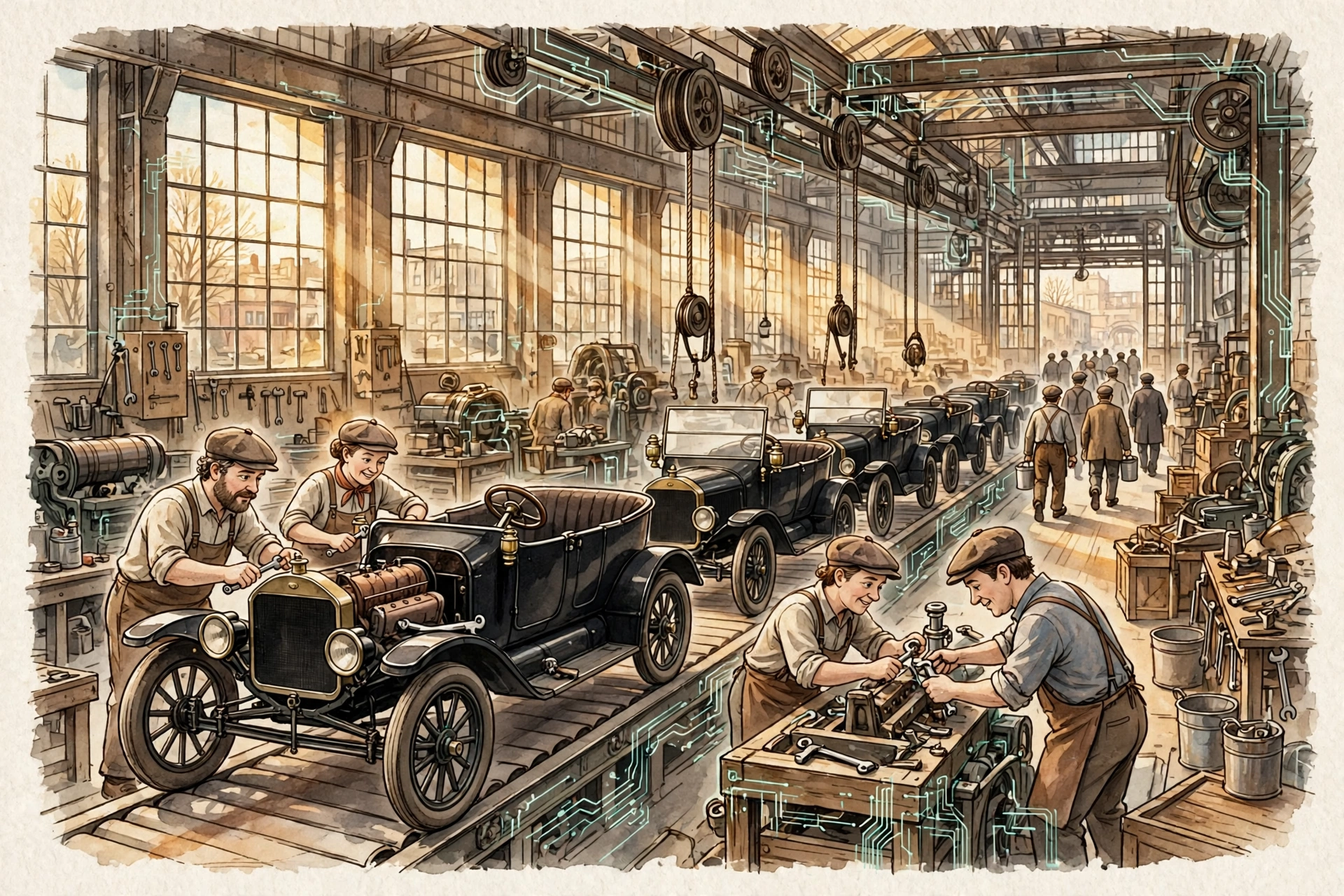
On January 5, 1914, Ford announced the $5 day: the workday cut from nine hours to eight, and pay roughly doubled from $2.34 a day. Newspapers called it philanthropy. Rival manufacturers called it madness. A century later it is still told the same way: the carmaker who paid his workers enough to buy his cars, inventing the middle class out of generosity.
Underneath it was a number: 370%. That was Ford's worker turnover in 1913. The new moving assembly line at Highland Park built cars faster than anyone ever had — and the work was so punishing that, by Ford's own account, the company hired about 53,000 men that year to keep 14,000 jobs filled. Some of the $5 story is documented. Some of it is legend. We checked which is which.
What's documented
- The $5 was not a straight raise. The base wage stayed at $2.34 a day; the rest was a profit-sharing bonus on top — a raise with conditions attached, not a new wage.
- The conditions were personal: no drinking, a clean home, money in savings, no boarders taken in at home. Ford's Sociological Department sent fifty investigators into workers' homes with a 150-question checklist to decide who qualified.
- It did not cover everyone on the floor: the announcement applied to men 22 and older, and workers who failed the checklist stayed at the base wage until they qualified.
- The motive in the record is retention. Ford's own corporate historian summarizes the $5 day as a move made 'mainly to stabilize the workforce' — the line was losing trained men faster than it could replace them.
- And it worked: turnover plunged, the hiring crisis ended, and thousands of applicants lined up outside Highland Park. Ford could suddenly choose the steadiest workers in Detroit instead of begging for them.
What's legend
- 'He paid them enough to buy his cars.' The famous explanation, repeated ever since — by Ford himself among others. The 1914 record points somewhere else: the raise answered a hiring crisis, not a sales plan. The generosity story came afterward.
- 'An act of pure philanthropy.' That was the newspapers' word, not Ford's ledger. A giveaway does not usually arrive with home inspections; the bonus was an instrument, and it bought the attendance and steadiness the line required.
- 'Every Ford worker earned $5 a day.' Many did not, at first: younger workers, and anyone the Sociological Department turned down, remained at $2.34. The $5 day was a target men qualified for, not a floor under everyone.
Sources: Wikipedia — Henry Ford · NPR — the middle class took off 100 years ago, thanks to Henry Ford? · The Detroit Bureau — $5 a day: how Henry Ford kick-started the American middle class
The first bubble was mostly a story
The legend goes like this. Holland, the 1630s: tulips become money. A single bulb trades for a mansion on an Amsterdam canal; servants, sailors, and chimney sweeps pile in; fortunes rise and vanish; and in February 1637 the market collapses, taking the Dutch economy with it. It is taught as the first great bubble — the original warning about prices detaching from value.
Almost everything in that paragraph descends from one book: Charles Mackay's Extraordinary Popular Delusions and the Madness of Crowds, published in 1841 — two hundred years after the fact, and built largely on the satirical pamphlets of the 1630s, which were written to make a moral point, not to record prices. When historian Anne Goldgar went back to the actual contracts and archives (Tulipmania, 2007), the record told a smaller and stranger story.
What's documented
- The price spike was real: in the winter of 1636–37, contract prices for rare bulbs — varieties like Semper Augustus and the Viceroy — rose to extraordinary levels, then fell sharply in February 1637.
- Most of those contracts were futures: agreements to pay later for bulbs still in the ground. When prices fell, most of the money had never changed hands — which is precisely why the damage stayed small.
- Goldgar's archival count puts the trade in a small circle: mainly wealthy merchants and skilled craftsmen in a few Dutch towns. Not the nobility, not the poor, and not the whole country.
- She identified fewer than half a dozen buyers and sellers who ran into serious financial trouble in the period — and even those cases are not clearly the tulips' fault. No bank failures. No national depression.
What's legend
- The famous price lists — one bulb equal to a mansion, a brewery, or twelve acres of land: those are Mackay's, drawn from pamphlet claims. They are not a recorded price series, and no archive supports them as transactions.
- The ruined nation — mass bankruptcies, suicides in the canals, a sailor imprisoned for eating a bulb he mistook for an onion: these trace to the same moral pamphlets, retold by Mackay as fact.
- The mania itself: on Goldgar's evidence, what swept the Netherlands was not a nation trading bulbs — it was, two centuries later, a bestselling story about a nation trading bulbs. The bubble story became the bubble.
Sources: Wikipedia — Tulip mania · History.com — Tulip Mania · Wikipedia — Extraordinary Popular Delusions and the Madness of Crowds
Explainers — what is…
What is a merchant category code?
The four-digit code on every card transaction that quietly sets your rate and your risk tier.
What does a payment actually cost?
Card, ACH, and cash, itemized — interchange, assessments, and the one negotiable layer.
Where does a small business's money go?
About 45% of it is software and services. Payments is the wedge, not the business.
Media
Interviews and coverage — Emanuel on the record, on camera.
Video interview · Tech Edge at Money20/20 — first published by Exec-Edge and Yahoo Finance, October 27, 2026 · Interview
AI Reshaping Payments Industry: Emanuel Pleitez, Live from Money20/20
Tech Edge's John Jannarone interviews Emanuel at Money20/20 in Las Vegas — on agents paying machines code-to-code, and Finix as the backbone of money movement.
Panel · Techonomy 26 at Finix HQ, San Francisco — October 6, 2026; video published by Worth Media, October 22, 2026 · Interview
When the Buyer Is a Bot: AI Agents, Payments, and Automation
An AI agent initiates a purchase — who accepts it, prices it, reconciles it, and owns it when it goes wrong? Emanuel's Techonomy 26 panel, with the founding story and the bank line.
Video interview · Streetsblog Los Angeles Mayoral Candidates Interview Series — February 18, 2013 · Interview
Streetsblog 2013: The Mayoral Interview on Mobility and the Underserved City
The first of Streetsblog LA's 2013 mayoral interviews — mobility as a portfolio of options, and zoning as social policy.
Prefer a human?
Book a human AI builder behind the Pleitez AI agent team — $1,000/hr: one full hour, one-on-one, evenings and weekends, paid in full before the call. That could be Emanuel, or someone of his caliber or better.
Book a human AI builder