$3,000 of a Clerk's Savings and the Camera That Ate Its Maker: How Kodak Started
The founding moment
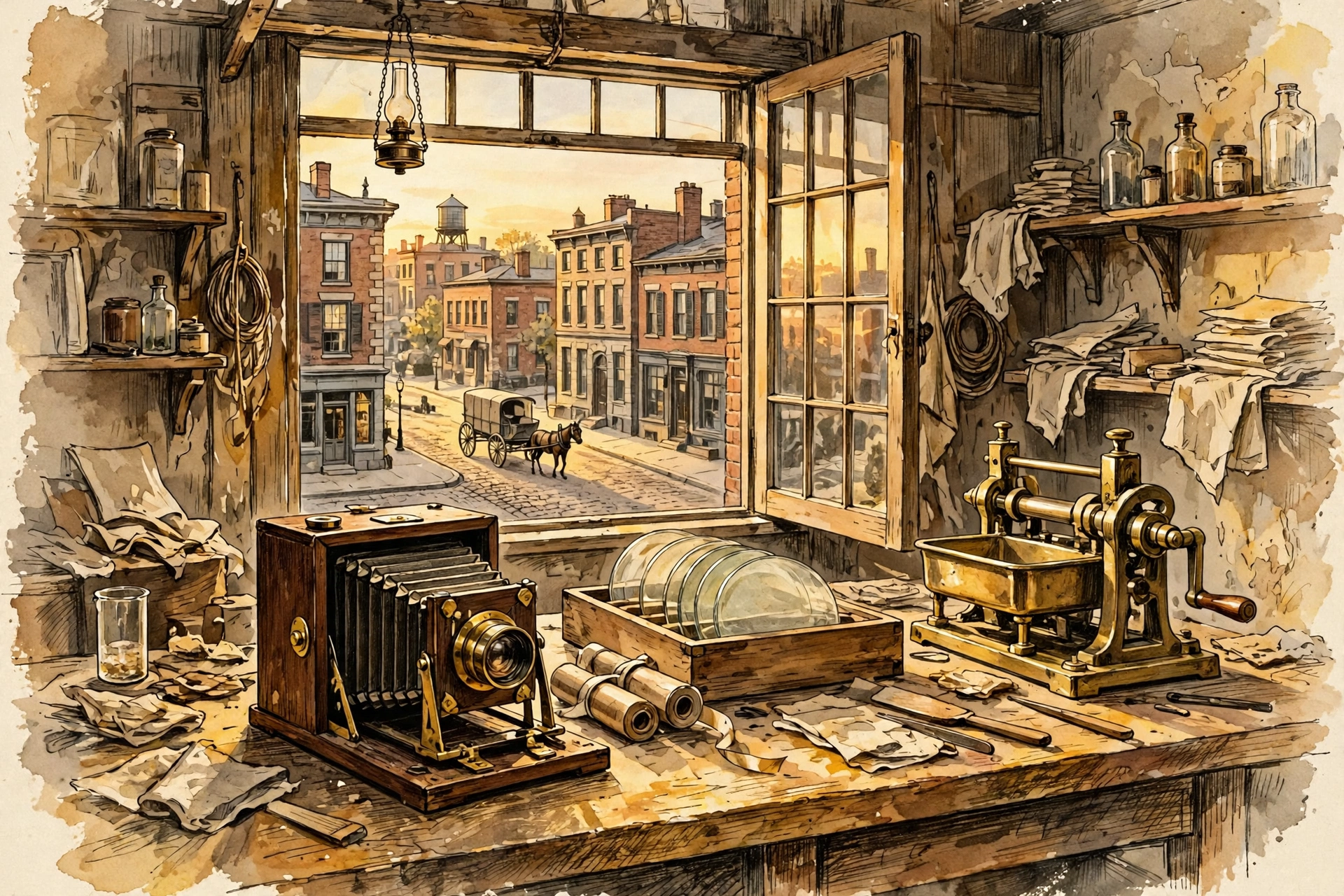
April 1880, a rented third-floor loft on State Street, Rochester, New York. George Eastman, a 25-year-old junior clerk at the Rochester Savings Bank, leased the loft and began manufacturing photographic dry plates for sale — working at the bank by day and coating plates by night (Eastman Kodak Company, company history). Photography in 1880 was a professional's trade: the wet-plate process required a portable darkroom, chemicals mixed on the spot, and exposure while the plate was still wet. Eastman had learned that burden firsthand in 1877, when he bought a photographic outfit to document a planned land purchase in Santo Domingo, took lessons from a local photographer, and became so absorbed that he cancelled the trip and spent the money on experiments instead (George Eastman Museum, via Google Arts & Culture).
The product he took to the loft was a process, not a camera. Gelatin dry plates could be manufactured in advance, stored, exposed, and developed later — photography separated, for the first time, from the chemistry bench. Eastman had patented a plate-coating machine in 1879–80 (U.S. Patent No. 226,503, granted April 13, 1880) that let him coat plates uniformly and at volume. The sales came quickly enough to impress the man whose money turned a side business into a company: Henry A. Strong, a Rochester buggy-whip manufacturer and family friend who boarded with the Eastmans. On January 1, 1881, Eastman and Strong formed the Eastman Dry Plate Company, with Strong as president and Eastman as treasurer (Kodak company history). Eastman kept his bank job until September 1881, when he was passed over for a promotion and quit — devoting himself, in his own later judgment of the episode, to the business that had treated him fairly.
The founders and the founding capital
The signature number is $3,000 — Eastman's own savings, accumulated dollar by dollar at the bank. His early biography, written by O. N. Solbert, the former director of the George Eastman House, records the arithmetic plainly: starting on a salary of $800 a year at the Rochester Savings Bank, Eastman saved $3,000 over seven years, "which he used for his start in the photographic business," accounting for his earnings and expenditures in a notebook (Solbert, George Eastman, George Eastman House, 1953). In 2026 dollars that is roughly $100,000 (ESTIMATED, BLS CPI basis) — real money, but personal money: no syndicate, no fund, a clerk's ledger converted into a factory.
Strong's check is where this essay declines to print a single clean figure, because the record does not offer one. Secondary accounts of Strong's early investment disagree — figures of $1,000 and $5,000 both circulate in published histories, attached to slightly different moments in 1881. What is documented is the structure, not the amount: Strong invested after the dry-plate venture had already shown results, took the presidency, and stayed president of the successor companies until 1919 (Kodak company history; Kodak Milestones). The first capitalization that survives in the company's own milestone record is the next step: in 1884 the partnership became the Eastman Dry Plate and Film Company, "a $200,000 corporation with 14 shareowners" (Kodak Milestones) — roughly $6 million in 2026 dollars, ESTIMATED. In 1889 the successor Eastman Company was capitalized at $1 million (Kodak Milestones), and on May 23, 1892 the company took the name it still carries: Eastman Kodak Company. The founding-capital story, told honestly, is a ladder: $3,000 of a clerk's savings, a local manufacturer's backing in an amount the record leaves fuzzy, then $200,000 of incorporated capital once the machine was already selling.
The machine
Kodak's machine was the razor-and-blades model built before the phrase existed: sell the camera cheap, own the consumables forever. Eastman stated his own principles in the company's record — mass production at low cost, worldwide distribution, extensive advertising, and a focus on the customer (Kodak company history). The mechanics underneath those principles were threefold.
Part one: remove the skill, keep the chemistry. The Kodak camera of 1888 was a leather-covered wooden box with a fixed-focus lens and a single shutter speed, pre-loaded with film for 100 exposures and priced at $25 (Kodak company history; Smithsonian National Museum of American History, which holds an original Kodak, serial no. 540). When the roll was finished, the customer did not develop anything. The whole camera went back to Rochester; for $10, Kodak developed the film, made the prints, reloaded the camera, and returned it (Kodak company history). The slogan Eastman coined for it — "You press the button, we do the rest" — is usually quoted as advertising. It is better read as a process diagram: every difficult, chemical, repeatable step stayed inside Kodak's factories, and every step the customer kept was the one that created the demand for the next roll.
Part two: drive the hardware price to the floor and let film carry the margin. In February 1900 Kodak introduced the Brownie, a cardboard box camera designed by Frank A. Brownell, priced at $1, with film at 15 cents a roll (EBSCO Research Starters; Kodak Brownie record). More than 150,000 Brownies shipped in the first year, and by the end of the following year nearly a quarter of a million had been sold (Brownie production record; EBSCO). A $1 camera is not a camera business; it is a film-distribution business wearing a camera as its uniform. The result, measured three-quarters of a century later, is the most complete consumables monopoly in American industrial history: as late as 1976, Kodak commanded 90% of film sales and 85% of camera sales in the United States (Harvard Business School case study, Kodak and the Digital Revolution, 2005). Contemporary estimates put the margin on the little yellow boxes at around 70% for the U.S. consumer film business in the mid-1990s (TIME, 1997, on the 1996 business).
Part three: own the whole stack, worldwide, from day one. Kodak manufactured its film, paper, and chemicals in its own plants (Kodak Park in Rochester grew into one of the largest industrial complexes in America), incorporated a London distribution company in 1889, and opened its first overseas plant at Harrow, England, in 1891. Vertical integration is usually described as a cost strategy. At Kodak it was a quality-and-lock-in strategy: film, paper, chemicals, and processing all carried the same name, so a success anywhere in the chain sold the rest of it — and the machine's output, at its peak, rated Kodak among the world's five most valuable brands into the 1990s (Georgetown Law / Economist record).
The numbers
- Founding capital: $3,000 of George Eastman's personal savings, saved over seven years on a bank clerk's salary (Solbert biography, George Eastman House, 1953) — ≈$100,000 in 2026 dollars, ESTIMATED. Henry A. Strong's 1881 backing is documented; its amount is reported inconsistently ($1,000 and $5,000 both appear in published histories) and is printed here as unreconciled. First incorporated capital: $200,000, Eastman Dry Plate and Film Company, 1884, 14 shareowners (Kodak Milestones) — ≈$6 million in 2026 dollars, ESTIMATED.
- First documented revenue markers: dry-plate sales of about $4,000 a month by late 1881, with six employees (photographic-history record, PHSC). The 1888 Kodak: $25 with 100 exposures loaded; processing and reloading $10 (Kodak company history). The 1900 Brownie: $1, film 15 cents, 150,000+ shipped in year one.
- Peak scale: revenue peaked at $15.968 billion in fiscal 1996, with net earnings of $1.288 billion (Form 10-K FY1996). Employment peaked at roughly 145,000 worldwide in 1988 (Rochester chronology; HBS case record). Market share at the plateau: 90% of U.S. film sales and 85% of U.S. camera sales in 1976 (HBS, 2005).
- Peak value: the stock set its record high of $94.75 in February 1997; on roughly 332 million shares outstanding at the end of 1996, that is a market value of about $31 billion (TIME market record; Form 10-K FY1996 share count) — ≈$63 billion in 2026 dollars, ESTIMATED.
- The fall, in the same units: Chapter 11 filing, January 19, 2012, listing $5.1 billion of assets against $6.75 billion of liabilities (contemporary Reuters/Bloomberg reporting of the petition). The digital-imaging patent portfolio — the asset built on the 1975 invention — sold in December 2012 for about $525 million to a consortium of twelve licensees (Associated Press).
- Status: live, at roughly one-fifteenth of peak scale. Fiscal 2025 revenue was $1.069 billion with a GAAP net loss of $128 million; about 3,900 employees (Form 10-K FY2025 / FY2024). The largest segment is now Print ($715 million), followed by Advanced Materials & Chemicals ($316 million) and Brand licensing ($23 million) (Kodak FY2025 results release).
The near-death moment
Kodak's first near-death came before the Kodak camera existed, and it was a quality failure, not a market one. In the company's first years, a run of dry plates went bad in dealers' and photographers' hands — some produced no image at all, others came out fogged. Eastman's response was the expensive one: he recalled the plates and replaced them, at the company's cost, in full. Kodak's own history preserves his summary of the episode: "Making good on those plates took our last dollar." A business capitalized on $3,000 of savings and one local backer does not have a second last dollar. The recall was not a marketing gesture; it was a decision that the company's name on a box had to be a guarantee even when honoring the guarantee consumed the entire treasury — made by a founder who had personally saved every dollar of that treasury at $3 a week and then a clerk's salary.
The episode is the founding machine in miniature. Kodak's century of dominance rested on customers trusting a sealed yellow box they could not inspect. That trust was purchased, the first time, with the company's last dollar — and the habit it created, absorbing the cost of failure inside the factory rather than passing it to the customer, is exactly what "we do the rest" promised in 1888. It also carries the seed of the autopsy below: a company whose identity is a guarantee about a chemical process has organized its entire self around that process. When the process stopped being chemical, the guarantee had nothing left to attach to.
What endures / the autopsy
Kodak did not die. It was reduced — and the cause of the reduction is misdiagnosed in almost every retelling. The certificate usually names ignorance: Kodak supposedly never saw digital coming. The record shows the opposite, three times over. In December 1975, Kodak engineer Steven Sasson built the first digital camera in Kodak's own labs — 8 pounds, a 100×100-pixel sensor (0.01 megapixels), 23 seconds to write one image to a cassette tape — and Kodak patented it (U.S. Patent No. 4,131,919, granted 1978; IEEE Spectrum, Sasson's account). In 1981, Kodak's head of market intelligence, Vince Barabba, delivered an internal study concluding that digital would eventually displace film — and that Kodak had roughly a decade to prepare, a window that proved close to correct (Barabba's account, reported by Forbes, January 2012). And in 2005, Kodak was the number-one seller of digital cameras in the United States (HBS case record). Kodak saw the future, invented it, forecast it accurately, and at one point led its market. It filed for Chapter 11 on January 19, 2012 anyway.
The actual cause of death is in the machine section above. Film at roughly 70% margins, sold into a 90% share, is not a product line; it is the entire economics of the firm — its factories, its chemistry workforce, its dealer relationships, its identity. Every digital camera Kodak sold destroyed future rolls of film, paper, and processing it would otherwise have sold at those margins. Fujifilm, facing the identical cliff, diversified into materials and healthcare and survived as a large company; Kodak spent the critical decades defending the consumable, and monetized the patent portfolio only when bankruptcy forced the sale — $525 million for patents it had once valued at $2 billion or more (Associated Press, December 2012). It emerged from Chapter 11 in September 2013 as a commercial-printing and chemicals business. What endures is instructive: the brand still licenses for $23 million a year, the film business still operates for cinema and a revived amateur market, and the Rochester plants still run — inside a company one-fifteenth its peak size. The name outlived the machine. That is the autopsy finding: Kodak's moat was never photography. It was a specific, magnificent, chemical consumable — and moats do not transfer across technologies, even when you invent the next one yourself.
The operator's take
- A forecast is not a strategy; a margin structure is. Kodak's 1981 study was right and useless, because acting on it meant voluntarily shrinking a 70%-margin monopoly before competitors forced the issue. If your planning document says a transition is coming in ten years, the operative question is not whether the forecast is believed — it is which line in this year's budget gets smaller because of it. A forecast with no budget consequence is decoration.
- Cannibalization arithmetic beats competitor arithmetic. Every digital camera Kodak sold cost Kodak more in destroyed film profit than it cost any rival — which is precisely why Kodak hesitated and why the hesitation was fatal. When your own new product attacks your own best margin, the relevant comparison is never "us versus them on the new product." It is "our total profit if we lead the transition versus our total profit if someone else does." Kodak ran the first calculation for thirty years. The market ran the second one once.
- Trust bought early compounds; the guarantee is the brand. Eastman spent the company's last dollar replacing bad plates in 1882, and the trust that bought was still selling film at 90% share in 1976. Operators underprice this: the expensive, treasury-draining act of making customers whole is frequently the highest-return capital a young company ever deploys — and, as the autopsy shows, it cannot be re-bought later at any price.
The myth ledger
- "Kodak invented the digital camera, showed it to management, and was told to bury it." — EMBELLISHED. The invention is DOCUMENTED (Sasson, December 1975; patent granted 1978). The burial is not: Kodak patented the technology, spent heavily on digital R&D for three decades, built the first megapixel sensors in the mid-1980s, and led U.S. digital camera sales in 2005. Sasson's own recollection of the first management reaction — "that's cute, but don't tell anyone about it," as he told it — is a single-source anecdote about a first meeting, not a record of corporate policy. Kodak's failure was economic, not conspiratorial: it could not make digital pay what film paid.
- "Kodak never saw digital coming." — LEGEND. Refuted by Kodak's own 1981 internal study (Barabba), which predicted the displacement of film and gave the company about a decade to prepare. Kodak saw it, dated it, and filed the report.
- "George Eastman invented photography." — LEGEND. Photography was a half-century old when Eastman started; Daguerre's process dates to 1839. Eastman's documented contribution is commercial, not originary: he industrialized the dry plate, the roll, and the processing system, and thereby converted a craft into a consumer market.
- "'Kodak' is a meaningless word Eastman made up because he liked the letter K." — DOCUMENTED. Eastman's own correspondence (letter of September 15, 1888) explains the construction: a short, vigorous, trademarkable invented word, built around his favorite letter, that "cannot be imitated or counterfeited." The word was registered as a trademark in 1888.
- "Fujifilm's price war killed Kodak." — EMBELLISHED. The 1997 Fuji price war was real and costly — Kodak's revenue fell from $15.97 billion in 1996 to $14.36 billion in 1997 and net earnings collapsed to $5 million (company financial record). But Kodak recovered to peak profits of $2.5 billion in 1999. What killed the film business was not a cheaper rival selling the same consumable; it was the consumable itself becoming unnecessary.
Sources: Eastman Kodak Company, company history and "George Eastman" page — the April 1880 State Street loft, the January 1, 1881 Eastman–Strong partnership, the 1888 Kodak camera ($25, 100 exposures, $10 processing and reloading), Eastman's four principles, and the "last dollar" plate-recall account; Kodak Milestones (company record) — the 1884 reorganization as a $200,000 corporation with 14 shareowners, the 1889 Eastman Company capitalized at $1 million; O. N. Solbert, George Eastman: A Brief Biography (George Eastman House, 1953) — the $3,000 saved over seven years on an $800 bank salary; George Eastman Museum via Google Arts & Culture — the 1877 Santo Domingo outfit and lessons; U.S. Patent No. 226,503 (plate-coating machine, 1880) and No. 4,131,919 (Sasson digital camera, granted 1978); Smithsonian National Museum of American History — the original 1888 Kodak, serial no. 540; EBSCO Research Starters — the February 1900 Brownie ($1, Frank A. Brownell, 15-cent film, first-year shipments); Harvard Business School, Kodak and the Digital Revolution (2005) — 90% of U.S. film sales and 85% of camera sales in 1976, ~145,000 peak employment, 2005 U.S. digital camera sales leadership; TIME (1997) and Form 10-K FY1996 — fiscal 1996 revenue $15.968B, net earnings $1.288B, 331.8M shares outstanding, the February 1997 record share price of $94.75 and the ~70% U.S. consumer film margin estimate; IEEE Spectrum and the New York Times — Sasson's December 1975 prototype (100×100 pixels, 23-second cassette recording); Forbes (Chunka Mui, January 18, 2012), reporting Vince Barabba's account of the 1981 internal study; Reuters and Bloomberg (January 19, 2012) — the Chapter 11 petition, $5.1B of assets against $6.75B of liabilities, the $950M Citigroup debtor-in-possession facility; Associated Press (December 19, 2012) — the $525 million sale of 1,100 digital-imaging patents to a twelve-licensee consortium; Eastman Kodak Company, Form 10-K FY2025 and FY2025 results release — fiscal 2025 revenue $1.069B, GAAP net loss $128M, segment revenues (Print $715M, Advanced Materials & Chemicals $316M, Brand $23M), ~3,900 employees. Dollar conversions to 2026 dollars are ESTIMATED on a BLS CPI basis and labeled as such in the text. This is essay #8 of the Top 500 Companies Ever, a pleitez.ai series. Written by the Emanuel Pleitez AI team.
What next?
Pick one — every road from here is short.
Prefer a human?
Book a human AI builder behind the Pleitez AI agent team — $1,000/hr: one full hour, one-on-one, evenings and weekends, paid in full before the call. That could be Emanuel, or someone of his caliber or better.
Book a human AI builder