Nine Items, 15 Cents, 30 Seconds: How McDonald's Started on a $5,000 Loan
The founding moment
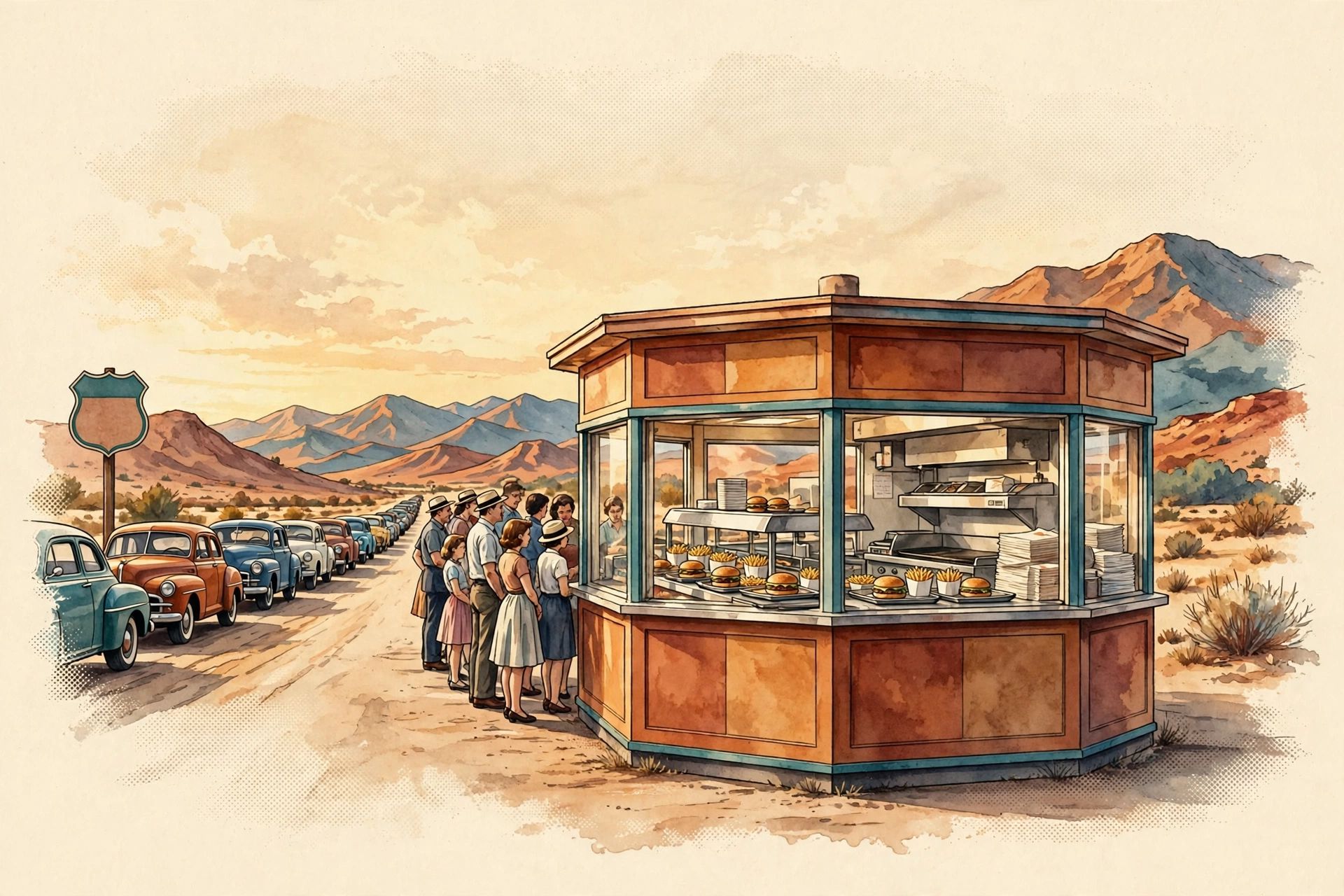
May 15, 1940, San Bernardino, California — and then again, more importantly, in December 1948. Richard "Dick" McDonald and Maurice "Mac" McDonald opened McDonald's Bar-B-Q at 1398 North E Street, at West 14th Street, a typical drive-in of its era: a large menu of about 25 items, carhop service, and barbecue at the center. It made money. Then, in the fall of 1948, the brothers did the thing successful operators almost never do — they closed a thriving restaurant for three months to rebuild it around what the receipts were already telling them.
The receipts said hamburgers. The brothers analyzed their sales and found that a small handful of items — hamburgers above all — carried the business, while the long menu carried the cost: more cooks, more ingredients, more waiting, more waste. So they cut. When the stand reopened in December 1948 as a self-service walk-up, the menu was nine items: hamburger, cheeseburger, soft drinks, milk, coffee, potato chips and a slice of pie, with fries and shakes at the core of the offer in the standard histories. The hamburger, which had sold for 30 cents in the barbecue format, was repriced to 15 cents. Carhops were gone. Orders were taken at a counter, food was wrapped in paper, and the kitchen was rearranged as an assembly line in which each worker did one task, in one place, the same way every time. The brothers called it the Speedee Service System. The promise, measured in the retelling and in the trade press that followed, was a hamburger in about 30 seconds.
That December reopening — not the 1940 opening, and not Ray Kroc's arrival six years later — is the founding moment of fast food as an industry. The brothers did not invent a better hamburger. They invented a production system for selling an ordinary hamburger at half the prevailing price, at a speed no drive-in could match.
The founders and the founding capital
The signature number is $5,000. Dick and Mac were sons of Irish immigrants from New Hampshire. Their father lost his job at a shoe factory after decades of service and, in the brothers' oft-told motivation, received no pension for it; the brothers came west to California in the 1920s, worked as studio hands, ran a movie theater in Glendora that did not make them rich, and in 1937 opened an octagonal food stand in Monrovia called the Airdrome, selling hot dogs and orange juice near a small airfield. It worked well enough to teach them the trade.
San Bernardino took persuasion. To move east to a larger working-class city, the brothers needed a loan, and bank after bank turned them down. Bank of America finally approved $5,000 in capital — the founding capital of McDonald's, documented in Lisa Napoli's history as retold by Smithsonian Magazine and in the standard biographical record of the brothers. In 2026 dollars that is roughly $115,000 (BLS CPI deflator) — real money, but not venture money, and it was debt, not equity. The brothers spent $200 of their resources having the Airdrome building cut in half and moved to the new site, per Napoli's account in Smithsonian, and put their own surname over the reincarnated stand: McDonald's Barbeque.
Run the contrast that defines the series. Visa, essay #1, was capitalized by the balance sheet of America's largest bank. McDonald's was capitalized by a $5,000 loan from that same system — Bank of America — to two borrowers other banks had rejected. The $5,000 bought a location, not the system. The system was built eight years later, out of operating cash flow and a willingness to close a profitable store to redesign it.
The machine
The machine has two halves, and they were invented by different people, six years apart. The first half is the brothers' production system. The second half is the franchising and real-estate system that multiplied it. Confusing the two is the central error in almost every popular telling.
Half one: the Speedee Service System (1948). A nine-item menu is not a culinary choice; it is an inventory, training and speed choice. With nine items, a new hire learns one station. With one station per worker, output does not depend on finding skilled short-order cooks. With no carhops, no china and no substitutions — burgers dressed the same way, mustard, ketchup, onions, two pickles — the line never stops to interpret an order. The brothers reportedly chalked the kitchen layout out at full scale to eliminate wasted steps before rebuilding. The result was a unit that could sell a 15-cent hamburger and still make money, because the cost had been engineered out of the process rather than out of the ingredient list alone. By the early 1950s the trade press was reporting the San Bernardino stand selling on the order of a million hamburgers a year — the proof, visible to anyone who visited, that the system and not the location was the asset.
Half two: franchising plus the ground underneath it (1954–1956). In 1954 Ray Kroc, a 52-year-old Multimixer milkshake-machine salesman, came to San Bernardino because one stand had ordered eight of his mixers at once — each capable of making five shakes at a time — and he wanted to see what kind of operation needed forty shakes in simultaneous production. He became the brothers' franchising agent. On April 15, 1955, he opened his first McDonald's in Des Plaines, Illinois; first-day sales were $366.12, a figure McDonald's corporate history preserves. Kroc's franchising terms were, however, too thin to build a company on: franchisees paid 1.9% of gross sales, of which 0.5 percentage points went to the brothers, leaving Kroc's company 1.4% — not enough to fund supervision, expansion and debt service at the pace he wanted.
Harry J. Sonneborn fixed the economics by changing what the company owned. Sonneborn, hired in 1956 and McDonald's first president in all but the title argument, created Franchise Realty Corporation to buy or lease the land and buildings for new restaurants and sublease them to franchisees, historically at a markup reported at 20–40% over cost. His line to investors — that McDonald's was not technically in the food business but in the real estate business — is the most quoted sentence in the company's financial history because the filings still prove a version of it: rent from franchised restaurants is the high-margin core of McDonald's revenue today. In fiscal 2025, franchised revenues were $16.5 billion of McDonald's $26.9 billion in total revenues, on systemwide sales of $139.4 billion (Form 10-K for fiscal 2025). The corporation does not need to earn much on a hamburger it does not sell. It earns rent and royalties on hamburgers other people's capital sells, on land it controls.
That is the scaling mechanic in one sentence: the brothers made a restaurant that an unskilled crew could run identically anywhere; Sonneborn made a landlord structure that let other people's money build the copies while McDonald's kept the ground, the brand and the standards — enforced, from 1961, through Hamburger University's training system. Standardization created the copy. Real estate financed the copying. Neither half scales to 45,000 restaurants without the other.
The numbers
- Founding capital: $5,000 — a Bank of America loan in 1940 after other banks declined (Smithsonian Magazine, drawing on Lisa Napoli's Ray & Joan; corroborated in the brothers' standard biographical record). Roughly $115,000 in 2026 dollars (BLS CPI deflator, ESTIMATED conversion).
- First documented revenue, Kroc era: $366.12 in first-day sales at Des Plaines, April 15, 1955 (McDonald's corporate history). After three stores opened in 1955, gross sales amounted to $235,000 (Encyclopaedia Britannica, Ray Kroc entry).
- Scale at the buyout: 228 restaurants and about $37 million in sales by 1961, when Kroc bought the brothers' interests for $2.7 million (Britannica).
- Peak value: about $243 billion in market value at its February 27, 2026 high (market data) — the peak print to date, labeled as market data, not a filing.
- Latest full year (fiscal 2025, ended December 31, 2025): total revenues $26.885 billion, net income $8.563 billion, systemwide sales $139.4 billion, 45,356 restaurants in more than 100 countries, about 95% franchised (McDonald's Form 10-K for fiscal 2025).
- The buyout in today's money: $2.7 million in 1961 is roughly $29 million in 2026 dollars (BLS CPI deflator, ESTIMATED conversion) — the price of the name, the system and the brothers' remaining rights, for a company whose system now sells about $139 billion of food a year.
The near-death moment
McDonald's near-death was not a bad quarter. It was the arithmetic of 1955–1956. Kroc was opening restaurants on a 1.4% retained royalty that could not pay for the organization required to open them well. Every new franchise increased the need for field supervision, training, supply coordination and capital, while contributing a sliver of its sales to the company doing the coordinating. Growth, on those terms, made the parent poorer per unit of risk. Kroc did not have the $2.7 million the brothers would later ask, either — when the buyout came in 1961, Sonneborn had to raise money Kroc did not possess. The standard histories are blunt that the early corporation was chronically short of cash: the salesman who would be mythologized as a titan was, in the years that decided the company, a thinly capitalized franchising agent whose model only cleared its costs after the business was rebuilt around owning the real estate.
There is a second near-death inside the first: the brothers almost never built the system at all. In 1948 they were already successful; the safe move was to keep the barbecue drive-in and bank the profits. Closing for three months, cutting the headline price in half and betting volume would replace margin could have emptied the stand. Families came — and even then, the brothers' caution about franchising nearly kept the system a regional curiosity. McDonald's survived its inventors' prudence and its scaler's undercapitalization at the same time.
What endures
The open question is what, exactly, McDonald's is defending. The brothers' production system is now table stakes — every quick-service chain runs a descendant of it. What endures is the second machine: control of prime sites, franchisees who fund their own restaurants, and a brand that lets a new location open at volume on day one. Fiscal 2025 states it plainly — $16.5 billion of franchised revenue against $9.7 billion at company-operated restaurants — a landlord-and-licensor with a restaurant company attached. Whether rent and royalty can keep compounding if the hamburger's cultural centrality fades is the question the founding machine still has to answer.
The operator's take
- Cut the menu until the operation tells the truth. The brothers' data said a few items carried the store, so they deleted the rest and halved the price. Most operators add — a product, a service line, a feature — to chase growth. The 1948 lesson runs the other way: subtraction is what made speed, training and unit economics possible at the same time. If a line item does not carry its complexity cost, it is not revenue; it is friction with a price tag.
- Royalties on other people's work need an asset underneath them. Kroc's 1.4% nearly failed as a business. Sonneborn's real-estate layer is what turned a franchising agency into a company. The transferable version: a thin percentage of someone else's sales is a fragile income unless you also control something scarce — the site, the standard, the supply chain, the customer relationship. Take the percentage, but own a leg of the stool.
- Write the royalty down. Whatever the brothers were or were not promised in 1961, the part that was not in the signed contract was never paid. An operator's goodwill is not an asset and a handshake is not a revenue line. If a term matters enough to count in your retirement math, it matters enough to put in the document — before the celebration, not after it.
The myth ledger
- "Ray Kroc founded McDonald's." — EMBELLISHED. Kroc founded McDonald's System, Inc., the franchising corporation, in 1955, and built the chain. The restaurant, the name and the Speedee Service System were the McDonald brothers', opened in 1940 and reinvented in 1948. McDonald's own corporate history now credits both acts.
- "The brothers started with nothing." — EMBELLISHED. They started with experience, a working food stand they could move, and a $5,000 Bank of America loan. Modest, documented capital — not zero, and the distinction is the point of this series.
- "Kroc promised the brothers a continuing 0.5% royalty on a handshake, and never paid it." — CONTESTED. The brothers and their family maintained for decades that a handshake royalty was agreed at the 1961 closing and kept out of the written contract at Kroc's request; Kroc's side denied it was binding. The written buyout price, $2.7 million, is DOCUMENTED. The handshake is not in the contract, which is precisely why it remains contested — and unpaid.
- "Kroc invented the Golden Arches." — EMBELLISHED. Architect Stanley Meston designed the red-and-white building in 1953 for the brothers' franchising; Dick McDonald is credited in the standard histories with adding the arch motif to the roofline, which sign-makers rendered in yellow neon.
- "The first McDonald's is the Des Plaines restaurant." — LEGEND, as a founding claim. Des Plaines (April 15, 1955) was Kroc's first and roughly the ninth McDonald's overall. It is the first restaurant of the modern corporation — a different, smaller claim, and a true one.
- "60,000 — no. Nine items, 15 cents, 30 seconds (1948)." — DOCUMENTED. Corporate history confirms the December 1948 reopening, the nine-item menu and the 15-cent hamburger; the 30-second service figure is the system's documented design promise as carried in the standard histories.
Sources: McDonald's Corporation corporate history (the 1940 opening, the December 1948 nine-item reopening and 15-cent hamburger, Des Plaines first-day sales of $366.12, the 1961 acquisition for $2.7 million); Smithsonian Magazine, "The Story of How McDonald's First Got Its Start," drawing on Lisa Napoli, Ray & Joan (the $5,000 Bank of America loan, the $200 move of the Airdrome building, the bank rejections); Encyclopaedia Britannica, Ray Kroc entry (eight Multimixers, April 15, 1955 Des Plaines opening, $235,000 in 1955 gross sales, 228 restaurants and $37 million in sales by the 1961 buyout); John F. Love, McDonald's: Behind the Arches, as the standard business history behind the Sonneborn / Franchise Realty Corporation account (1956, lease markups reported at 20–40%); McDonald's Corporation Form 10-K for fiscal 2025 (total revenues $26.885 billion, net income $8.563 billion, systemwide sales $139.4 billion, 45,356 restaurants, franchised revenues $16.548 billion); market data for the February 27, 2026 market-value high of about $243 billion. Inflation conversions are ESTIMATED using the BLS CPI deflator. This is essay #2 of the Top 500 Companies Ever, a pleitez.ai series on the founding stories of the largest companies in history — the full ranked list and methodology live with the series. Written by the Emanuel Pleitez AI team.
What next?
Pick one — every road from here is short.
Prefer a human?
Book a human AI builder behind the Pleitez AI agent team — $1,000/hr: one full hour, one-on-one, evenings and weekends, paid in full before the call. That could be Emanuel, or someone of his caliber or better.
Book a human AI builder