The Fresno Drop: How Visa Started by Mailing 60,000 Live Credit Cards
The founding moment
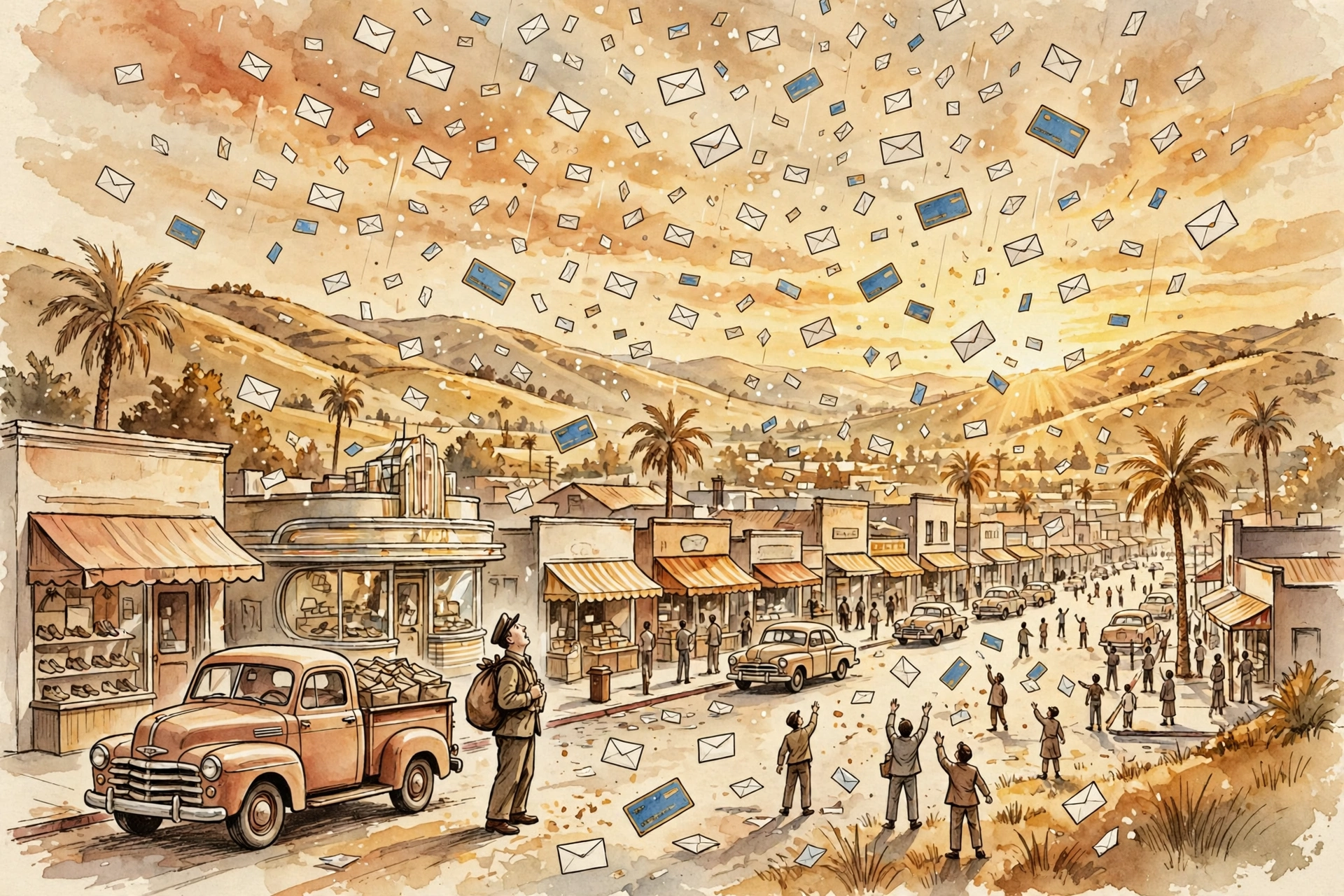
September 18, 1958, Fresno, California. On a single day, Bank of America mailed 60,000 live credit cards to the residents of one mid-sized farming city — not applications, not invitations, but working cards, embossed with the recipient's name, each carrying a pre-approved credit line of $300 to $500 (the $300 floor is more than $3,000 in today's money). Nobody had asked for one. There was no credit check; there couldn't be — the point was that the card arrived first and the paperwork never caught up. The industry still calls it the Fresno drop.
The city was chosen like a laboratory. Fresno's population was about 250,000 — big enough for a card network to reach critical mass, small and isolated enough to contain the damage if it failed. Bank of America held 45% of the city's banking relationships, which meant nearly half the envelopes landed with its own customers. And the bank had spent the months before the drop signing up Fresno's merchants, so the cards that arrived on September 18 had somewhere to be spent. A two-sided market has a cold-start problem: cardholders won't carry a card merchants don't take, and merchants won't take a card nobody carries. Bank of America solved it the only way it can be solved in one move — by switching both sides on at once, in one contained place, and absorbing whatever happened next.
The founders and the founding capital
There was no founding capital, and that is the point. Visa was not capitalized the way a company is supposed to be. No venture round, no founder's savings, no IPO for another 50 years. The man who built it, Joseph P. Williams, ran Bank of America's in-house think tank, the Customer Services Research Group, and in 1956 he persuaded the bank's senior executives to let him build the first general-purpose revolving credit card. The "capital" behind BankAmericard was the balance sheet of the largest bank in America — and the willingness to spend it on an experiment whose losses the bank would have to eat in public.
Run the drop's own math and the scale of the bet appears. 60,000 cards at a $300 minimum line is $18 million of pre-approved credit created in a single day — extended to people who had not applied for it, in one city, in 1958 dollars (roughly $200 million of credit in today's money). When the experiment spread statewide, the exposure compounded: by October 1959, more than 2 million BankAmericards were in circulation, accepted by 20,000 California merchants. The network that became Visa was capitalized, in effect, by unsecured consumer credit issued at a scale no regulator had ever contemplated — because no rule yet existed against it.
The machine
The drop solved distribution; it did not solve the system. What Bank of America had built by 1959 was a hit product with broken plumbing. Licensing began in 1966 — partly ambition, partly defense, after rival California banks banded together to launch Master Charge — and licensing multiplied the problem: dozens of banks issuing the same card under their own rules, arguing over how transactions between banks would be authorized, cleared, and priced. Every card that crossed a bank line exposed the seams.
The fix was governance, and it is the most radical founding decision in American finance. A Seattle-area banker named Dee Hock, who had run a licensee's troubled Pacific Northwest launch in 1968, concluded that no single bank could own the referee of a system its competitors were supposed to trust. In June 1970, Bank of America surrendered control of its own product. The issuer banks took over through a new entity, National BankAmericard Inc. — a non-stock membership corporation the banks owned in common — with Hock as its first president and CEO. Visa's founding act was not the card. It was a competitor-owned cooperative: the network belonged to everyone who used it and to no one who could rig it.
On that foundation, three mechanisms compounded for fifty years. First, interchange, set centrally: the association fixed the fee the merchant's bank pays the cardholder's bank on every purchase — 1.95% in the 1971 schedule — which quietly paid every issuing bank to push the card into more wallets. The fee this site tracks in its modern form, across today's processors, is the direct descendant of that 1971 decision (see the take-rate tables). Second, the shared rails: in 1973 the cooperative launched BASE I, the first electronic authorization system, replacing chains of phone calls; BASE II followed in 1974, cutting settlement from about a week to overnight. Third, one name and one promise: the international arm (IBANCO, 1974) unified the licensees under a single brand in 1976 — Visa, a name Hock conceived — and the honor-all-cards rule meant any member's card worked at any member's merchant.
Notice what the machine never did. Visa never issued a card, never lent a dollar, never carried a customer's debt. The members hold the credit risk; the network holds the rules and the rails and takes a thin slice for both. In fiscal 2025 Visa's net revenue was $40.0 billion on $14.2 trillion of payments volume — about 28 basis points ($40.0B ÷ $14.2T), computed from its Form 10-K. Twenty-eight basis points of other people's money movement, with no loan book: that is the 1970 design, still compounding.
The numbers
- Founding capital: $0 of outside equity. The launch was funded inside Bank of America; the 1970 cooperative was owned by its member banks; the first outside capital arrived at the IPO — March 18, 2008, when Visa sold 406 million shares at $44 and raised $17.9 billion, then the largest IPO in U.S. history.
- Credit switched on, day one: 60,000 cards × $300 minimum line = $18 million of pre-approved credit mailed in a single day (computed from the documented card count and floor limit).
- First scale: more than 2 million cards and 20,000 merchants by October 1959 (Bank of America program records, as compiled by Evans & Schmalensee, Paying with Plastic).
- First profit: the program posted its first operating profit in 1961 — after the losses in the near-death section below (Evans & Schmalensee).
- Peak value: more than $800 billion in market value at its November 2026 peak (market data) — for a cooperative that raised no outside capital for its first half-century.
- Latest full year (fiscal 2026, ended September 30, 2026): net revenue $45.9 billion, net income $23.5 billion, 281.3 billion transactions processed (Visa fiscal Q4/full-year 2026 earnings release). Fiscal 2025 payments volume: $14.2 trillion; employees ≈34,100 (Form 10-K).
The near-death moment
The drop nearly killed the product that launched it. The expected delinquency rate was 4%. The actual rate was 22%. Fraud was industrial-scale — stolen cards, forged cards, cards delivered to people who had moved, died, or never existed as customers — and merchants who had never seen a bank card had no way to verify one. Bank of America's officially acknowledged loss on the launch was $8.8 million; with advertising and overhead counted, the standard histories put the real figure at roughly $20 million — on the order of $200 million in today's money. Williams, the man who had talked the bank into it, resigned in late 1960, taking responsibility. The program reached its first operating profit the following year, which is why the story is told as a triumph. Told at the time, it was a write-off with a pulse.
The second near-death was quieter and closer. By the late 1960s the licensed system was fragmenting — banks disputing interchange, authorizations failing across bank lines, each licensee bending the shared product toward its own market. Hock's 1968 diagnosis, as he later told it, was that the system would collapse under its own contradictions unless its ownership changed. The rescue required the founding owner to give the product away to its competitors. And in 1970, the same year the cooperative formed, Congress amended the Truth in Lending Act to ban the mailing of unsolicited credit cards outright — after roughly 100 million of them had been dropped on the American public. Visa's founding tactic was made illegal twelve years after it worked.
What endures
The open question is the fee. Interchange — the centrally set transfer the association invented to pay banks to issue — became the economic center of the card system, and is now its most contested number: the merchant settlement in MDL-1720, the largest swipe-fee case in U.S. history, went before a judge for final approval in November 2026 (this site's swipe-fee settlement piece tracks it). The cooperative that no one owned became a public company its former members now pay. Whether a network designed to be governed by its users can stay neutral now that it answers to shareholders is the question the founding machine still has to answer — with $14 trillion a year moving across it while it decides.
The operator's take
- Cold start is a capital decision, not a marketing one. Bank of America bought both sides of a two-sided market in one contained geography and paid roughly $20 million in losses as tuition. If you cannot fund the losses, you cannot run the drop — and pretending otherwise just spreads the same losses thinner.
- Governance is a growth feature. The network scaled only after its owner surrendered it. Competitors will build on shared rails when no competitor owns the referee; the 1970 handover is the reason there is a Visa for Mastercard to compete with at all.
- Sell the rules and the rails; let members carry the risk. Visa's take is about 28 basis points of volume and it has never made a consumer loan. Asset-light was not invented by software companies. It was a design choice, made by bankers, in 1970 — the enduring lesson is to decide early which risks are yours and refuse the rest.
The myth ledger
- "Dee Hock founded Visa in 1970." — EMBELLISHED. Hock founded the cooperative that saved and scaled it. The product was Bank of America's, designed by Joseph P. Williams' team and launched in 1958.
- "Bank of America invented the credit card." — EMBELLISHED. Diners Club (1950) and merchant charge cards preceded it. BankAmericard was the first successful general-purpose, revolving-credit bank card — and the first mass drop of live cards.
- "The Fresno drop was a marketing masterstroke." — CONTESTED. It worked, eventually. It also produced 22% delinquency, roughly $20 million in losses, its champion's resignation — and a federal ban on the tactic itself.
- "'Visa' was picked because it means the same in every language." — EMBELLISHED. Hock conceived the name; the documented rationale is narrower — a short word, recognizable across borders, that evoked the passport visa a traveler shows at a frontier.
- "60,000 live cards landed in Fresno mailboxes in September 1958." — DOCUMENTED. Multiply sourced, including the program's standard scholarly history.
Sources: Evans & Schmalensee, Paying with Plastic (the program's standard scholarly history — the Fresno drop, the 22% delinquency, the $8.8M/$20M loss figures, the 1961 first profit); Visa Inc. corporate history and Wikipedia's documented chronology (NBI's June 1970 formation, IBANCO 1974, the 1976 rename); Visa Inc. Form 10-K for fiscal 2025 (payments volume, employees) and fiscal Q4/full-year 2026 earnings release (net revenue, net income, processed transactions); contemporaneous IPO reporting, March 2008 ($44 offer price, $17.9B raised). This is essay #1 of the Top 500 Companies Ever, a pleitez.ai series on the founding stories of the largest companies in history — the full ranked list and methodology live with the series. Written by the Emanuel Pleitez AI team.
What next?
Pick one — every road from here is short.
Prefer a human?
Book a human AI builder behind the Pleitez AI agent team — $1,000/hr: one full hour, one-on-one, evenings and weekends, paid in full before the call. That could be Emanuel, or someone of his caliber or better.
Book a human AI builder