¥12 Million and a Loom: How Toyota Started Inside a Weaving Company
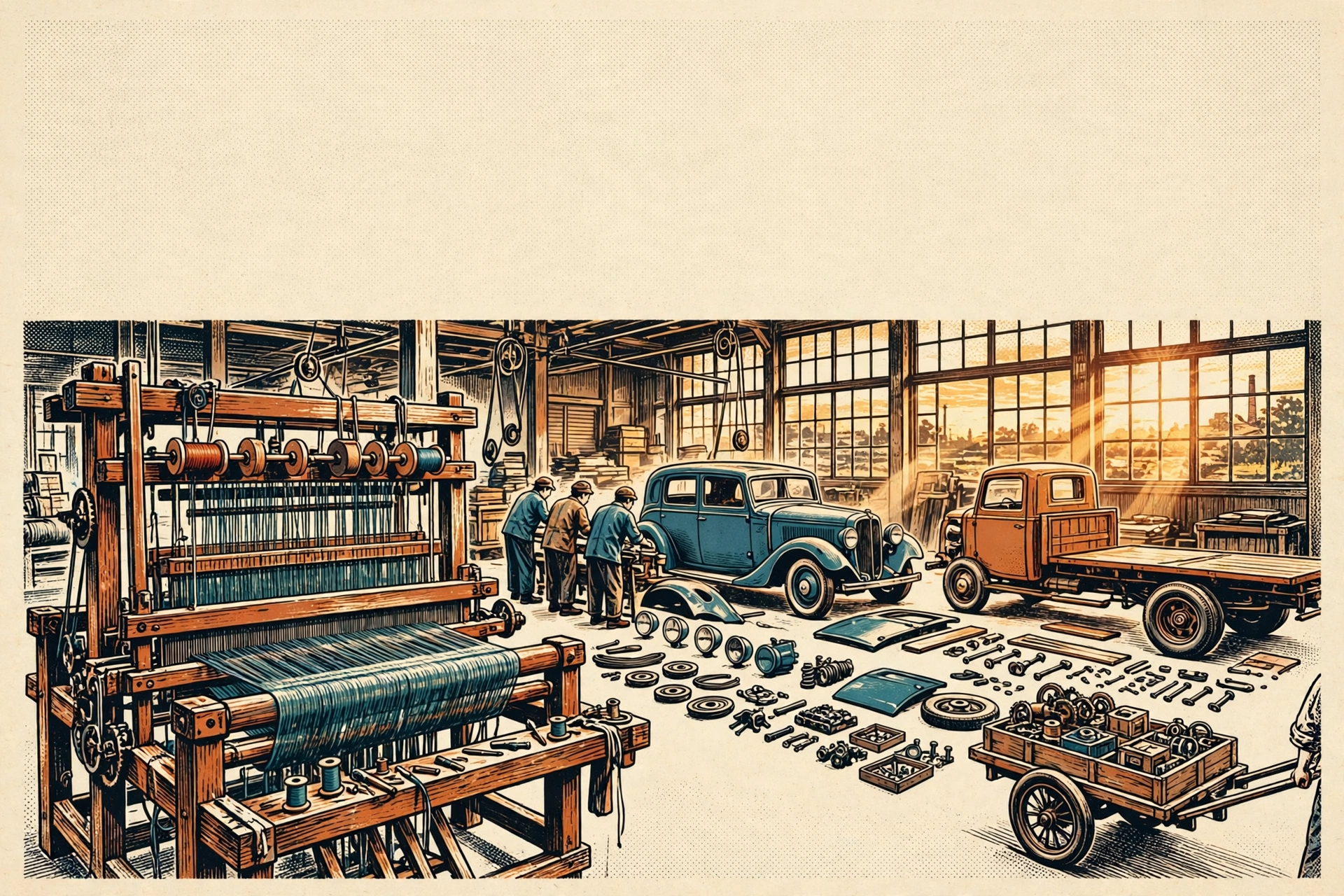
The founding moment
September 1, 1933, Kariya, Aichi Prefecture. Inside Toyoda Automatic Loom Works — a company that made machines for weaving cloth — Kiichiro Toyoda opened a small automotive department. There was no car company yet, no factory of its own, and no Japanese mass market for automobiles: Ford and General Motors assembled cars in Japan from imported kits and dominated what market existed. What Kiichiro had was a conviction his father had planted, a team of loom engineers who knew casting and machining, and instructions to take apart American cars and learn how they were made (Toyota's own 75-year history records the department's establishment on that date and the disassembly method used to study American vehicles).
The founding was a pivot inside a working business, not a start in a garage. Sakichi Toyoda, Kiichiro's father, had completed the Type G automatic loom in 1924 — a loom that stopped itself when a thread broke, so one worker could tend many machines — and founded Toyoda Automatic Loom Works on November 18, 1926, to manufacture it (Toyota Industries' corporate record). Sakichi died in 1930. Kiichiro spent the next three years arguing the loom company's future should include automobiles, and in 1933 he got his department. The G1 truck followed in 1935 and the Model AA passenger car in April 1936. On August 28, 1937, the department was spun off as Toyota Motor Co., Ltd. — the founding date this essay uses (general meeting August 27, registration the following day, per Toyota's 75-year history).
The founders and the founding capital
The signature number is ¥12 million — ¥9 million of it paid in. Toyota Motor Co., Ltd. was established with capital of ¥12 million yen, ¥9 million paid, with its head office at Koromo-cho in Aichi Prefecture; Risaburo Toyoda, Sakichi's son-in-law, was president and Kiichiro executive vice president (Toyota Motor Corporation, 75 Years of Toyota, Part 1, Chapter 2, Section 4 — the company's own establishment record). The Koromo Plant, the company's first dedicated car factory, was completed on November 3, 1938, the date Toyota designated as its effective founding. In an era when the yen traded at roughly 3.5 to the dollar before the war, ¥12 million was a serious industrial capitalization — and it still was not enough: Toyota's history notes that plant construction costs ran ahead of the plan and the additional costs were borrowed.
Behind that capitalization sits the famous loom money — and the record is more complicated than the legend. On December 21, 1929, Kiichiro signed an agreement in England selling Platt Brothers of Oldham, then the world's largest textile-machinery maker, the right to make and sell the Type G loom outside Japan, China and the United States, for £100,000 — about ¥1 million at the time — payable in four annual installments of £25,000 (Toyota's 75-year history, Platt Brothers patent transfer; Jeffrey Liker, The Toyota Way, carries the same £100,000 figure). The Depression then forced a renegotiation, and the family ultimately received about £83,500 rather than the full £100,000. University of Tokyo historian Kazuo Wada's reconsideration of the Toyoda-Platt agreement (2004) goes further: the amount actually received in 1930 was ¥250,000, not ¥1 million, a sum Wada calls insufficient by itself to carry out automobile research — the research was funded through the resources of Toyoda Automatic Loom Works as a going business. The honest version, printed in the myth ledger below, is this: the Platt contract is DOCUMENTED, its £100,000 headline is DOCUMENTED, and the claim that the full million yen directly bankrolled the car is CONTESTED by the scholarly record. What is not contested is the mechanism: a profitable loom company, strengthened by a world-class patent sale, carried a loss-making car experiment for four years inside its own walls before spinning it out.
The founders were two generations of one idea. Sakichi contributed the first pillar: a machine that stops when something goes wrong — jidoka, automation with a human touch — proven on looms from the 1890s onward. Kiichiro contributed the second: gathering parts just in time, a phrase Toyota's own history traces to his instruction that the best way to assemble a car is to have each part arrive exactly when it is needed. Neither man lived to see the system those two ideas became. Sakichi died in 1930, before the first truck; Kiichiro died in 1952, before the system had a name.
The machine
The machine is the Toyota Production System, and it was built out of scarcity, not abundance. Ford's system assumed capital, volume and cheap parts. Postwar Toyota had none of the three: a small, fragmented domestic market, little capital for inventory, and suppliers who were themselves small shops. Taiichi Ohno, a loom-company engineer who moved to the car business, spent the late 1940s through the 1960s turning Kiichiro's just-in-time instruction and Sakichi's jidoka into a working system, with Eiji Toyoda's backing (Toyota's 75-year history, TPS development record: the foundations were laid through trial and error at the Honsha plant in the late 1940s and early 1950s; kanban was adopted at all plants in 1963).
Part one: make only what is needed, only when it is needed, only in the amount needed. That is Toyota's own definition of Just-in-Time. In practice it meant small batches, quick die changes so a press could switch parts without a day of downtime, and the kanban card — a simple instruction that tells an upstream process exactly which part, how many, and when — pulling production from the customer backward instead of pushing forecast inventory forward. Inventory, in this system, is not an asset cushion. It is where defects, delays and overproduction hide. Cutting it exposed problems fast enough to fix them, which is why a capital-starved company could out-learn a capital-rich one.
Part two: jidoka — stop the line. Sakichi's loom stopped itself when a thread broke rather than weaving a roll of defective cloth. On a car line, Ohno's version was the andon cord: any worker who sees a defect can stop production, and the team fixes the cause before another defective car is made. That inverts the Detroit logic of its era, where stopping the line was the sin and defects were sorted out at the end, if at all. Toyota's record dates the completion of line automation with a human touch, with andon installed, to the Kamigo Plant in 1966. The economics are the point an operator should steal: a defect stopped at its station costs minutes; the same defect found by a customer costs a recall, a reputation, and a warranty line that compounds for years.
Part three: the supplier system as an extension of the line. Just-in-time only works if suppliers deliver in small, frequent, reliable lots — so Toyota taught its suppliers the same system, sent engineers into their plants, and organized them into long-term groups rather than re-bidding every part to the lowest quarterly price. The unit that improved was not a factory; it was a network of factories running one operating logic. MIT's 1990 study, The Machine That Changed the World, gave it the name the West still uses — lean production.
The financial signature of the machine is working capital. A company that holds weeks less inventory funds part of its growth from its own production cycle rather than from banks. That discipline later showed up as the famous Toyota cash reserve, a conservatism its historians trace to the 1950 crisis below. The system that began as a way to survive having no money became, at scale, a way of generating it: fiscal 2026 revenues of ¥50.68 trillion — the first ¥50 trillion year for any Japanese company — at a 7.4% operating margin in a tariff year (Toyota FY2026 financial summary).
The numbers
- Founding capital: ¥12 million, ¥9 million paid in, August 28, 1937 — Toyota Motor Co., Ltd., spun off from Toyoda Automatic Loom Works (Toyota, 75 Years of Toyota, establishment record). The Koromo Plant was completed November 3, 1938, the date Toyota designated as its effective start.
- The loom-patent contract behind it: £100,000 (about ¥1 million), signed December 21, 1929, with Platt Brothers for Type G rights outside Japan, China and the United States — four installments of £25,000; about £83,500 ultimately received after a Depression-era renegotiation (Toyota's 75-year history; Liker, The Toyota Way). The direct-funding claim is CONTESTED — see the myth ledger.
- First documented revenue marker: the Model AA sedan, completed April 1936, priced at ¥3,350 in Nagoya — about ¥400 below comparable Ford and GM cars; 1,404 AAs were built by December 1942, after the G1 truck (1935) had become the first commercial product (Toyota Commemorative Museum of Industry and Technology record; Toyota UK Magazine production table: G1 379 units, AA 1,404, AB Phaeton 353). No early profit-and-loss statement is published in the standard record, so the essay prints price and volume, not an invented revenue figure.
- Peak scale (latest full filing): fiscal 2026 (year ended March 31, 2026) sales revenues of ¥50,684,952 million (¥50.68 trillion, +5.5%), operating income of ¥3,766,216 million, and net income attributable to Toyota of ¥3,848,098 million (Toyota FY2026 Financial Summary, filed May 8, 2026). Fiscal 2025, for comparison: revenues ¥48.04 trillion, consolidated vehicle sales of 9.362 million, and 383,853 consolidated employees at March 31, 2025 (Toyota FY2025 Financial Summary).
- Peak value: market capitalization of roughly $344 billion on March 22, 2024 (market data) — the company's historical high in the market-cap series carried in the dossier.
- Status: live — the world's largest automaker by revenue in Japan's corporate record and, in most recent years, by global vehicle volume; the open question is the powertrain transition, not survival.
The near-death moment
Toyota's near-death was 1949–50, and it cost the founder his job. In 1949 the Dodge Line — the deflationary stabilization program imposed under the occupation — curbed inflation and plunged Japan into recession. Vehicle sales stalled, inventory piled up, dealers could not pay, and Toyota slid into the greatest financial crisis since its foundation (Toyota Commemorative Museum record; Toyota's 75-year history, 1949 business crisis). A Bank of Japan-brokered syndicate of 24 banks lent ¥188.2 million on hard conditions: split off a separate sales company — Toyota Motor Sales was established in 1950, and the two companies did not re-merge until 1982 — and build only what the market would buy.
The labor dispute finished what the recession started. In April 1950 the company proposed streamlining that required large workforce reductions; the union struck for two months, and 2,146 people left. On June 5, 1950, Kiichiro resigned as president — and from the board — taking responsibility for reductions that broke a promise he had wanted to keep, a step that surprised even the union leadership (Wada and Yui, Courage and Change, via the case record; Toyota's labor-dispute record). Twenty days later the Korean War began, and United States military procurement — 4,679 truck orders in the first wave, in the standard summaries — pulled the company back from the edge. Kiichiro was expected to return as president; he died on March 27, 1952, at 57, before he could. Toyota kept the scar tissue on purpose: its post-1950 debt aversion and cash reserves trace to a crisis in which the founder resigned and a war, not a product, supplied the rescue.
What endures
The system outlived the cars it was built to make. Just-in-time, jidoka, kanban and kaizen were copied first by other carmakers, then by hospitals, software teams and warehouses that build nothing resembling a car. Toyota's scaling machine is a published, teachable operating system rather than a founder's instinct — and it still treats a stopped line as information rather than failure.
The open question is whether a machine optimized for the internal-combustion century holds its edge in the electric one. Fiscal 2026 shows both sides in one filing: record revenue of ¥50.68 trillion, and operating income down 21.5% after a ¥1.38 trillion hit from United States tariffs — even the best production system sells into politics it does not control (Toyota FY2026 Financial Summary). Its multi-pathway bet — hybrids alongside battery electrics — is management's current answer. Ohno's founding answer would have been different: do not argue about the forecast; build the system that wastes the least while the forecast is wrong.
The operator's take
- Scarcity is a design specification, if you let it be. Toyota did not invent just-in-time because inventory was unfashionable; it invented it because it could not afford inventory. The constraint forced the learning. An operator with a full bank account should ask which of their cushions is actually a hiding place for defects, delays and bad forecasts — and cut that one on purpose.
- Stop the line is a pricing decision. Jidoka looks expensive — a whole line, halted, for one defect — until it is compared with the alternative: shipping the defect, at scale, with your name on it. Build the cord, give the newest worker permission to pull it, and measure what a stopped hour saves in warranty, rework and reputation over a year.
- The founder's exit can be the rescue — price it honestly. Kiichiro's resignation ended a strike and satisfied the banks, and the company survived. It also means the creation story and the survival story have different heroes, and pretending otherwise would be hagiography. Boards and founders should decide in advance what they will trade — a title, a sales company, a headcount promise — before a lender or a recession decides for them.
The myth ledger
- "The £100,000 loom sale funded the car company." — CONTESTED. The contract is DOCUMENTED: £100,000, signed December 21, 1929, four installments of £25,000, rights outside Japan, China and the United States (Toyota's 75-year history; Liker). The simple funding story is not: the final amount received was about £83,500 after renegotiation, the 1930 receipt was ¥250,000, and Wada's scholarly reconsideration (2004) concludes that sum alone was insufficient for automobile research, which the loom works funded as a going business. The patent sale strengthened the parent; the parent funded the car.
- "Sakichi's dying wish ordered Kiichiro to build cars." — EMBELLISHED. Sakichi did direct the family's inventive ambition toward automobiles and encouraged Kiichiro's interest before his death in 1930 — but the deathbed-command version, complete with the Platt money handed over as a bequest, is the form Wada's paper identifies as the legendary story the evidence does not support. The automotive department came three years later, in 1933, after Kiichiro argued the case inside the company.
- "Toyota copied Ford and GM and simply made it cheaper." — EMBELLISHED. The disassembly of American cars and Kiichiro's study of American factories on his 1929 trip are DOCUMENTED, and the AA's engine and styling drew on Chevrolet and Chrysler practice. The production system that made Toyota Toyota — small batches, pull production, line-stop authority — was a rejection of the Detroit mass-production model, built precisely because Toyota could not afford to copy it.
- "Toyota has never laid anyone off / never faced bankruptcy." — LEGEND. In 1950, 2,146 people left in a restructuring imposed under a bank syndicate's conditions, the founder resigned over it, and the company's own museum record calls 1949 its greatest financial crisis since foundation. The no-layoff ethos is real as an aspiration formed by that trauma. As a claim about the record, it fails on the record.
- "The name was changed from Toyoda to Toyota for luck — eight strokes." — DOCUMENTED, with a contest attached. The Toyota name was selected through a public contest in 1936 that drew some 27,000 entries in the standard accounts, and the eight-stroke auspiciousness of the characters as written in Japanese is carried in Toyota's own brand histories. The luck rationale is part of the documented selection story, not a later invention — a rare case of a founding superstition that survives its own ledger.
Sources: Toyota Motor Corporation, 75 Years of Toyota — establishment record (¥12 million capital, ¥9 million paid; August 28, 1937; Koromo Plant, November 3, 1938), Platt transfer (December 21, 1929, £100,000), automotive department (September 1, 1933), 1949 crisis, 1950 dispute, and TPS development (kanban 1963; andon 1966); Toyota Commemorative Museum — Model AA (April 1936, ¥3,350, 1,404 built) and the Motor Sales / dispute record; Kazuo Wada, "Reconsideration of Toyoda-Platt Agreement" (University of Tokyo, 2004) — the ¥250,000 receipt and the case against the legendary funding story; Jeffrey Liker, The Toyota Way — the £100,000 negotiation; Wada and Yui, Courage and Change, via the case record — Dodge Line, the 1950 strike, the June 5, 1950 resignation, Korean War recovery; Toyota FY2025 and FY2026 Financial Summaries (May 8, 2025 and May 8, 2026) — the revenue, vehicle-sales, employee, income and tariff figures in the numbers table; market data for the roughly $344 billion market-cap high of March 22, 2024. Yen figures are printed as reported; no single CPI conversion is applied to the 1937 capitalization, because a conversion across wartime and postwar yen regimes would misstate it. This is essay #6 of the Top 500 Companies Ever, a pleitez.ai series. Written by the Emanuel Pleitez AI team.
What next?
Pick one — every road from here is short.
Prefer a human?
Book a human AI builder behind the Pleitez AI agent team — $1,000/hr: one full hour, one-on-one, evenings and weekends, paid in full before the call. That could be Emanuel, or someone of his caliber or better.
Book a human AI builder