The $25,000 Was 1945: How Walmart Actually Started in Rogers
The founding moment
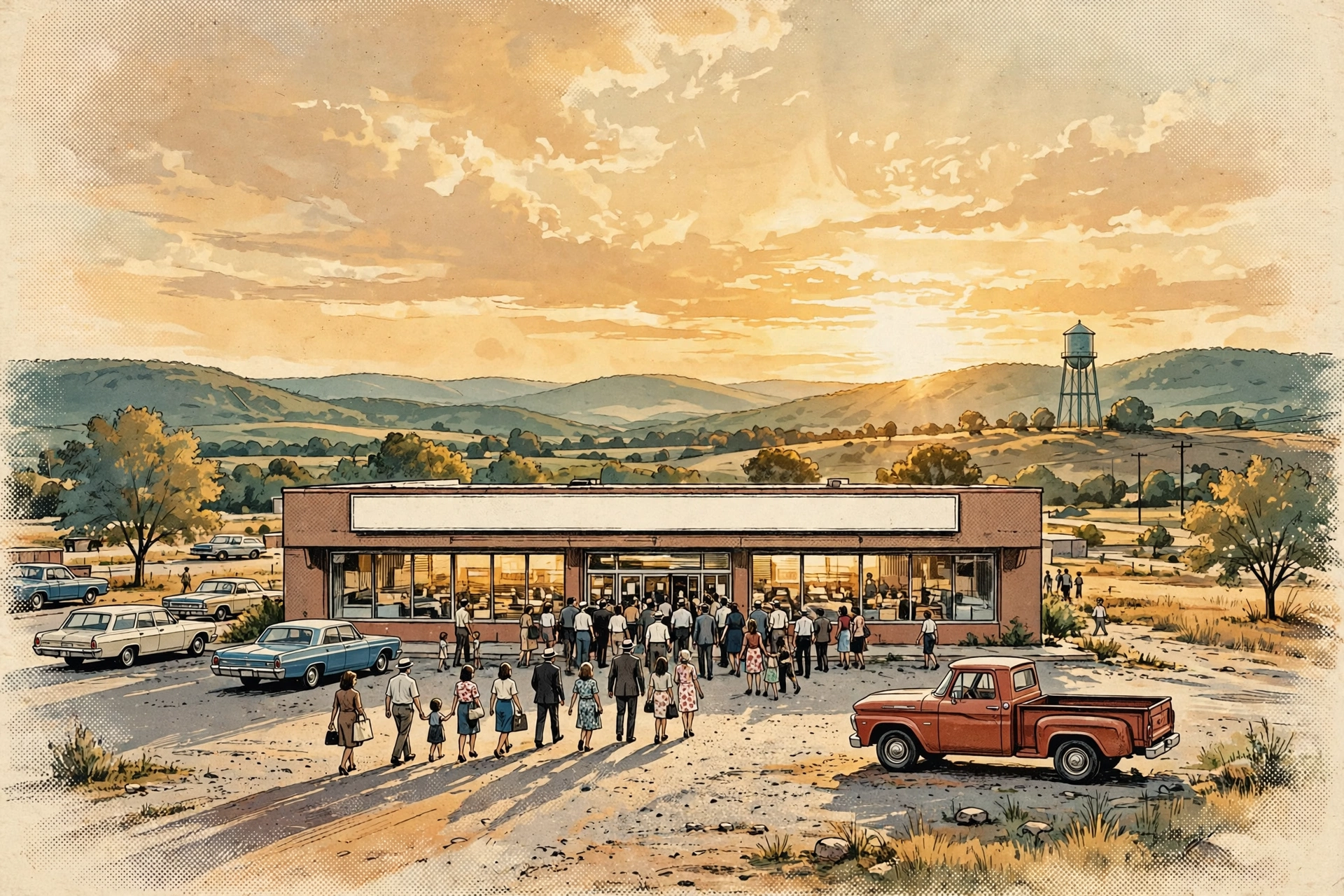
July 2, 1962, Rogers, Arkansas. Sam Walton opened Wal-Mart Discount City — Store No. 1 — at 719 West Walnut Street, a plain single-story box on the edge of a small Ozark town. It was not his first store, and that is the first thing most tellings get wrong. Walton was 44 and had been running retail stores for 22 years. What opened in Rogers was the full-size discount format — everything under one roof, priced below every competitor in the county — that he had spent a decade walking other men's stores to study.
The date that actually made Walmart possible was twelve years earlier: 1950, Newport, Arkansas. In 1945 Walton had bought a failing Ben Franklin variety store there — about $72,000 a year in sales against more than $150,000 across the street. In five years he made it the number-one Ben Franklin in Arkansas and the whole six-state region, at about $250,000 a year (Walton's memoir, corroborated in the EBSCO business-history record). Then his landlord, P.K. Holmes, refused to renew the lease — at any price. The lease Walton had signed at 27 contained no renewal option. Holmes wanted the proven store for his own son, bought Walton's franchise, fixtures and inventory for about $50,000, and kept the location. Walton called it the low point of his career. He restarted in Bentonville and negotiated a 99-year lease on the space next door: never build a business on ground you do not control.
Store No. 1 was a second act.
The founders and the founding capital
The signature number is $25,000 — and the popular version of it is attached to the wrong store. In 1945, Walton bought the Newport Ben Franklin for $25,000: $5,000 of his and Helen's Army-years savings, and $20,000 borrowed from Helen's father, L.S. Robson, a prominent Oklahoma lawyer, banker and rancher. Walton states the split himself in Made in America — later retellings that hand the whole $25,000 to the father-in-law are wrong. In 2026 dollars it is roughly $450,000 (BLS CPI deflator, ESTIMATED) — family money and a family loan, not a lone-wolf grubstake.
Helen Robson Walton was not a bystander to the capital structure; she was half of it. She held a 1941 degree in economics and finance from the University of Oklahoma, and her financial statement is what let the couple borrow at the scale expansion required — she co-signed every note, Walton recalled, and they pledged "everything we had." Her vetoes set strategy: no cities ("ten thousand people is enough for me," as the memoir quotes her) and no partners. Her father's advice produced the 1953 family partnership behind the family's later control.
Rogers, 1962, has no documented dollar figure — the honest number is a structure, not a sum. Walton never states Store No. 1's total capitalization. He records the ownership — himself 95%, his brother Bud 3%, manager Don Whitaker 2% ("I think Bud put in 3 percent," he hedged) — and the rest was borrowed: small-bank notes, co-signed by Helen, against everything the family had. By 1960 he was already the largest independent variety-store operator in America: 15 stores, about $1.4 million in sales (the Ghemawat Harvard Business School case record). Walmart was founded by the most experienced independent variety retailer in the country, borrowing to the hilt.
The machine
The machine is not a price. It is a cost stack, built in layers, each layer buying the next. Walton did not invent discounting — 1962 was a four-way birth year (Kmart, Target and Meijer's first supercenter all opened the same year), and he said plainly that he "borrowed" as many ideas from Sol Price's FedMart as from anyone. His contribution was to make everyday low prices a permanent operating discipline instead of a promotional event, and to aim it at small towns the national chains considered too small to bother with.
Layer one: density before sprawl. Walmart expanded in rings around its distribution centers — a warehouse placed to serve 150 to 200 stores within a day's drive, then the territory filled in back toward it (the saturation pattern in the Dartmouth/Tuck case record). Dense clusters are cheap to supply and cheap to supervise; a truck route becomes a milk run instead of an expedition. Rivals who planted flags nationally paid national freight. Walmart paid regional freight and let the map compound.
Layer two: own the box-moving. Distribution centers ran 24 hours a day on cross-docking — freight received on one side while store orders were filled on the other, touching storage as little as possible. By the late 1980s roughly 85% of merchandise moved through Walmart's own system, against half to two-thirds at rivals, at an estimated distribution cost near 1.7% of cost of goods against about 3.5% at Kmart and 5% at Sears (case-record estimates — the gap, not the decimal, is the documented point). The FY2025 Form 10-K counts 379 distribution facilities worldwide.
Layer three: information as a weapon, bought early. In 1987 Walmart completed a $24 million private satellite network — then the largest in the world — linking every store to Bentonville with two-way voice and data (company-history record). In 1991 came Retail Link, which handed suppliers the same store-level sales and inventory data Walmart saw — and pushed replenishment work onto the people who made the goods. Whoever sees the whole board first prices the game.
Layer four: buying scale, spent on price, not margin. EDLP is a flywheel — lower prices widen volume, volume widens buying leverage and density, and the savings pass back into price rather than being harvested as margin. No promotional spikes means demand arrives smooth and trucks run full. Grocery completed the circuit — supercenters (the first opened in Washington, Missouri, in 1988) put weekly food trips under the same roof as general merchandise, and Walmart became America's largest grocer, at roughly a quarter of U.S. grocery sales by recent estimates (ESTIMATED — industry trackers, not filings).
The numbers
- Founding capital: $25,000 for the Newport Ben Franklin in 1945 — $5,000 of Sam and Helen Walton's savings plus $20,000 borrowed from Helen's father, L.S. Robson (Walton, Made in America; corroborated in the standard biographical record). Roughly $450,000 in 2026 dollars (BLS CPI, ESTIMATED). Store No. 1 (Rogers, 1962) has no documented capital total — only the 95/3/2 ownership split and borrowed-to-the-hilt financing, as Walton told it.
- Store No. 1, first year: about $1 million in sales — Walton's own round figure in the memoir; the case-study record prints about $975,000.
- At the IPO (October 1, 1970): 32 stores — 18 Wal-Marts and 14 Ben Franklin variety stores — with sales of $31 million and profits of $1.2 million for the year ended January 1970 (Wal-Mart 1980 Annual Report). The offering: 300,000 shares at $16.50 — about $4.95 million gross, roughly $3 million net (1970 prospectus record, via the Arkansas Business retrospective).
- Peak value: about $1.07 trillion in market value at its May 19, 2026 high (market data) — the first traditional retailer to cross $1 trillion, in February 2026.
- Latest full year (fiscal 2026, ended January 31, 2026): total revenues $713.2 billion, net sales $706.4 billion, operating income $29.8 billion, net income attributable to Walmart $21.9 billion, about 2.1 million associates (Form 10-K for fiscal 2026).
- The revenue crown, honestly stated: #1 on the Fortune Global 500 for twelve consecutive years through the 2025 list; on the 2026 list Amazon took #1 — Walmart stands #2 worldwide, #1 on the U.S. Fortune 500.
The near-death moment
Walmart's near-death came in two acts, and neither was a bankruptcy. Act one was the money. Through the 1960s the company was a patchwork of partnerships — ultimately 78 partners holding pieces of 32 stores — financed through small-town banks, with Sam and Helen's personal guarantees underneath. By 1969 Walton had borrowed from nearly every bank in Arkansas and southern Missouri, carried roughly $2 million of personal debt on memoir-derived accounts, and was turned down for more: "We weren't generating enough profits both to expand and pay off our debts… We really needed the money." The IPO was the rescue — planned for May 1970, delayed by a falling market, and bridged by a $2.5 million Mass Mutual loan (prospectus record, via Arkansas Business). Going public, Walton said, "took a huge load off me." The company was profitable throughout; what almost broke was the founder's balance sheet, which was the company's credit.
Act two was the people, and it was closer. In 1974 Walton stepped back and split the company between two successors — Ron Mayer, the new-guard finance chief, as chairman and CEO, and Ferold Arend, the old-guard merchant, as president — then kept intervening while both factions competed. In June 1976 he took the chairmanship back; Mayer quit rather than take the vice-chairman's seat, and the men who ran finance, data processing and the distribution centers walked out behind him — by Walton's count, a third of senior management. "It was a real, bona fide exodus," he wrote, "and for the first time in a long time, things looked pretty grim." Fortune's later profile of David Glass — who joined in 1976 to run finance — calls the succession attempt a disaster outright. What walked out was the three functions the machine is made of. The rescue was Walton himself, back in the chair at 58, plus Glass.
What endures
The open question is whether a machine built to move boxes through stores can stay the cheapest way to move boxes, period. The four founding layers still describe the company: $713.2 billion of fiscal 2026 revenue is the largest print any retailer has ever filed. But the contested ground moved — Amazon took the #1 revenue slot on the 2026 Fortune Global 500, and Walmart's growth now sits in e-commerce, marketplace and advertising. The international record carries the lesson both ways: Mexico (1991) stumbled on American assumptions, localized, and became Walmart's largest division outside the U.S.; Germany (1997) never localized and was sold to Metro in 2006 at a pre-tax loss of about $1 billion (Walmart's 2006 Form 8-K). The machine travels when it is rebuilt locally. It fails when it is photocopied.
The operator's take
- Control the ground under the business. Newport was the best store in a six-state region and Walton still lost it, because a lease without a renewal clause made the landlord the owner of his work. Every later decision — the 99-year lease, the owned distribution centers, the saturation map — is that lease rewritten as strategy. Whatever your ground is — the lease, the platform, the rails, the data — if someone else can decline to renew it, they hold your equity.
- Your financing structure is a growth ceiling, and it binds before the market does. Walmart in 1969 was not losing to Kmart; it was losing to its own partnership patchwork and personal guarantees. The IPO was not a trophy — it was the removal of the binding constraint. The company could not grow past the combined credit of two people's signatures.
- Borrow ideas; build systems. Walton stole ideas shamelessly, from FedMart to Kmart's aisles — and said so. None of it mattered until it was assembled into one system: EDLP as discipline, density as geography, information as reflex. Ideas are everywhere and unprotectable; a system that makes an idea cheaper to run every year is the asset.
- Founder succession is an operating risk, not a retirement plan. Walton's 1974 step-back cost the company a third of its senior management in one Saturday — self-inflicted and foreseeable. Handing over the title without handing over the system is how a company finds out which one it actually had.
The myth ledger
- "Sam Walton started Walmart with $25,000 and a pickup truck." — EMBELLISHED. The $25,000 is real and DOCUMENTED — for the 1945 Newport Ben Franklin ($5,000 of savings, $20,000 from his father-in-law). By 1962 Walton had run stores for 22 years and owned America's largest independent variety-store operation: 15 stores, about $1.4 million in sales.
- "He built the best variety store in a six-state region, then lost it over a lease." — DOCUMENTED. Newport was the #1 Ben Franklin in Arkansas and the six-state region by 1950 (memoir; EBSCO record); landlord P.K. Holmes refused renewal — the lease had no renewal clause — because he wanted the store for his son. Walton sold out for about $50,000 and started over in Bentonville.
- "Walton founded Walmart at 44 with no retail experience." — LEGEND, as a founding claim. He had J.C. Penney training from 1940 and the largest independent variety chain in the country. Age 44 is the only true number in the sentence.
- "Walmart invented discount retailing and everyday low prices." — LEGEND as invention; DOCUMENTED as system. Discounting dates to the mid-1950s; FedMart (1954) taught Walton directly, and Kmart, Target and Meijer all launched in 1962. His contribution is EDLP as a permanent operating system in small towns — the systematizer, not the inventor.
- "Walmart killed Main Street single-handedly." — CONTESTED. The literature disagrees with itself: Basker finds modest net job gains with some displacement; Neumark and co-authors find each Walmart job displacing roughly 1.4 others; Jia attributes 50–70% of small-retailer decline to Walmart and Kmart together. Small-town decline also predates Walmart by half a century (Kenneth Stone's Iowa studies). Walmart accelerated a 70-year decline; it did not start the fire.
- "Low wages were the whole secret of the low prices." — CONTESTED. Wages were one real line in the cost stack. The measurable gap was logistics: distribution cost near 1.7% of cost of goods against roughly 3.5% at Kmart (case-record estimates). Equally low-wage rivals lost anyway — the experiment that isolates the variable.
- "The first Mexico City store had an ice rink in it." — LEGEND. No source exists. It is a garbled descendant of a documented item: Walmart stocked ice skates where they couldn't sell, and its automated replenishment kept reordering them.
Sources: Sam Walton with John Huey, Made in America (1992) — the Newport purchase and climb, the Holmes lease refusal, the Rogers ownership split and Helen's co-signing (as Walton told it), the 1969 debt squeeze, the 1976 exodus; the Wal-Mart 1980 Annual Report (32 stores, $31 million sales, year ended January 1970); the 1970 prospectus record as reprinted by Arkansas Business (IPO terms; about $3 million net); Walmart corporate history and split history (Rogers opening; IPO terms; Sam's Club 1983; first Supercenter 1988; the 1987 satellite network); Walmart Form 10-K for fiscal 2025 ($681.0 billion revenues, 379 distribution facilities) and fiscal 2026 ($713.2 billion revenues, $21.9 billion net income attributable, about 2.1 million associates); Walmart Form 8-K, August 2006 (Germany exit, about $1 billion pre-tax loss); Fortune Global 500, 2025 and 2026 lists; Ghemawat, Harvard Business School case record (largest independent variety operator by 1960; discounting's origins); Basker (2005), Neumark et al. (2006), Jia (2005) and Kenneth Stone's Iowa studies for the Main Street ledger; market data for the May 19, 2026 high of about $1.07 trillion. Inflation conversions are ESTIMATED using the BLS CPI deflator. This is essay #3 of the Top 500 Companies Ever, a pleitez.ai series. Written by the Emanuel Pleitez AI team.
What next?
Pick one — every road from here is short.
Prefer a human?
Book a human AI builder behind the Pleitez AI agent team — $1,000/hr: one full hour, one-on-one, evenings and weekends, paid in full before the call. That could be Emanuel, or someone of his caliber or better.
Book a human AI builder