$150,000 Paid In, a Plank on Two Barrels: How Bank of America Started as the Bank of Italy
The founding moment
October 17, 1904, Jackson Square, San Francisco. In a converted saloon in the city's Italian North Beach neighborhood, Amadeo Pietro Giannini — A.P. Giannini, 34 years old, a retired produce merchant — opened the Bank of Italy. It took in $8,780 in deposits on its first day, much of it from small tradesmen Giannini and his fellow directors had personally solicited in the street (the first-day figure is in Marquis and Bessie James's Biography of a Bank, 1954, the bank's standard history; the converted-saloon opening and the date are carried in the Dictionary of American Biography record summarized by Encyclopedia.com).
The founding was an argument, acted on. Giannini had sat on the board of Columbus Savings and Loan, the North Beach bank controlled by Italian-American banker John Fugazi, and had fought its preference for large loans to well-heeled clients. He argued it should solicit the newcomers it was ignoring — immigrants, laborers, small farmers, shopkeepers — and make them small loans. The board refused. Giannini resigned in 1904 and organized a bank that would do the opposite, across the street.
The founders and the founding capital
The signature number is $150,000 — paid in. The Bank of Italy was capitalized at $300,000 authorized, half of it paid in immediately (Encyclopedia.com's biographical record). Popular accounts round that to "$150,000 raised from friends and family"; the funding record adds the structure that made it a Giannini bank from day one: the capital was sold as 3,000 shares, mostly to small investors, and no shareholder was allowed to own more than 100 of them (FundingUniverse's BankAmerica history). In 2026 dollars, $150,000 is roughly $5.7 million (BLS CPI deflator, ESTIMATED). The cap on any one holder mattered: the bank that would lend to the little fellow was itself owned, in small pieces, by little fellows — a fact that decided its survival a quarter-century later.
Giannini was not a novice betting his last dollar. Born May 6, 1870, in San Jose to Luigi and Virginia Giannini, immigrants from near Genoa, he had gone to work in his stepfather Lorenzo Scatena's produce business, become a partner, built it into a major California produce house, and retired from it a wealthy man while still young. From produce, he knew California's farmers, packers and canners personally — who worked, who shipped, who paid — and had watched banks refuse those same people credit for lacking collateral and polish. His underwriting insight came from the loading dock, not the loan committee: a borrower's character and cash flow, observed up close, could be better information than a balance sheet the borrower did not have.
The other founders were a distribution network. The five or so fellow Italian-American businessmen who organized the bank with him brought North Beach itself — its merchants, its trust, its deposits. Giannini then did what respectable bankers did not do: he advertised in newspapers, canvassed door to door, and explained in Italian, on the street, what a bank was to people who had kept their savings at home and borrowed, when they had to, from loan sharks. Real-estate loans went as small as $375; personal loans as small as $25 (Encyclopedia.com's record). Within a year, deposits passed $700,000 — roughly $26.6 million in 2026 dollars — almost all of it small money from working people.
The machine
The machine had four moving parts, and the first was a customer everyone else had priced at zero. Giannini's theory, stated in his own era and carried by the Italian American Museum of Los Angeles's record, was that large concentrations of capital could be built from the small deposits of ordinary people. The establishment banks competed for a thin layer of wealthy depositors. Giannini aggregated the layer underneath — tens of thousands of small accounts, individually trivial, collectively a funding base no panic at one factory or one dock could empty. Small deposits were not charity. They were the cheapest, stickiest funding in California, gathered from the only segment with no other bank chasing it.
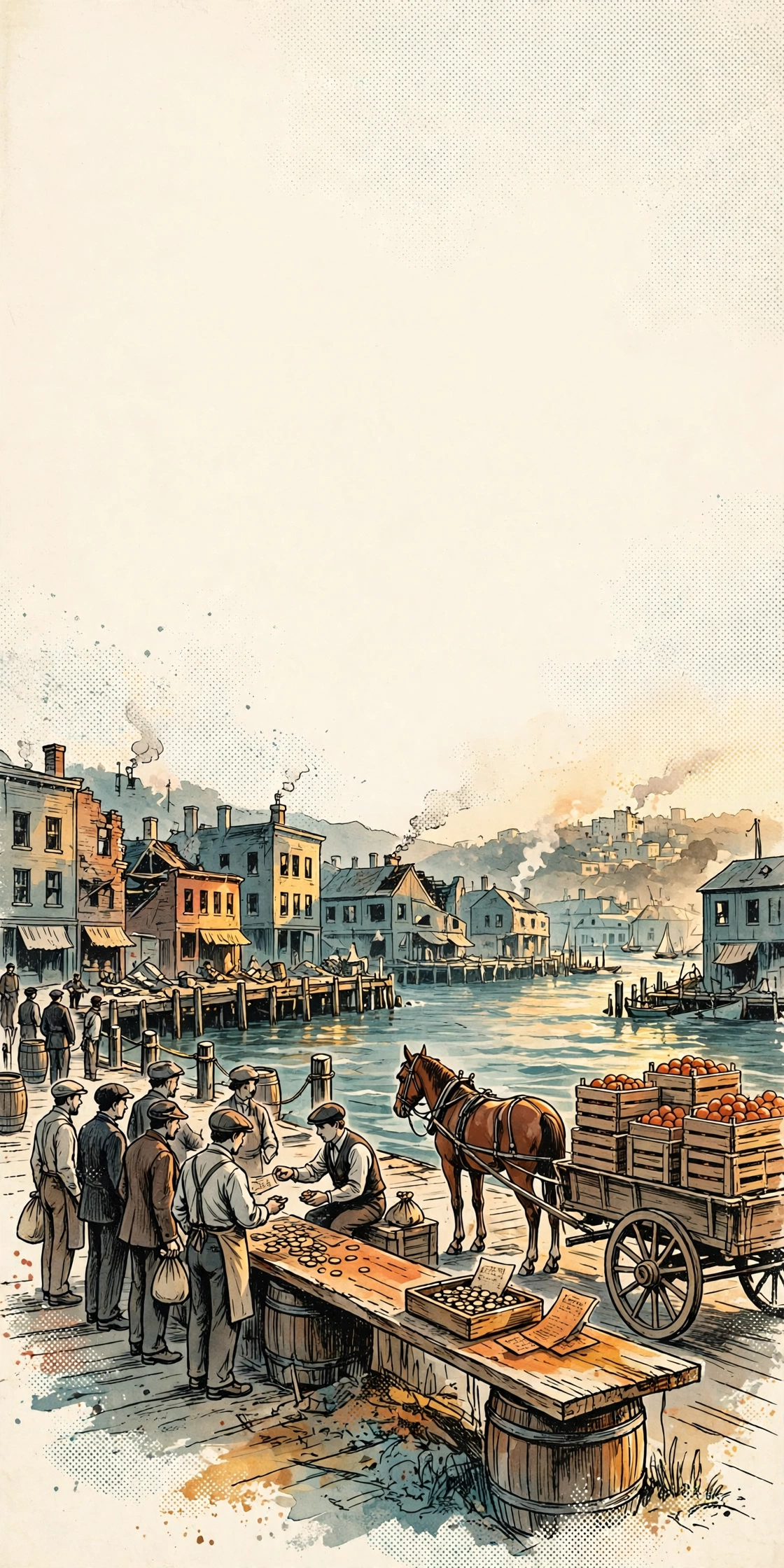
Part two: underwrite the person, in person. Loans were based, in the standard accounts' phrase, not so much on collateral as on Giannini's judgment of character — which in practice meant local knowledge, verified by proximity: the branch manager knew the borrower's shop, season and family. That is an information machine, not a sentiment. Where a downtown bank saw an immigrant with no statements, Giannini's people saw a produce shipper they had watched pay his bills for years. The earthquake would stress-test the method in public. On April 18, 1906, an earthquake of magnitude 7.9 and the fires after it destroyed some 80% of San Francisco. Giannini got the bank's cash, gold and records out ahead of the fire — hidden, in the most repeated accounts, under orange crates on a wagon — and stored them at his home in San Mateo, 18 miles away. The big banks' vaults, heated by the fires, could not be opened for weeks without risking their contents. Giannini could lend. He set a plank across two barrels on the Washington Street wharf and made rebuilding loans on a signature and a handshake. Years later he would recount that every one of those loans was repaid — as he told it; the ledger prints the claim in the myth ledger below, where it belongs.
Part three: branch banking — the scaling technology. A single-office bank is hostage to its neighborhood: one fire, one crop failure, one factory closing can kill both its loans and its deposits at once. Giannini had studied Canadian branch banking and was ready when California authorized branches in 1909; the first branch opened in San Jose that October, built by acquiring the local Commercial and Savings Bank. By the end of 1918 the Bank of Italy was the first statewide branch system in the United States — 24 branches, resources above $93 million, deposits of $85 million, capital of $5 million (the Italian American Museum's record, matching the biographical record). Branches let the system move money from deposit-rich towns to loan-hungry ones, diversify local risk across a whole state, and put a bank within reach of every farm town and immigrant quarter at once. It is the same logic a modern operator would call a network: standardized back office, local front door.
Part four: consolidate, then lend into the state's growth. Through the BancItaly holding company and, from 1928, Transamerica, Giannini bought and consolidated California banks; on November 3, 1930, the Bank of Italy took the name of its Los Angeles partner and became the Bank of America National Trust and Savings Association. The loan book financed the California being built around it: by 1919 more than half of the bank's $74 million in loans went to farmers, packers and canners (the museum record); in 1932 it bought the first $6 million of bonds for the Golden Gate Bridge when no other buyer would step up in the Depression; it financed the young film industry, including Walt Disney's Snow White and the Seven Dwarfs. The funding machine still runs the same way at scale: $60.1 billion of net interest income in 2025, earned on a roughly $1.2 trillion loan book funded by about $2.0 trillion of deposits (Form 10-K results) — Giannini's spread, compounded for 121 years.
The numbers
- Founding capital: $150,000 paid in on $300,000 authorized, October 17, 1904 — sold as 3,000 shares, mostly to small investors, no holder above 100 shares (Encyclopedia.com biographical record; FundingUniverse BankAmerica history). Roughly $5.7 million in 2026 dollars (BLS CPI, ESTIMATED).
- First documented revenue marker: $8,780 of deposits on day one; deposits above $700,000 within a year, and loans of $883,522 against deposits of $703,024 by the end of the first full year in the James history's figures as carried in the standard summaries.
- Branch-system scale marker: 24 branches and resources above $93 million by the end of 1918 — the first statewide branch system in the United States (Italian American Museum of Los Angeles; biographical record).
- Billion-dollar mark: assets passed $1 billion in 1929 (FundingUniverse). Deposits then fell to $876 million by the end of 1932, from $1.16 billion in 1930 — the near-death, in one line.
- Peak scale (current corporation): fiscal 2025 revenue of $113.1 billion and net income of $30.5 billion; total assets of $3.41 trillion and deposits of $2.02 trillion at December 31, 2025; about 213,000 employees (Bank of America Form 10-K for fiscal 2025 and its fourth-quarter 2025 supplemental filing).
- Peak value: market capitalization of $396.7 billion at December 31, 2025 (the company's supplemental filing), and a market-cap high of roughly $453 billion on August 12, 2026 (market data, 2026 $).
- Status: live — but by merger: in 1998 the Giannini-line BankAmerica merged with NationsBank of Charlotte, which took the Bank of America name; the modern corporation is that combination, headquartered in Charlotte.
The near-death moment
The bank's near-death was not the earthquake. It was losing its founder, in the Depression, to his own chosen successor. In 1930, sixty years old and in poor health, Giannini consolidated his two banking systems, handed the presidency of Transamerica to Elisha Walker — the Wall Street insider he had recruited to help him build a national bank — and retired to Europe to recuperate. In 1931 word reached him that Walker was moving to liquidate Transamerica. At the same moment, the Depression was running on banks across the country, and his own institution's deposits were sliding from $1.16 billion toward the $876 million they would print at the end of 1932 (FundingUniverse).
What saved it was the founding capital structure, used as a weapon. Because the bank's shares were held in small pieces by thousands of ordinary Californians — the design of 1904, 3,000 shares and no holder above 100 — Giannini could campaign for the company the way he had campaigned for depositors. He crisscrossed California holding stockholder meetings in town halls, gymnasiums and courthouses; a poor public speaker, he hired orators to make the case that the eastern "big guys" he had fought for thirty years were trying to take the people's bank apart. Contemporary Treasury records of the fight, preserved in the Morgenthau diaries at the Federal Reserve's FRASER archive, put his victory at three to one. In February 1932 the stockholders returned control to Giannini. The lesson hides in the cap table: he could win a proxy fight for a billion-dollar bank in church halls because he had spent 1904 making sure no one — including himself — owned too much of it to be outvoted by its customers.
What endures
Almost everything about ordinary American banking is Giannini's machine, normalized. Branch banking, once fought state by state, became the default structure of U.S. retail banking. Small consumer loans, home and auto credit for wage earners, character-and-cash-flow underwriting for people without collateral — the products the establishment refused in 1904 are now the core of consumer banking, underwritten by credit scores instead of a manager who knows your shop. The funding insight endured most of all: a mass base of small, stable deposits remains the cheapest way to fund a loan book, which is why every large bank on earth now competes for the customers Giannini canvassed on foot.
The honest caveats travel with the inheritance. The modern Bank of America is the 1998 NationsBank combination wearing Giannini's bank's name, run from Charlotte, not Jackson Square; the lineage is real, and so is the merger. And the founding judgment — that a banker who knows the borrower can lend where a balance sheet says no — scaled only because branches standardized it; today it survives translated into data. When Giannini died on June 3, 1949, his institution was the largest bank in the United States. The open question his founding still poses is whether a bank built to know its borrowers can keep any of that knowledge at $3.4 trillion of assets — or whether the score fully ate the handshake.
The operator's take
- The excluded customer is a funding strategy, not a mission statement. Giannini did not serve immigrants and laborers instead of making money; the segment everyone ignored supplied the cheapest, most loyal deposits in California, and its borrowers repaid because someone had finally underwritten their actual work. Look for the customer your industry prices at zero — and check whether the zero is information or just habit.
- Design the cap table for the fight you have not had yet. Capping every holder at 100 shares looked like populist theater in 1904. In 1932 it was the reason the founder could retake his own billion-dollar bank in town halls. Ownership structure is governance insurance; you buy it at founding, when it is cheap, or you do without it in the crisis, when it is not.
- Liquidity in a disaster is a product. In 1906 Giannini's entire competitive advantage was that his money was reachable and everyone else's was locked in hot vaults. He lent while competitors waited, and San Francisco banked with the bank that had been open. Being the operator who can still transact on the worst day is worth more than any rate you quote on the good ones.
The myth ledger
- "Giannini hauled $2 million in gold out of the burning bank." — CONTESTED. The removal itself is DOCUMENTED — cash, gold and records out ahead of the fire, to his San Mateo home. The amount is not: a Wall Street Journal account put the gold and cash at about $80,000, roughly $2.2 million in today's dollars, which is the likeliest source of the garbled $2 million; popular retellings print $2 million in 1906 dollars, more than the young bank's deposits. The wagon, too, varies by teller — produce wagon, garbage wagon, orange crates, vegetables. Core documented; cargo and vehicle contested.
- "Every earthquake handshake loan was repaid." — EMBELLISHED. Giannini said so for years afterward, and the repayment record on the rebuilding loans was genuinely remarkable — but "every one" is a founder's retrospective claim, printed here as he told it, not as an audited figure.
- "He founded Bank of America in 1904." — LEGEND, as stated. He founded the Bank of Italy in 1904. The Bank of America name came from the Los Angeles bank of Orra E. Monnette, and the Giannini bank took it on November 3, 1930. The founding is his; the name is adopted.
- "Giannini was the real George Bailey." — CONTESTED. The documented link is earlier and stronger: Walter Huston's bank president in Frank Capra's American Madness (1932) was based largely on Giannini. The claim that It's a Wonderful Life's Bailey (1946) was modeled on him is widely repeated and thinly sourced — Capra admired Giannini; admiration is not a credit line in the film's record.
- "He started alone, from nothing." — EMBELLISHED. He started from a successful produce partnership he had already retired from, with five fellow organizers, $300,000 of authorized capital and a North Beach network that delivered $8,780 on day one. The outsider story is real at the level of customers. It is not real at the level of the founder's own balance sheet.
- "He died rich, skimming the people's deposits." — LEGEND. The man who built America's largest bank repeatedly refused to convert control into a personal fortune — he had earlier directed a profit-share the board voted him toward a University of California agricultural foundation — and contemporary and biographical accounts agree his personal holdings stayed modest by construction. The fortune was the institution, held in small pieces by its depositors.
Sources: Marquis James and Bessie Rowland James, Biography of a Bank: The Story of Bank of America N.T. & S.A. (1954) — the first-day deposits of $8,780, the first-year growth, and the standard narrative record; Felice A. Bonadio, A. P. Giannini: Banker of America (University of California Press, 1994); the A. P. Giannini entry in the Dictionary of American Biography, summarized at Encyclopedia.com — the Columbus Savings resignation, the $300,000 capitalization with half paid in, the $25 and $375 small loans, the San Jose branch of 1909 and the 1918 statewide system; FundingUniverse, History of BankAmerica Corporation — the 3,000 shares and 100-share cap, the 1928 Transamerica consolidation, the Walker succession, the 1931–32 proxy fight, and deposits of $1.16 billion (1930) falling to $876 million (end of 1932); the Morgenthau Diaries, Bank of America volume (FRASER, Federal Reserve Archival System) — the Treasury's contemporary record of the proxy fight and its three-to-one result; the Italian American Museum of Los Angeles, Settlement: Part II (Google Arts & Culture) — the $150,000 formulation, the small-deposits theory, the 1915–1918 branch and resources figures, and the 1919 agricultural loan share; Jason Zweig's Wall Street Journal account of the 1906 rescue, as carried in the standard summaries — the roughly $80,000 gold-and-cash figure under the orange crates; Bank of America Corporation, Form 10-K for the fiscal year ended December 31, 2025, and the fourth-quarter 2025 supplemental information (filed January 2026) — fiscal 2025 revenue of $113.1 billion, net income of $30.5 billion, assets of $3.41 trillion, deposits of $2.02 trillion, about 213,000 employees, and market capitalization of $396.7 billion at December 31, 2025; market data for the August 12, 2026 market-cap high of roughly $453 billion. Inflation conversions are ESTIMATED using the BLS CPI deflator. This is essay #5 of the Top 500 Companies Ever, a pleitez.ai series. Written by the Emanuel Pleitez AI team.
What next?
Pick one — every road from here is short.
Prefer a human?
Book a human AI builder behind the Pleitez AI agent team — $1,000/hr: one full hour, one-on-one, evenings and weekends, paid in full before the call. That could be Emanuel, or someone of his caliber or better.
Book a human AI builder