$150,000 and a Crate of Unwanted Watches: How Sears Started, Then Closed Its Own Catalog
The founding moment
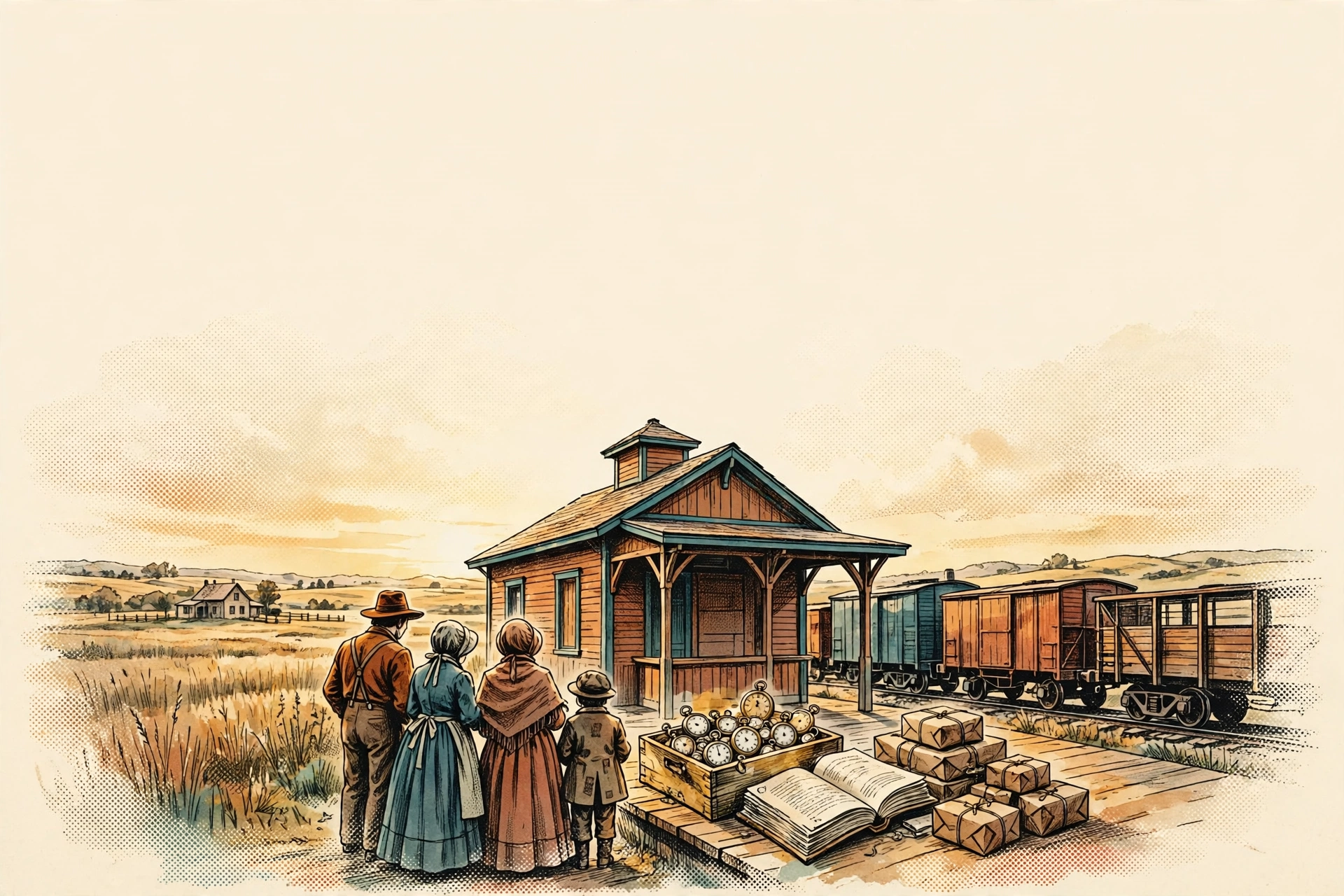
Sears starts with a shipment nobody wanted, at a railroad station in North Redwood, Minnesota, in 1886. Richard Warren Sears, born in Stewartville, Minnesota, in 1863, was working as the freight and station agent for the Minneapolis and St. Louis Railroad in North Redwood after his father died in 1879, shortly after losing the family fortune in a speculative stock deal (standard histories; Britannica). A Chicago jeweler shipped a consignment of pocket watches to a local jeweler, who refused delivery rather than return them to the manufacturer. Sears bought the watches himself and sold them, at a low price and a profit, to station agents down the line, who resold them to passengers and townspeople (Encyclopedia.com company history; Britannica). He ordered more, and sold more.
Within six months he had made $5,000 — more than a station agent could expect to save in years — and he quit the railroad to found the R.W. Sears Watch Company in Minneapolis in 1886 (Encyclopedia.com). The watch was the perfect first mail-order product: valuable for its size, standardized, shippable by rail and post, and exactly the kind of good a rural buyer overpaid for at a local store with no competition. Sears had not invented mail order — Aaron Montgomery Ward had started a general mail-order business in Chicago in 1872 — but he had found, by accident, the distribution the rest of his company would be built on: sell directly, state the price plainly, and let the railroad and the mail do what a storefront could not.
The company moved to Chicago in 1887, the continent's rail and communications hub, where Sears hired Alvah Curtis Roebuck, a watch repairman, to service what he sold (Britannica). The first catalog followed in 1887–88 — 80 pages of watches, diamonds and jewelry in the Encyclopedia.com account. Then Sears did the first of several things the hagiographies smooth over: in 1889 he sold the business for $100,000 and left for Iowa, planning to be a rural banker (standard histories). He came back. In 1892 he started again in Chicago with Roebuck as partner, and on September 16, 1893, the partners renamed the firm Sears, Roebuck and Co. and began to diversify beyond watches (company histories; the September 16, 1893 date is carried in the standard record). The catalog that followed is the founding document of modern American retail.
The founders and the founding capital
The signature number of this essay is $150,000 — the capital stock of the reorganized Sears, Roebuck and Co. in August 1895. That is not the watch business's first dollar; it is the first capital figure for the diversified company that survives with two-source support, and the essay prints it as such. The sequence matters. By 1894 the catalog had grown to 322 pages — sewing machines, bicycles, sporting goods, clothing — and sales were over $400,000 in 1893 and over $750,000 in 1895 (standard histories). Growth on that slope, in a depression, consumed cash faster than it produced it.
Richard Sears was the salesman; Roebuck was the repair bench and the caution. Sears wrote the copy himself — hyperbolic, urgent, price-led — and kept adding categories a farm household might want. Roebuck, by the standard accounts, was unwilling to carry the risk Sears wanted to carry. When the cash squeeze came (told in full in the near-death section below), Roebuck decided to leave. In August 1895, Sears sold Roebuck's half of the company for $75,000 to Aaron Nusbaum, a Chicago businessman, who brought in his brother-in-law Julius Rosenwald, a clothing manufacturer whose firm, Rosenwald and Weil, was already a principal supplier of men's clothing to Sears and to whom Sears owed money (Britannica; standard histories of Rosenwald). The new Sears, Roebuck and Co. was re-incorporated in Illinois that month with a capital stock of $150,000.
Rosenwald was not a founder. He was the rescue capital — and then the operator who made the machine rational. He brought diversified product lines, supplier discipline and a management philosophy the copywriter-founder lacked: dry goods, consumer durables, drugs, hardware, furniture, and nearly anything else a farm household could desire, sourced at volume and sold on a money-back guarantee. Sears and Rosenwald bought Nusbaum out in 1903 for $1.3 million — a measure, eight years on, of what the $150,000 reorganization had become. From 1895 to 1907, under Rosenwald as vice president and treasurer, annual sales climbed from about $750,000 to upwards of $50 million (standard histories). In 1906 the company went public in a $40 million offering — $10 million of preferred and $30 million of common, led by Goldman Sachs — the first major retail initial public offering in American financial history (Goldman Sachs firm history; standard histories). Henry Goldman's innovation was to value Sears on its earnings, which had nearly doubled between 1902 and 1906, rather than on hard assets a catalog company did not have. Richard Sears resigned the presidency in 1908 for reasons of health; Rosenwald succeeded him and ran the company into the 1920s. Sears died in 1914.
The machine
Sears's machine was a catalog, a guarantee, and a logistics system that turned rural isolation into a single national market. At the end of the nineteenth century roughly 70% of Americans lived in rural places (Encyclopedia.com catalog history), served by local general stores with thin stock, high prices and, for many Black families in the Jim Crow South, discriminatory treatment and credit traps at the only store in town. Sears offered the alternative in print: hundreds, then more than a thousand, pages of standardized goods at stated prices, ordered by mail, delivered by rail and post, backed by satisfaction or your money back. Two public infrastructure decisions made the machine cheaper to run: rural free delivery, begun in the 1890s, and parcel post in 1913, of which Sears quickly became the largest single customer (Encyclopedia.com). The state built the last mile; Sears built everything before it.
The economics were volume buying against local monopoly. Sears bought in quantities no country store could match, specified private-label goods to manufacturers — Kenmore appliances, Craftsman tools (from 1927), DieHard batteries later — and used the catalog's own demand data, accumulated order by order, to decide what to stock and at what price. The 1894 catalog proclaimed Sears the "Cheapest Supply House on Earth"; by 1895 the book was 532 pages, and at its peak the catalog advertised more than 100,000 items (Richmond Fed history; standard histories). In 1906 Sears opened its vast Chicago mail-order plant on the West Side, a fulfillment complex built to pick and ship single items to single households — the direct ancestor of the modern e-commerce fulfillment center, built eighty years before the web.
The machine's most startling product was a house. From 1908 to 1940, Sears sold more than 70,000 Modern Homes by mail (Sears Modern Homes record; NPR and Richmond Fed accounts put the range at 70,000–75,000, ESTIMATED — Sears left no complete sales record). A kit arrived by railroad boxcar with, in the standard account, some 30,000 parts and about 25 tons of material, priced in the first 1908 book from $360 to $2,890. A company that could ship a house to a farm could ship anything to anyone; that was the point, and customers understood it.
Then the machine learned two more tricks: credit and stores. Sears began offering customer credit in 1911, when banks would not lend to ordinary consumers (Encyclopedia.com), and later built the financial empire that grew from that insight — Allstate insurance (1931), and in the 1980s Dean Witter and the Discover card (1985). In 1925, under Robert Wood, a former Montgomery Ward executive Rosenwald had hired in 1924, Sears opened its first retail store in Chicago; by the end of the decade there were 324, and by 1931 retail sales topped mail-order sales (Britannica; Encyclopedia.com). The pivot is usually told as abandoning the catalog. It was the opposite at first: the stores rode the catalog's brands, buying and distribution into the suburbs the automobile was creating, and Sears became the first chain to put free parking lots beside its stores. For most of the twentieth century the combined machine — catalog, stores, private labels, credit, insurance — made Sears the largest retailer in the United States, a position it held into 1990.
The numbers
- Founding capital: $150,000 capital stock, August 1895, on the Illinois re-incorporation that followed the $75,000 purchase of Roebuck's half by Nusbaum and Rosenwald (standard histories; Britannica). The seed profit that started the watch company was $5,000, made in six months in 1886 (Encyclopedia.com). In 1889 Sears sold the first watch business for $100,000 and later started again.
- First documented revenue: over $400,000 in 1893; over $750,000 in 1895; about $50 million by 1907 (standard histories). The 1894 catalog was 322 pages; the 1895 catalog, 532 pages.
- Peak value: era-relative, as the SPEC prescribes for a company whose standalone market-cap record is fragmented across two corporate eras. Sears was the largest retailer in the United States through the 1980s; in the early 1970s, on Donald Katz's account in The Big Store, its sales accounted for roughly 1% of the entire U.S. economy and two-thirds of Americans shopped at Sears in a given quarter. In the successor era, Sears Holdings' market value peaked at more than $23 billion in April 2007, when its shares hit an all-time high (market reporting). Neither nominal figure is printed as a 2026-dollar conversion here, because the two eras' entities are not the same company in the same form.
- Peak scale: revenues of $53.794 billion in 1989 for Sears, Roebuck and Co. (1989 annual report, via the company's annual-reports archive), with net income of $1.51 billion; Sears Holdings, the merged successor, reported $53.012 billion of revenue in fiscal 2006 (year ended February 3, 2007; company results release) and $16.702 billion in fiscal 2017 (Form 10-K record). Peak employment is reported at about 350,000 around 1969–73 and at 460,000 in the Encyclopedia.com company profile of the early 1990s — both printed, because the counts cover different perimeters (retail alone vs. the group including financial services).
- The end, in numbers: Chapter 11 filed October 15, 2018, listing $6.9 billion of assets against $11.3 billion of liabilities (bankruptcy reporting; Investopedia account of the filing). About 700 stores remained at filing, against roughly 3,500 Sears and Kmart stores at the 2005 merger; about five U.S. Sears stores were still open in late 2025 (company and press counts).
- Status: effectively dead as a national retailer — a handful of stores survive under Transformco, which bought the remaining business out of bankruptcy in 2019 for $5.2 billion. The brands outlived the store: Craftsman was sold to Stanley Black & Decker in 2017 for a net present value of about $900 million.
The near-death moment
Sears nearly died before it was ten years old, and the cause was the depression that bears the founding era's name: the Panic of 1893. The company had sales of about $800,000 in 1895 on some accounts — $750,000 on others; the essay prints the range the record carries — but the national depression that began in 1893 produced the classic growth-company squeeze: a cash shortage and large quantities of unsold merchandise, bought for a demand that had vanished (standard histories). Catalog growth did not pause for the business cycle. Inventory did not sell itself. The receivables and the stockroom consumed the cash the sales figures implied the company had.
The near-death is visible in who left and who arrived. Roebuck, the cautious partner, decided to quit — he later returned in a publicity role, and his name stayed on the door for another century, but his ownership ended in August 1895. The rescue was not a bank loan. It was a supplier taking equity: Rosenwald, to whom Sears already owed money, came in with Nusbaum for $75,000, the company was recapitalized at $150,000 of capital stock, and the new partner imposed the rational management — assortment, sourcing, working-capital discipline — that let sales rise sixty-fold in twelve years without repeating the squeeze. Every fast-growing operator should recognize the shape: the founding product worked, the founding balance sheet did not, and survival required giving a large piece of the company to the person who understood the second problem. Sears survived 1895 because its founder, whatever his gifts as a copywriter, sold half his company to his creditor instead of pretending the inventory would clear. It is the decision the company's last owners, a century later, would not make in reverse — they kept control and sold the assets instead.
What endures / the autopsy
Sears is dead, and the death certificate — Chapter 11, October 15, 2018, $11.3 billion of liabilities — names the wrong decade, in the way this series' Sears rule predicts. The disease was diagnosed in public long before. Walmart passed Sears as America's largest retailer in 1990 (1990 sales: Walmart $32.6 billion against Sears's $31.9 billion, on contemporary reporting). In 1992 Sears posted a $3.9 billion loss, then the largest ever by a North American retailer. On January 25, 1993, in the restructuring that followed, Sears announced it would discontinue the big catalog — 113 stores closed and 50,000 jobs cut alongside it (UPI contemporary reporting; Encyclopedia.com catalog history dates the catalog's close to 1993). The catalog in its last full year still brought in an estimated $3.3 billion (UPI estimate, labeled as such). One year later, in 1994, Amazon was founded on the catalog's exact premise: shop from home, delivered to your door.
That sequence is the autopsy. Sears did not miss the internet. It co-founded Prodigy with IBM and CBS in 1984, an online service with shopping a decade before the browser; it sold Craftsman tools on sears.com in 1997 and put the Wish Book online in 1998. What it had dismantled, in 1993, was the asset those services needed: the single-item fulfillment network, the warehouses tuned to ship one wrench to one household, and the living customer record a century of catalog orders had built. The 2005 merger with Kmart — an $11 billion combination engineered by Eddie Lampert's ESL Investments, itself fresh from Kmart's bankruptcy — added stores and real estate, not a new machine. Under Sears Holdings, revenue fell every year from $53.0 billion in fiscal 2006 to $16.7 billion in fiscal 2017, cumulative losses since 2010 ran to $6.26 billion by the filing, and the valuable pieces — Lands' End, Sears Canada, Orchard Supply, Craftsman, the real estate spun into Seritage — were separated or sold while the stores were starved of the capital spending the filings themselves record. What endures is not the store. It is the kit houses still standing, the private-label playbook every retailer now runs, the earnings-based IPO that opened public markets to consumer companies, and a warning with a date on it: a distribution machine is not a legacy asset to be harvested. It is the business. When Sears closed the catalog to save money, it saved the money and closed the business, twenty-five years early.
The operator's take
- Your channel is your customer file. The catalog was never just a book; it was Sears's demand data, fulfillment network and direct relationship in one object. Cutting a channel for its standalone margin, without pricing the data and logistics it carries for everything else, is how a $3.3 billion business gets valued at zero in a restructuring deck. Before you kill a channel, list what else dies with it.
- Rescue capital should bring an operator, not just cash. The 1895 save worked because Rosenwald arrived with supplier knowledge and management discipline, not only $75,000. The 2005 combination failed in part because it arrived with a financial thesis about real estate and buybacks. Same company, same distress, opposite kind of money. When you take rescue capital, ask what the new owner knows how to run.
- Being early is a wasting asset. Prodigy in 1984, online tools in 1997, a century of home delivery — Sears held every head start and still lost home shopping to a company founded the year after it closed its catalog. A head start compounds only while you keep investing in the new form of your own machine. The moment the new form is managed to protect the old one's margins, the lead is already being spent.
The myth ledger
- "A refused crate of watches founded Sears." — DOCUMENTED. The North Redwood jeweler's refusal, Sears's purchase and resale to station agents, and the $5,000 profit in six months are carried in the Encyclopedia.com company history, Britannica and the standard histories. The precise dialogue sometimes attached to the scene is not documented; the transaction is.
- "Julius Rosenwald founded Sears." — LEGEND. Richard Sears and Alvah Roebuck founded it; Rosenwald bought in in August 1895, in the rescue reorganization, and became its defining operator and later president. Crediting him as founder erases both the watch company and the near-death that brought him in.
- "Amazon killed Sears." — EMBELLISHED. Walmart took the revenue crown in 1990, Sears posted its $3.9 billion loss in 1992 and closed its own catalog in 1993 — all before Amazon sold its first book in 1995. Amazon inherited the premise Sears abandoned; it did not take a thriving catalog away from it.
- "Sears never saw the internet coming." — LEGEND. Sears co-founded the Prodigy online service in 1984, sold online in 1997 and put the Wish Book online in 1998. It saw the internet early and dismantled, in 1993, the fulfillment and customer-data spine the internet business would have needed.
- "Sears sold whole houses by mail." — DOCUMENTED. More than 70,000 Modern Homes, 1908–1940, shipped by rail as kits (70,000–75,000, ESTIMATED — no complete company record survives). The houses are the best physical evidence the catalog machine ever produced.
- "Roebuck left because the business failed." — EMBELLISHED. He left in the 1895 cash squeeze, sold his half for $75,000, later returned in a publicity role, and watched the reorganized company reach $50 million of sales by 1907. He sold a distressed half-share, not a corpse — and, on the record, at the bottom.
Sources: Encyclopedia.com, Sears, Roebuck and Co. company history and Sears, Roebuck Catalog history (the $5,000 six-month watch profit, the 80-page first catalog, the 1893 Panic cash squeeze, customer credit in 1911, the first store in 1925 and retail topping catalog sales by 1931, the 460,000-employee profile, the catalog's 1993 close); Britannica, Sears, Roebuck and Company (the 1886 R.W. Sears Watch Company in Minneapolis, the 1887 Chicago move and Roebuck hire, the 1893 name, Rosenwald's 1895 purchase of Roebuck's interest, the 1925 store and 1931 crossover); standard histories carried in the Sears record (the September 16, 1893 renaming, sales over $400,000 in 1893 and over $750,000 in 1895, the August 1895 $75,000 sale of Roebuck's half and $150,000 Illinois capital stock, the 1903 $1.3 million Nusbaum buyout, sales of about $50 million by 1907, the 1889 sale of the first business for $100,000); Goldman Sachs firm history, the 1906 Sears IPO ($40 million — $10 million preferred, $30 million common; Henry Goldman's earnings-based valuation, earnings nearly doubling 1902–1906; the first major retail IPO); Sears, Roebuck and Co. 1989 annual report via the annual-reports archive (fiscal 1989 revenues $53.794 billion, net income $1.51 billion); Sears Holdings results releases (fiscal 2006 revenues $53.012 billion, net income $1.5 billion; fiscal 2007 revenues $50.7 billion); Form 10-K record for fiscal 2017 revenues of $16.702 billion; bankruptcy reporting and Investopedia's account of the October 15, 2018 Chapter 11 filing ($6.9 billion of assets, $11.3 billion of liabilities; the $5.2 billion Transformco purchase in 2019; the Craftsman sale's approximately $900 million net present value); Richmond Fed, "The House Is in the Mail," and NPR accounts of Sears Modern Homes (more than 70,000 homes, 1908–1940, ESTIMATED; the 1908 prices from $360 to $2,890); Donald Katz, The Big Store, as cited for the early-1970s scale markers (roughly 1% of the U.S. economy; two-thirds of Americans shopping at Sears quarterly); UPI contemporary reporting, January 1993 (the catalog discontinuation, 113 stores, 50,000 jobs, and the estimated $3.3 billion of last-full-year catalog revenue). This is essay #13 of the Top 500 Companies Ever, a pleitez.ai series. Written by the Emanuel Pleitez AI team.
What next?
Pick one — every road from here is short.
Prefer a human?
Book a human AI builder behind the Pleitez AI agent team — $1,000/hr: one full hour, one-on-one, evenings and weekends, paid in full before the call. That could be Emanuel, or someone of his caliber or better.
Book a human AI builder