$28,000 and a $223.65 Bank Balance: How Ford Started
The founding moment
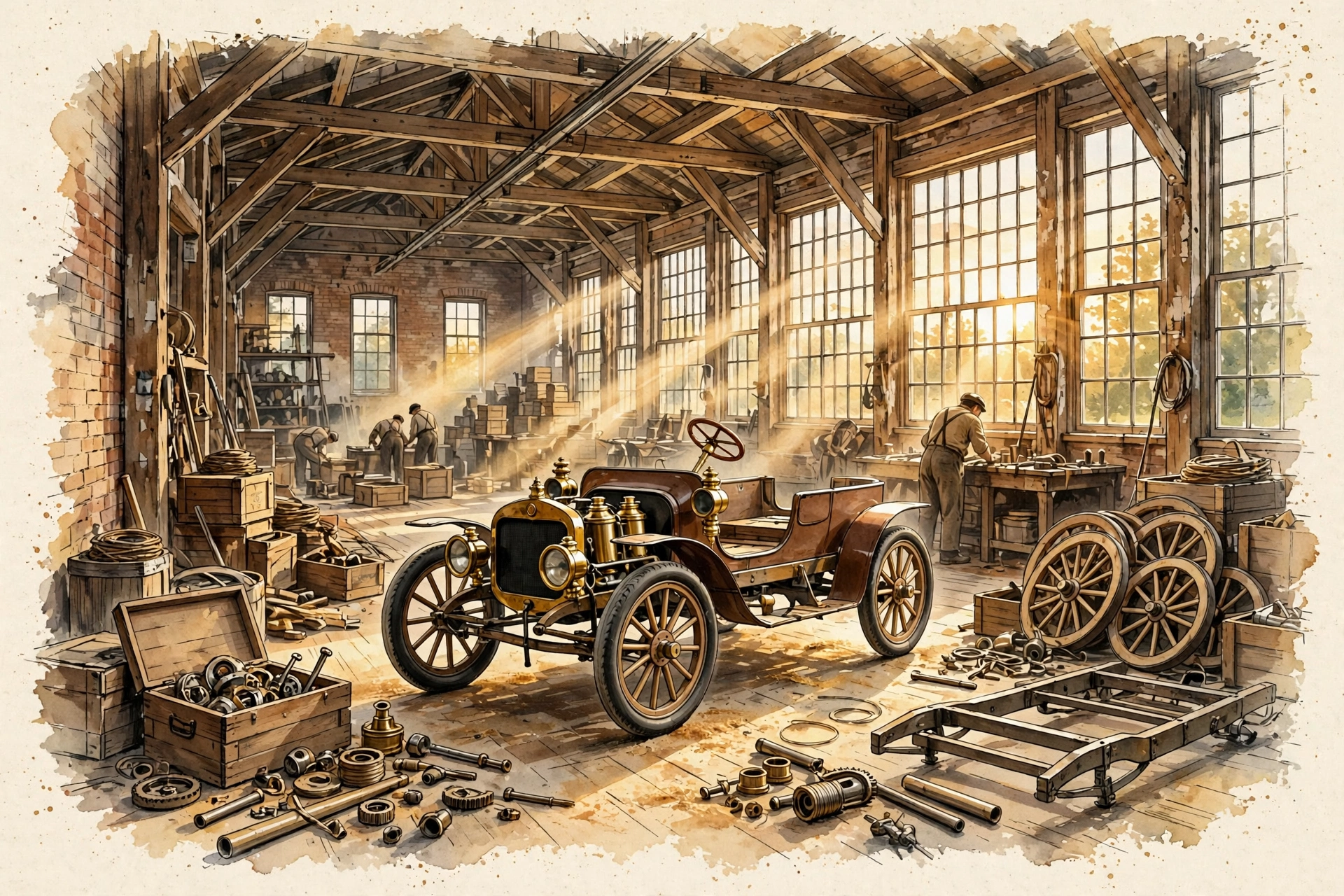
June 16, 1903, Detroit, Michigan. At about 9:30 in the morning, Henry Ford and twelve stockholders signed the articles of association for the Ford Motor Company, and the papers went to the Michigan Secretary of State (HISTORY; Ford corporate record). The company they formed was, by the standards of the automobile business of 1903, almost comically small: a rented wood-frame building on Mack Avenue, an assembly room 250 feet long and 50 feet wide, and a business model that consisted of buying nearly everything in and bolting it together — the Dodge brothers supplied the chassis, C. R. Wilson the bodies, and Ford bought the wheels, the tires, and the upholstery. What Ford Motor Company owned, at the start, was a design, a name, and $28,000 in cash.
Ten days later the company was nearly dead. The original checkbook survives in the collection of The Henry Ford, kept by the company's secretary, James Couzens. The account opened on June 26, 1903 with $14,500. Sixty checks later — rent, parts, payroll, the ordinary burn of a business that had sold nothing — the balance stood at $223.65 on July 10, 1903 (The Henry Ford, K-12 research guide; corroborated by the RM Sotheby's ledger essay on the first Model A). No order had been received. The rescue arrived in the middle of that same month, in the form of three orders totaling $1,320: a Chicago dentist named Ernst Pfenning paid $850 in full for a two-cylinder Model A with a tonneau, and two other buyers put down deposits of $300 and $170 (Ford's 2012 press release; HISTORY). The dates in the record disagree by days — Ford's own release says July 13, its museum guide says July 15, delivery is variously July 23 or 28 — but the sequence does not: the money arrived when the balance was $223.65, and from that week the balance climbed and never looked back. Within three months the company had turned a profit of about $37,000 (MoneyWeek). Ford had already failed twice at starting a car company. The third attempt survived by ten days and $223.65.
The founders and the founding capital
The signature number is $28,000 — cash, from twelve investors. It is the figure every history prints, and it is correct, but it is not the whole capitalization, and the whole capitalization matters, because it shows what kind of company Ford was at birth: a company whose most valuable asset was not money. The Michigan articles authorized $150,000 of capital stock, of which $100,000 was paid up at incorporation — $49,000 in cash, $40,000 in letters patent, and $11,000 in machinery and contracts (Wilgus, Michigan Law Review 17 (1919), summarizing the Dodge v. Ford record). The patents were Ford's. The machinery and contracts were the Dodge brothers'. The cash was twelve men's.
The twelve were not a syndicate; they were a Detroit room. Alexander Malcomson, a coal dealer, had bankrolled Ford since 1902 and assembled the group; he and Ford each took 255 shares. John S. Gray, president of Detroit's German-American Bank, put in $10,500 at the last minute — after the Dodges threatened to seize machines over unpaid bills — and became the company's first president, chosen to reassure investors that Ford, who had already walked out of two car companies, would not walk out of this one (Hyde, The Dodge Brothers; Malcomson biography). James Couzens, Malcomson's clerk, became secretary and kept the checkbook. And the Dodge brothers, John and Horace, put in no cash at all. They contracted in February 1903 to supply 650 chassis sets at $250 each — a $162,500 order — and spent $60,000 to $75,000 of their own money retooling before receiving a dollar of revenue. When Ford could not pay, they forgave a $7,000 past-due bill and extended $3,000 more credit in exchange for 100 shares — 10 percent of the company, conventionally valued as a $10,000 investment (Hyde; Encyclopedia.com, "Dodge Brothers"). In July 1919 Ford bought their 10 percent back for $25 million.
Ford himself arrived at the third company with a record of failure and a reputation for leaving. The Detroit Automobile Company (1899–1901) built about 20 vehicles and burned through roughly $86,000 before dissolving. The Henry Ford Company (incorporated November 30, 1901) ended when Ford left on March 10, 1902, after a dispute with his backers over racing versus production — taking his name and $900 with him. His backers brought in Henry Leland, and the company became Cadillac in August 1902. The $28,000, in that light, was not a bet on a proven founder. It was a bet on a man who had twice failed to ship, backed by a coal dealer, a banker, a clerk, and two parts suppliers who had already put their own money into his machines. In 2026 dollars the $28,000 is roughly $1,050,000 (ESTIMATED, BLS CPI basis) — real money, but the kind a Detroit room could raise in a week.
The machine
Ford's machine was a price ladder, and the ladder was the strategy. Every other carmaker of the era sold cars; Ford sold a car that got cheaper every year, and the cheapness was the product. The Model T was introduced on October 1, 1908, at $825 for the runabout and $850 for the touring car (R. E. Houston, Ford Production Department, August 3, 1927, the company's own price/production table). Then the ladder ran down, year after year, in the open: $680 in 1911, $525 in 1913, $440 in 1914, $345 in 1916, $265 in 1924, and $260 in 1925 — the touring car $290 that year. In 2026 dollars that is a car falling from roughly $31,000 to roughly $5,000 (ESTIMATED, BLS CPI basis). The volume followed the price down: 10,666 cars in the 1909 model year, 170,211 in 1913, 501,462 in 1916, 2,011,125 in 1923. More than 15 million Model Ts were built before the last one rolled off the line on May 26, 1927, and the car held the best-selling record in history until the Volkswagen Beetle passed it in 1972.
The ladder had two engines: the moving line and the $5 day, and they were the same engine. The first moving chassis line started at Highland Park on October 7, 1913 — a rope and windlass pulling a chassis down a 150-foot line past 140 assemblers. The labor time on a chassis fell from 12 hours 28 minutes stationary, to 5 hours 50 minutes on the rope line, to 1 hour 33 minutes by early 1914, on the elevated, power-driven line (Ford, My Life and Work, 1922; Ford heritage releases; Guinness World Records). But a line that moves that fast breaks its workforce. In 1913 Ford hired 50,448 people to hold an average workforce of 13,623 — 370 percent annual turnover (Raff, Journal of Economic History, 1988, from Slichter's The Turnover of Factory Labor, 1921). On January 5, 1914, Ford and Couzens announced the $5 day: a minimum of $5 for an eight-hour day, effective January 12, replacing about $2.34 for nine hours — roughly $169 a day in 2026 dollars (ESTIMATED). It was framed as profit-sharing, and it was conditional: the base stayed near $2.34, the rest was a bonus policed by the Sociological Department's home visits. Turnover fell to 54 percent in 1914 and 16 percent in 1915. The generosity story is the one that survived; the retention calculation is the one the record supports.
The third part of the machine was a lawsuit Ford won by refusing to pay rent on an idea. The Association of Licensed Automobile Manufacturers, formed in 1903 around George Selden's 1895 patent, claimed a royalty on every gasoline car built in America; Ford's license application was denied, and the association sued on October 22, 1903 — four months after incorporation. Ford lost at trial in September 1909, appealed, and won on January 9, 1911, when the appeals court held that Selden's patent covered only a two-stroke engine and Ford's four-stroke engines did not infringe (FEE; Association of Licensed Automobile Manufacturers record). The eight-year fight kept Ford's cost structure free of a royalty its licensed competitors paid, and made Ford — the outsider denied a license — the public champion of the independent manufacturer. Behind the ladder, the line, and the lawsuit sat the fourth part: vertical integration at the River Rouge, where by the 1930s more than 100,000 workers a day made nearly everything a Ford contained. The company that started by buying everything in ended by buying almost nothing in.
The numbers
- Founding capital: $28,000 cash from twelve investors, June 16, 1903 (Ford corporate record; Malcomson biography) — ≈$1,050,000 in 2026 dollars, ESTIMATED. Authorized capital $150,000; $100,000 paid up — $49,000 cash + $40,000 letters patent + $11,000 machinery and contracts (Wilgus, Michigan Law Review 17 (1919), summarizing Dodge v. Ford — single source for the split).
- First documented revenue: $850, Model A with tonneau to Dr. Ernst Pfenning of Chicago, mid-July 1903 — first three orders totaled $1,320 (Ford 2012 press release; HISTORY). The record disagrees on the day (order July 13 or 15; delivery July 23 or 28); the essay prints the mid-July window.
- The unit economics: Dodge chassis $250 + body $52 + wheels $26 + tires $40 + upholstery $16 = $384 of bought-in parts against a $750 runabout / $850 tonneau price (Couzens' summer-1903 costing, via Mac's Motor City Garage). First nine and a half months: $98,851 net profit on 658 cars — about $150 of net profit per car (Ford press release).
- Peak scale: more than 15 million Model Ts built, 1908–1927 (Ford's engine count: 15,007,033; R. E. Houston's production tally: 14,689,525). Model T low price $260 runabout / $290 touring, 1925 (Houston table). Cumulative company production: 350 million vehicles by August 31, 2012, the last official count; a journalist's estimate puts the total near 420 million by about 2025 (ESTIMATED).
- Peak value: market value crossed $100 billion intraday on January 13, 2022 — the first time ever — on F-150 Lightning reservations and the doubled EV production target, closing that day at $99.99 billion (CNBC; Bloomberg; Electrek, January 13, 2022). Current market value is roughly $46–48 billion as of mid-November 2026 (market data).
- Peak revenue: $187.3 billion in fiscal 2025 — a record — with a net loss of $8.2 billion after $17.4 billion of special items, mostly EV and battery charges (Form 10-K FY2025, filed February 11, 2026). Best recent profit year: fiscal 2024, $185.0 billion of revenue and $5.9 billion of net income (Form 10-K FY2024). About 169,000 employees at December 31, 2025; about 4,395,000 vehicles wholesaled in FY2025 (Form 10-K FY2025). Peak headcount: a compiled company-reported series puts it near 494,579 in 1980 — single-sourced, printed here as approximate.
- Status: live, at roughly half its peak market value, selling more cars than ever and losing money on the transition. The $5.9 billion profit of 2024 and the $8.2 billion loss of 2025 are the same company's two most recent answers to the same question.
The near-death moment
The near-death is the checkbook, and the checkbook is the founding scene. On July 10, 1903 — twenty-four days after incorporation, five days before the first order — the Ford Motor Company had $223.65 in the bank, about $8,600 in 2026 dollars (ESTIMATED). The account had opened at $14,500 on June 26 and spent itself down through sixty checks: rent on the Mack Avenue shed, parts from the Dodges, payroll for a workforce that had built cars nobody had yet bought. There was no second round to call, no line of credit to draw, no founder with a fortune behind him — Henry Ford had left his last company with $900 and his name. What saved the company was not a rescue but a sale: three orders in mid-July, $1,320 in cash and deposits, the first of them a Chicago dentist paying $850 in full for a car that did not yet exist in his hands. The margin between the Ford Motor Company and the Detroit Automobile Company — Ford's first failed attempt — was, measured precisely, $223.65 and ten days. That is the whole founding story in one number: a company that started by buying everything in, and therefore needed only one thing it did not have, which was a customer, in time.
What endures / the autopsy
Ford has now had the same near-death twice, forty-two years apart, and the second time the rescue was a management system, not a sale. Edsel Ford died on May 26, 1943, at 49; the 79-year-old founder retook the presidency and ran the company through his enforcer Harry Bennett's Service Department. When Henry Ford II took over on September 21, 1945, at 28, the company was, by the Whiz Kids' own calculation, losing up to $10 million a month — roughly $175 million a month in 2026 dollars (ESTIMATED) — on nearly $1 billion a year of revenue, and the Roosevelt administration had weighed a government takeover to protect wartime production. Henry II fired Bennett on his first day, settled with the UAW, brought in Ernest Breech from Bendix, and hired the ten former Army Air Forces statistical-control officers — the Whiz Kids, Robert McNamara among them — who started on February 1, 1946. The 1949 Ford, built in nineteen months, put the company back in the car business. The open question is the one in the numbers table: Ford's machine was built to make a car cheaper every year until everyone could buy one, and the 2025 result — record revenue of $187.3 billion and an $8.2 billion loss — is a company that can still sell the volume and cannot yet make the new machine pay. The Dodge brothers' story is the coda: in 1916 the Dodges sued Ford for withholding dividends to fund the River Rouge expansion, and in 1919 the Michigan Supreme Court ordered the dividend paid — the case that still anchors shareholder-primacy doctrine. The suppliers who took stock instead of cash got $25 million for their 10 percent, and the founder who took their parts got a court order telling him the company was not his alone.
The operator's take
- The balance sheet is the founding story; the anecdote is the footnote. Ford's first month is remembered as a car company starting in a shed. The document that matters is a checkbook: $14,500 in, sixty checks out, $223.65 left, ten days before the first order. When a young company tells its founding story, the number to lead with is the cash low point and the date of the first dollar in — everything else is scenery.
- Price is a system, not a decision. The Model T did not get cheap because Ford cut the price once. It got cheap because the line, the wage, the lawsuit, and the Rouge were all built to take cost out every year, and the price followed the cost down the ladder — $825 to $260 over sixteen model years — while volume multiplied two hundredfold. A price cut that is not backed by a cost system is a promotion; a price ladder backed by one is a moat.
- Pay for retention, and say so. The $5 day is taught as generosity and it was not: it was a retention calculation against 370 percent turnover on a line that could not run with strangers. It worked — turnover fell to 16 percent in two years — and it worked in public, which was also part of the calculation. The lesson is not to pay more; it is to find the number your operation is actually losing money on, pay to fix that number, and let the story take care of itself.
The myth ledger
- "Henry Ford invented the assembly line." — LEGEND. Ransom Olds ran a stationary assembly line for the Curved Dash Oldsmobile from 1901, and the moving-line template was the Chicago meatpackers' disassembly lines. What Ford invented, and what the record supports, is the moving assembly line: the first in the auto industry, at Highland Park in 1913 (Guinness World Records).
- "Any customer can have a car painted any color that he wants so long as it is black." — DOCUMENTED (the quote); "the Model T was always black" — LEGEND. The line is Ford's own, from My Life and Work (1922), recounting a 1909 announcement. But 1908–1913 Model Ts came in grey, green, blue, and red; all-black ran only from 1914 to 1925. The popular reason — Japan black dried fastest — is CONTESTED: archival research (Boggess) finds the fast-drying claim unsupported by Ford's engineering documents and attributes the choice to black paint being cheap, durable, and damp-proof.
- "The $5 day was Henry Ford's generosity." — EMBELLISHED. The documented motive is retention: 370 percent turnover in 1913, 50,448 hires to hold 13,623 jobs, on a moving line that stopped when a stranger fumbled. The "so workers could afford the cars they built" rationale is a later Ford talking point, not the 1914 record (Raff, 1988).
- "Henry Ford invented the automobile." — LEGEND. Karl Benz built the Patent-Motorwagen in 1885 and patented it on January 29, 1886; Daimler built a motorized vehicle the same year. Ford's first car, the Quadricycle, was 1896 — a decade later. Ford's documented achievement is affordable mass production, not invention.
- "Workers rioted at the Highland Park gates when the $5 day was announced." — DOCUMENTED (in substance). Within days of January 5, 1914, thousands of job seekers crowded the gates, the crowds grew disorderly, and they were turned away with fire hoses in icy January weather — The Henry Ford's own account uses the word "riots." The crowd-size figures that circulate (10,000–12,000 men) are unverified; the essay prints "thousands."
Sources: The Henry Ford — K-12 Research Guide: Ford Motor Company (the 1903 checkbook: $14,500 on June 26 to $223.65 on July 10 after 60 checks; first car sold mid-July 1903 for $850) and "Ford's Five-Dollar Day" (Matt Anderson, 2014; the Highland Park gate crowds and fire hoses); Ford Motor Company — "The First Model A Laid a Foundation for the Future" (press release, 2011: three first orders totaling $1,320; $98,851 net profit in the first 9½ months on 658 cars); Henry Ford with Samuel Crowther, My Life and Work (Doubleday, 1922), ch. 5 (the moving line: 12h 28m → 5h 50m → 1h 33m) and the "any color so long as it is black" passage; Daniel M. G. Raff, "Wage Determination Theory and the Five-Dollar Day at Ford," Journal of Economic History 48(2), June 1988 (announced January 5, 1914; $2.34 for nine hours; 370% turnover in 1913 from Slichter, 50,448 hires to hold 13,623 jobs; 54% in 1914, 16% in 1915); R. E. Houston, Ford Production Department, August 3, 1927 (Model T price/production table, via "Ford Model T": 1909 runabout $825 / touring $850; 1925 runabout $260 / touring $290; production 14,689,525; "more than 15 million" per Ford's engine count of 15,007,033); Horace L. Wilgus, "Corporations, Shareholders' Right to Have a Dividend Declared," Michigan Law Review 17 (1919), pp. 502–3 (authorized $150,000, $100,000 paid up: $49,000 cash + $40,000 patents + $11,000 machinery and contracts); Charles K. Hyde, The Dodge Brothers (Wayne State University Press, 2005) and Encyclopedia.com, "Dodge Brothers" (650 chassis sets at $250; $60,000–$75,000 of Dodge money; 100 shares for $7,000 forgiven + $3,000 credit; $25 million buyout, July 1919; 98% dividends by June 1904); HISTORY — "Ford Motor Company incorporated" (June 16, 1903) and "Ford Motor Company takes its first order" (July 15, 1903); RM Sotheby's, 1903 Ford Model A Hershey 2012 lot essay ($223.65; $1,320; the original Ford ledger); Guinness World Records, "First industrial moving assembly line" (Highland Park, 1913); Mercedes-Benz Group, "Benz Patent Motor Car: The first automobile (1885–1886)"; CNBC, Bloomberg, and Electrek, January 13, 2022 (market value crossed $100 billion intraday; closed at $99.99 billion); Ford Motor Company, Form 10-K FY2025 (filed February 11, 2026) and Form 10-K FY2024 — fiscal 2025 revenue $187.3B, net loss $8.2B, ~169,000 employees, ~4,395,000 vehicles wholesaled; fiscal 2024 revenue $185.0B, net income $5.9B; "Henry Ford II" record (president September 21, 1945; Whiz Kids started February 1, 1946; losses up to $10 million a month by the Whiz Kids' calculation). Dollar conversions to 2026 dollars are ESTIMATED on a BLS CPI basis (October 2026 CPI-U = 337.511) and labeled as such in the text. This is essay #9 of the Top 500 Companies Ever, a pleitez.ai series. Written by the Emanuel Pleitez AI team.
What next?
Pick one — every road from here is short.
Prefer a human?
Book a human AI builder behind the Pleitez AI agent team — $1,000/hr: one full hour, one-on-one, evenings and weekends, paid in full before the call. That could be Emanuel, or someone of his caliber or better.
Book a human AI builder