$1 Million, 10,000 Shares, 90% of American Oil: How Standard Oil Started in Cleveland
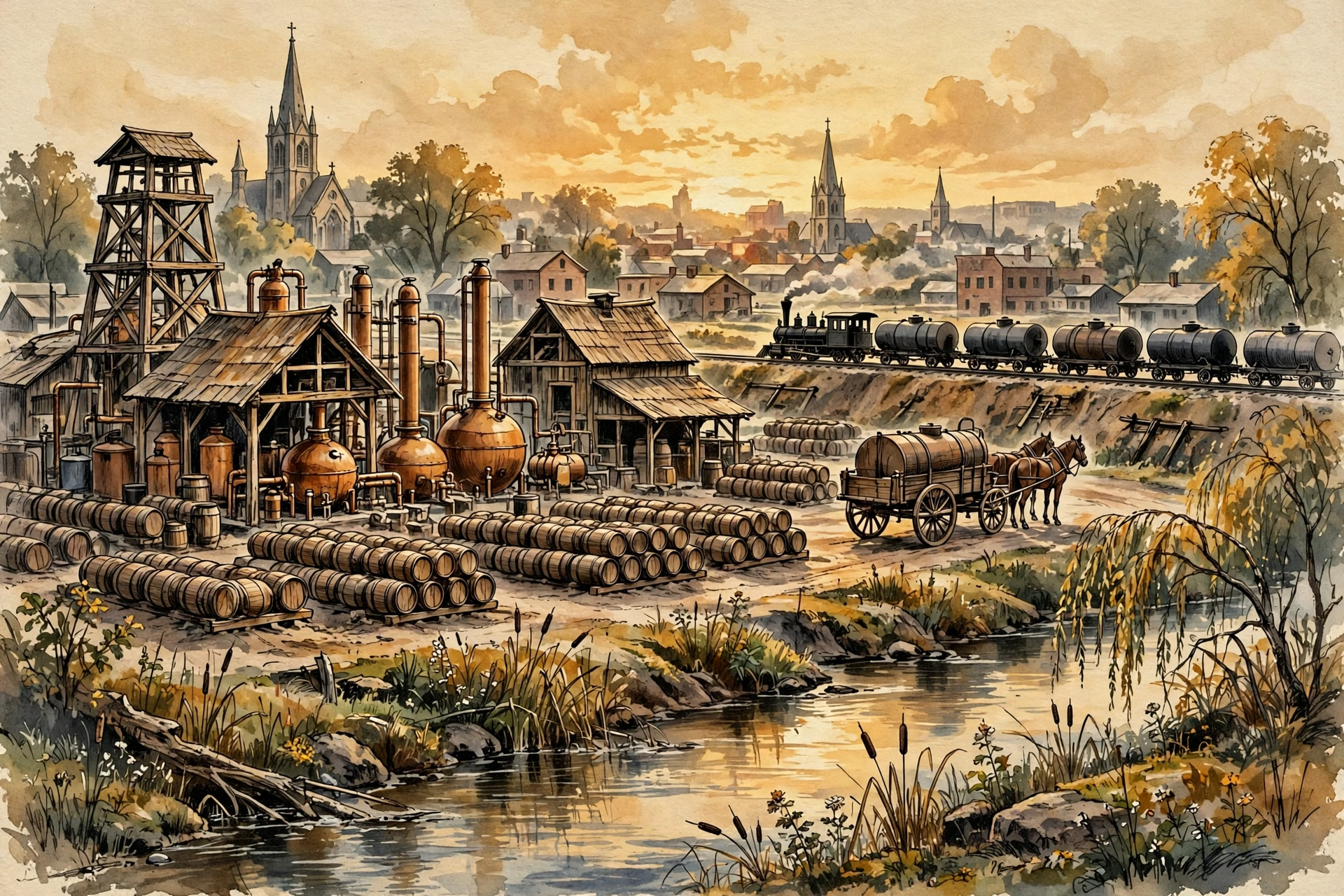
The founding moment
January 10, 1870, Cleveland, Ohio. The partnership of Rockefeller, Andrews & Flagler dissolved itself and re-emerged the same day as the Standard Oil Company — a joint-stock corporation capitalized at $1 million, divided into 10,000 shares that were never offered to the public. John D. Rockefeller, 30 years old, took 2,667 of them. The point of the corporate form was stated plainly in the record: stock existed so Standard could pay for other refineries with paper instead of cash, while control stayed in the founders' hands (EBSCO's research record of the incorporation; the share split is in Ida Tarbell's History of the Standard Oil Company, 1904, built from sworn testimony).
Cleveland was the right ground. By 1870 it was America's largest refining center — some 26 refineries along Kingsbury Run and the Cuyahoga, shipping about 1.46 million barrels of refined oil in 1870, up from 776,356 in 1868 (Tarbell, from the trade record). It was also a trap: national refining capacity ran at roughly three barrels for every barrel the market could absorb, and refined oil had collapsed from about 58 cents a gallon in 1865 to about 26 cents in 1870. Most Cleveland refiners were losing money. Standard was incorporated into an industry already overbuilt — which is precisely why it could be bought. And the name was a claim: "Standard" advertised a standard grade of kerosene, in a decade when lamp oil quality varied so wildly that lamps exploded.
The founders and the founding capital
The signature number is $1 million — the capitalization of January 10, 1870. In 2026 dollars that is roughly $25.7 million (BLS CPI deflator, ESTIMATED). It was not raised from strangers. It was the partners' own accumulated refining business, converted into shares: Rockefeller 2,667; Stephen V. Harkness, the silent money partner, 1,334; William Rockefeller, Samuel Andrews and Henry M. Flagler 1,333 each; Oliver B. Jennings 1,000; and the old firm itself 1,000. Eighteen months later, on January 1, 1872, the board raised the capitalization to $2.5 million — authorizing the stock that would fund the Cleveland acquisitions weeks later.
The road to that million started with $4,000. In 1863, Samuel Andrews — an English-born lamp-oil maker who had devised a better sulphuric-acid refining process — asked the produce firm of Clark & Rockefeller to back a refinery. They put in $4,000 and promised more (Tarbell's account). The Excelsior Works on Kingsbury Run grew until the partners had $100,000 or more in it. In February 1865 the partnership was auctioned between the Clarks and Rockefeller; Rockefeller won at about $72,500, sold his produce interests, and went all-in on oil. He later called that auction the day his life's path was decided — as he told it in his own Random Reminiscences (1909).
Each founder was a function. Andrews was the process — his kerosene yields beat the trade's. Flagler, who joined in 1867 bringing $100,000 of Harkness family money, was the dealmaker and railroad negotiator. William Rockefeller ran New York. Harkness was patient capital that never spoke in public. And John D. Rockefeller — bookkeeper by training, produce merchant from 19 — was the ledger: he knew his costs per barrel, per gallon and per mile when most refiners knew only their hopes. Chemist, negotiator, exporter, silent capital, and an accountant with absolute cost visibility.
The machine
The machine had four moving parts, and none of them was drilling for oil. Standard's share of crude production was only about 11% even in 1911. The machine sat in the middle of the river — refining, transport and distribution — and taxed everything that flowed through it.
Part one: buy the bottleneck in a bust, with stock. In February and March 1872 — the six weeks remembered as the Cleveland Massacre — Standard absorbed 22 of Cleveland's 26 refineries by the most common count (the sworn-testimony record supports 21 to 23). Sellers were offered Standard stock or cash, at Standard's appraisal, and Rockefeller advised them to take the stock. Those who did became rich; the advice was also the mechanism — acquisitions paid in paper enlarged the combination without draining its cash. The context was the South Improvement Company, a secret 1871 railroad pact giving members rebates on their own shipments and "drawbacks" — a cut of the higher rates charged to outsiders. The pact leaked, producers embargoed, Pennsylvania revoked its charter in April 1872, and no oil ever moved under it. But by then Cleveland had already sold, having seen the rates it would face outside. The threat did the work the contract never had to.
Part two: make transport a cost weapon, then own it. As the largest shipper, Standard negotiated railroad rebates — a practice the Hepburn Committee's 1879 investigation found general among large shippers, and which Standard carried furthest. Then it removed the railroads' leverage altogether by building pipelines: United Pipe Lines gathered crude in the oil regions, and by 1879 the long-distance trunk lines to the seaboard made Standard the one refiner no railroad could hold up. Whoever owns the pipe sets the toll.
Part three: run the refineries at a scale nobody else could match. The combination concentrated production into a few giant plants. Alfred Chandler's account in Scale and Scope puts the unit cost of refining at 2.5 cents a gallon in 1879, 0.5 cents in 1884 and 0.4 cents in 1885 — a fivefold cut in six years. The market saw the result in the price of light: kerosene fell from about 26 cents a gallon in 1870 to about 9 cents in 1880 and about 7 cents in 1890, while Standard's refining share rose from under a tenth to roughly 90%. Low price was not the opposite of the monopoly's profit. It was the moat around it — any rival had to match a cost structure built on 90% of the nation's throughput.
Part four: invent the holding structure to run it all. State law barred an Ohio corporation from holding stock in other states' companies, so on January 2, 1882, 41 investors signed the Standard Oil Trust Agreement: some 40 companies pooled under nine trustees, the trust valued at $70 million — the first great American trust, and the legal technology that let one management run refineries, pipelines, tank cars and marketing in a dozen states as a single firm. Ohio's courts dissolved it in 1892; the partners re-assembled the same control inside Standard Oil of New Jersey in 1899. The form kept changing. The control never lapsed.
The machine's output, in its own ledger: from 1882 to 1906 the combination earned $838.8 million and paid out $548.4 million in dividends — a 65.4% payout ratio (Hidy & Hidy's history of Jersey Standard; the federal Commissioner of Corporations' contemporary audit put earnings at "at least $790 million" — the two records bracket the same enormous fact). The retained third built the pipelines and plants. In modern terms: a midstream toll business at the lowest unit cost in its industry, distributing two-thirds of earnings and compounding the rest into more bottleneck.
The numbers
- Founding capital: $1,000,000 — capitalization of the Standard Oil Company (Ohio), January 10, 1870, in 10,000 shares; John D. Rockefeller held 2,667 (Tarbell, from sworn testimony; EBSCO research record). Roughly $25.7 million in 2026 dollars (BLS CPI, ESTIMATED). Prehistory: $4,000 put into Andrews's first refinery in 1863 (Tarbell).
- First scale marker: about 1,500 barrels a day of refining capacity in 1870 — the largest firm in Cleveland, and roughly 4–10% of U.S. refining capacity, depending on whether nameplate or running capacity is counted (Flagler's sworn Hepburn testimony; EBSCO record).
- Peak share: 90–95% of U.S. refining by 1879 (the scholarly record, from Montague's Rise and Progress to Chandler); in 1904 the federal study credited Standard with 91% of production and 85% of final sales. By the 1911 breakup the refining share had eroded to about 64%, against at least 147 competing refiners.
- Earnings at peak form: $838.8 million of net earnings, 1882–1906, with $548.4 million paid in dividends (Hidy & Hidy; bracketed by the Commissioner of Corporations' 1907 report).
- Peak value: the 34 successor companies were worth a combined roughly $600 million at the end of 1911 — roughly $20 billion in 2026 dollars (BLS CPI, ESTIMATED) — and about $2.9 billion a decade later, after paying $920 million in dividends in the interval (the New York Times' 1921 review of the breakup companies). Era-relative scale: Rockefeller's personal fortune was estimated at $900 million in 1913, about 2.3% of U.S. GDP — the same share of today's economy would be measured in the hundreds of billions.
- Peak headcount: about 60,000 employees (1909, company record as compiled in the standard references).
The near-death moment
Standard's near-death was a war with its own railroad, and it began on March 18, 1877. The Pennsylvania Railroad — then arguably America's most powerful corporation — had decided carrying oil was not enough: through its Empire Transportation Company it owned pipelines, tank cars and refineries with capacity Tarbell put at nearly half the world's consumption, and it set out to refine in Standard's territory. Standard answered by withdrawing all its freight from the Pennsylvania, diverting shipments to the New York Central and the Erie, and idling its Pittsburgh refineries to starve the road of traffic.
For five months it was genuinely in doubt. The Pennsylvania carried oil below cost and ordered Empire's refineries to sell into Standard's markets. What broke the deadlock was not strategy but catastrophe: in July 1877 the Great Railroad Strike reached Pittsburgh, riots burned railroad property across the city, and the Pennsylvania — which had cut wages to fund the rate war — lost millions, saw its stock fall to $27 against a $50 par, and passed its dividend for the first time in its history (Tarbell's account, from the Hepburn record). Tom Scott, the Pennsylvania's president, could no longer afford his oil company. On October 17, 1877, Empire Transportation — pipelines, tank cars, refineries — was sold to Standard.
Read it coldly: the challenger did not lose because its plan was wrong. It lost because its balance sheet and its labor relations broke in the same summer, while Standard's coffers, in Tarbell's phrase, were "literally bursting with profits" from a winter in which it had held refined prices up for nearly six months. Standard survived its most dangerous competitor because it entered the war liquid and its enemy entered it leveraged to a railroad's wage bill. That is a financing lesson wearing a history costume.
The autopsy
Cause of death: the state, on May 15, 1911 — but the certificate names the wrong culprit if it stops there. In Standard Oil Co. of New Jersey v. United States, the Supreme Court held the combination an "unreasonable" restraint of trade under the Sherman Act and gave it six months to dissolve into 34 independent companies. The legal death was real. The economic monopoly was already dying on its own: refining share had fallen from roughly 90% (1880) to about 70% (1906, when the federal suit was filed) to about 64% (1911), as Gulf, Texaco, Sun, Pure and Shell organized themselves as vertically integrated oil companies — using the industry structure Standard itself had pioneered — around new fields in Texas, Oklahoma and California that Standard's eastern pipeline system did not control. Ida Tarbell's History (1902–1904) had made the political case; the Bureau of Corporations made the evidentiary one; the market was quietly making a third.
And the punishment enriched the punished. Shareholders received pro-rata stakes in all 34 companies, so Rockefeller kept roughly a quarter of everything. The pieces, separately priced, proved worth more than the whole: roughly $600 million combined at the end of 1911 became about $2.9 billion within a decade, plus $920 million of dividends. Rockefeller's fortune reached an estimated $900 million by 1913; on September 28, 1916 he became America's first billionaire. The largest pieces never left the business of scale: Standard of New Jersey became Exxon, Standard of New York became Mobil — merged in 1999 as ExxonMobil — Standard of California is Chevron, and Amoco and Sohio sit inside BP. The trust died. Its machine became the template every surviving oil major still runs.
The operator's take
- Own the middle of the river. Standard never needed to own the wells (11% of production in 1911) or the lamps. It owned refining and transport — the narrow point every barrel had to pass — and set its economics there. In any value chain, find the step that is capacity-constrained, quality-sensitive and unavoidable, and be the lowest-cost operator at exactly that step.
- Stock is a consolidation currency; cash is a lifeline. Cleveland was bought mostly with paper, on Standard's appraisal, from sellers who were told — correctly — that the paper would be worth more than their plants. The combination kept its cash, and its cash is what let it outlast the Pennsylvania Railroad in 1877. Acquire with equity when you can; the liquidity you preserve is the weapon you fight the real war with.
- Cost leadership is the only durable answer to monopoly charges — and it still was not enough. Kerosene fell from 26 cents to 7 cents on Standard's watch, and the trust was dissolved anyway, because the methods — secret rebates, drawbacks, coerced sales — were documented in sworn testimony for forty years. The conduct record outlives the price record. An operator's true legacy file is the one investigators will read.
The myth ledger
- "Rockefeller started Standard Oil from nothing with a few hundred dollars." — LEGEND. The $1 million capitalization of 1870 stood on seven years of refining: $4,000 into Andrews's works in 1863, a $72,500 partnership buyout in 1865, and Cleveland's largest refinery by 1870.
- "The South Improvement Company scheme is how he seized the industry." — EMBELLISHED. The rebate-and-drawback contracts are DOCUMENTED, and the fear of them helped force the Cleveland sales of 1872. But the charter was revoked in April 1872 and no oil ever shipped under the scheme — the threat consolidated Cleveland; Standard's costs and pipelines did the rest, over decades.
- "Standard controlled 100% of American oil." — EMBELLISHED. Peak refining share was 90–95% (1879–1880s), it never monopolized crude production (about 11% in 1911), and its refining share had fallen to about 64% by the breakup, against 147-plus rivals.
- "The monopoly raised prices on a helpless public." — CONTESTED. Kerosene fell from about 58 cents a gallon (1865) to 26 cents (1870), 9 cents (1880) and about 7 cents (1890) as Standard's share rose — the efficiency record is real. So is the documented record of local price discrimination: high where unopposed, low where contested, as the federal investigations detailed. Both ledgers are true; quoting only one is advocacy.
- "The 1911 breakup destroyed Rockefeller." — LEGEND. It made him the world's richest man: he kept about a quarter of all 34 successors, their combined value roughly quintupled in a decade, and he became America's first billionaire in 1916.
- "He bought his rivals fairly, at full value, every time." — CONTESTED. Sellers took Standard's appraisal under the shadow of railroad rates they could not match, and Tarbell's sworn-testimony record is full of refiners who called it coercion. That many sellers who took stock ended rich is also documented. The ledger prints both.
Sources: Ida M. Tarbell, The History of the Standard Oil Company (1904) — the incorporation and share split, the $4,000 Andrews investment, Cleveland's refining shipments, the South Improvement contracts, the 1877 Empire war and the Pennsylvania's collapse, all built from sworn testimony including the Hepburn Committee record (1879); EBSCO Research Starters, "Standard Oil Company is Incorporated" — January 10, 1870, the $1 million capitalization, the January 1, 1872 increase to $2.5 million; John D. Rockefeller, Random Reminiscences of Men and Events (1909) — the 1865 buyout as he told it; Ron Chernow, Titan: The Life of John D. Rockefeller, Sr. (1998) — the standard modern biography; Alfred D. Chandler Jr., Scale and Scope (1990) and Harvard Business Review (1990) — refining unit costs 1879–1885 and the three-refinery concentration; Ralph W. and Muriel E. Hidy, Pioneering in Big Business: History of Standard Oil Company (New Jersey), 1882–1911 (1955) — net earnings of $838.8 million and dividends of $548.4 million, 1882–1906; Report of the Commissioner of Corporations on the Petroleum Industry (1907) — the federal audit bracketing earnings and dividends, and the 1904 share figures; Standard Oil Co. of New Jersey v. United States, 221 U.S. 1 (1911) — the dissolution into 34 companies; the New York Times' 1921 review of the successor companies — combined value of roughly $600 million at the end of 1911, about $2.9 billion a decade later, $920 million of dividends paid in the interval; Gilbert H. Montague, The Rise and Progress of the Standard Oil Company (1903) — the 90–95% refining share by 1878–1879. Inflation conversions are ESTIMATED using the BLS CPI deflator. This is essay #4 of the Top 500 Companies Ever, a pleitez.ai series. Written by the Emanuel Pleitez AI team.
What next?
Pick one — every road from here is short.
Prefer a human?
Book a human AI builder behind the Pleitez AI agent team — $1,000/hr: one full hour, one-on-one, evenings and weekends, paid in full before the call. That could be Emanuel, or someone of his caliber or better.
Book a human AI builder