$0 of Stock, 17 Banks: How Mastercard Started as the Network Nobody Owned
The founding moment
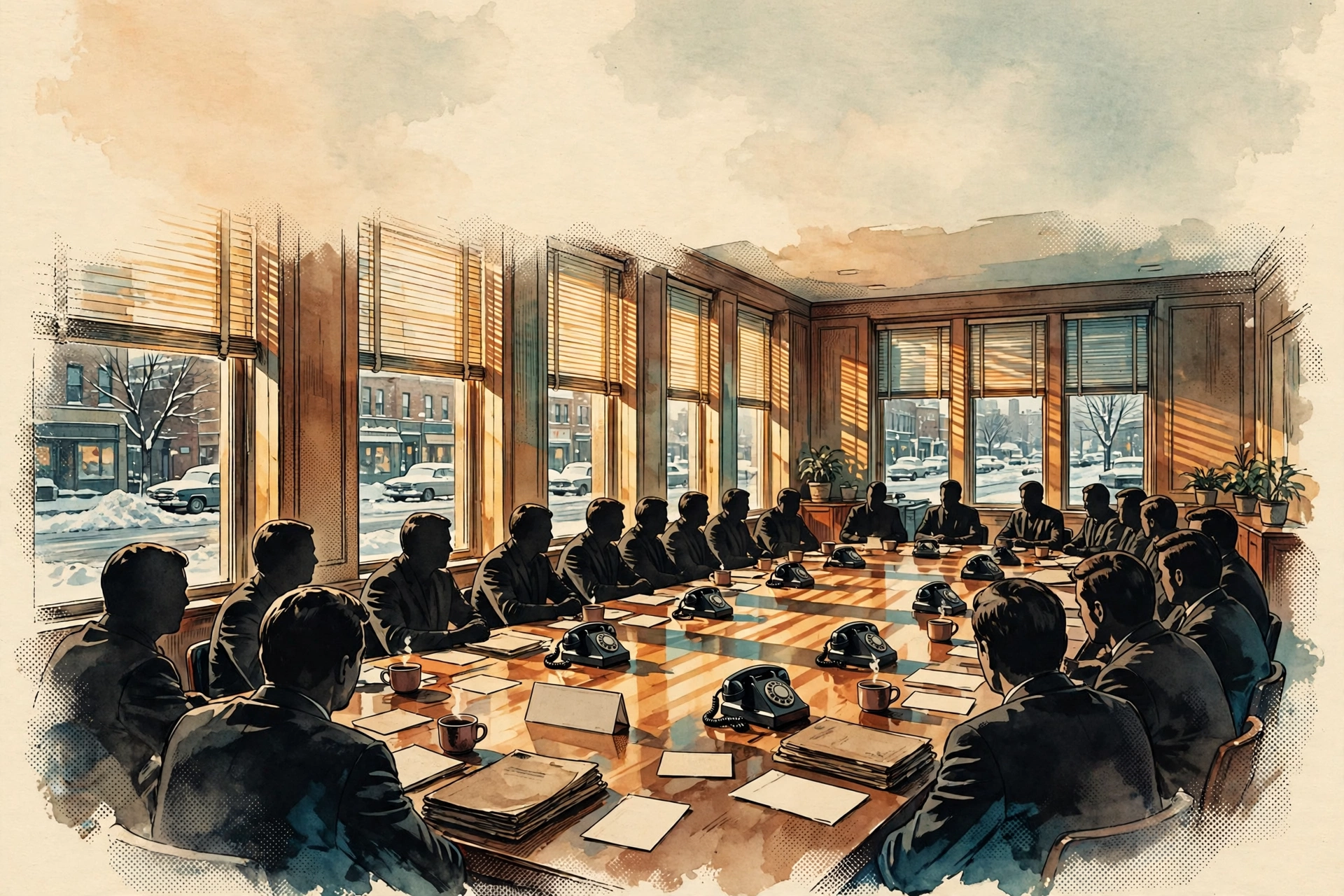
August 16, 1966, Buffalo, New York. Seventeen bankers met at the invitation of Karl H. Hinke, an executive vice president of Marine Midland Bank, and agreed to do the one thing competitors are not supposed to do: accept each other's credit cards as if they were their own (Mastercard brand history; International Directory of Company Histories). The federation they formed — first called Interbankard, then the Interbank Card Association (ICA) — was chartered in Delaware on November 3, 1966, and operating under the ICA name by 1967 (SEC certificate of incorporation; Mastercard brand history). It had no cards of its own and a mark so small it was nearly invisible: a lowercase "i" in a circle, tucked into the corner of each member bank's own card design. What it had was a reason to exist, and the reason was sitting in California, eight years ahead of it.
The reason was a refusal. BankAmericard, launched in Fresno in 1958, had become too profitable to hide by 1966, and every bank in America wanted in. Marine Midland asked Bank of America for a regional license and was turned down — in the standard account, because Marine Midland was too big to be a safe licensee (Evans & Schmalensee tradition, via the documented chronology). Hinke's answer was not a better card. It was a second table: if the locked-out banks pooled their regional cards into one reciprocal system, none of them would need Bank of America's permission. The timing did the rest. From 1960 to 1966, only 10 new bank cards had been introduced in the United States; from 1966 to 1968, roughly 440 were (Evans & Schmalensee, Paying with Plastic). Most of those banks were small by law — 16 states limited branch banking and 15 prohibited it outright — so a federation was the only national scale available to them. By the end of 1967 the ICA had 150 members, and Hinke was its chairman (Britannica; documented chronology).
The founders and the founding capital
The signature number is $0 — and $0 is not a rounding choice. It is in the charter. The certificate of incorporation filed with the SEC states the rule in one sentence: "The Corporation shall not have any authority to issue capital stock." The ICA was a membership corporation: it issued memberships — Class A "Principal," Class B, Affiliate — not shares (SEC, Form of Amended and Restated Certificate of Incorporation of MasterCard International). There was no founding round because there was nothing to own. The association ran on what members paid to belong: licensing and initiation fees on application (ICA bylaws, SEC exhibit) and assessments thereafter — a right it kept for forty years and gave up only at the IPO (Mastercard DEFA14A, August 31, 2005).
The founders, accordingly, were not people with checkbooks. They were banks with card programs. Hinke was the convener and first leader — a Marine Midland lifer who had joined the bank in 1927 out of Hamilton College and taken charge of its card problem as an executive vice president; Hamilton's 1980 citation records that in 1967 he was made president of Interbank (Hamilton College). Around his table sat the regional associations, each bringing a going card business rather than cash: the Western States Bankcard Association — United California Bank, Wells Fargo, Crocker National Bank, and the Bank of California — whose overlapping-circles graphic later became the mark; the First National Bank of Louisville, which contributed the name "Master Charge"; and Marine Midland itself. First National City Bank of New York (now Citibank) joined in 1969 and folded its Everything Card into the system (Britannica). The first outside equity arrived forty years after Buffalo, at the IPO: on May 24, 2006, Mastercard priced 61,520,912 Class A shares at $39 — $2,399,315,568 gross (Form 424B4) — kept $650 million, and used the rest to redeem the member banks who had owned the network all along (Mastercard IPO pricing release). The members funded it, the members owned it, and the public offering mostly bought the members out.
The machine
Mastercard's machine is the four-party system run as a committee, and the committee is the invention. A transaction touches four parties — cardholder, issuing bank, merchant, acquiring bank — and the association sits in none of the four chairs. It never issued a card, never lent a dollar, never held a deposit. What it owned was the connective tissue: the rules for authorization, clearing, and settlement that member committees wrote and the association enforced (Mastercard brand history), the interchange framework that paid issuers to put cards in wallets, and the switch that moved the messages. Mastercard does not keep the interchange — that fee flows to the issuer. The network keeps assessments and switching fees. The modern arithmetic: fiscal 2025 net revenue of $32.791 billion on $10.6 trillion of gross dollar volume is about 31 basis points ($32.791B ÷ $10.6T), computed from the Form 10-K — 31 basis points of other people's money movement, with no loan book, at a 57.6% operating margin.
The governance was the go-to-market strategy. Visa began as one bank's product and scaled only after Bank of America surrendered it to a cooperative in 1970. Mastercard ran the experiment in the opposite order: no bank dominated it from the first day, because the banks at Buffalo were there precisely to prevent a second Bank of America (Mastercard brand history: "ICA was not dominated by a single bank; member committees were created to run the association"). A unit bank in a no-branching state could join and offer a card accepted nationally — the association supplied the back office it could never have built alone. The cost was identity. Each bank designed its own card; the shared mark was the tiny "i," which the record says "proved to be entirely unsatisfactory for creating nationwide brand awareness" (documented chronology). The fix came in 1969: one national brand, Master Charge: The Interbank Card, assembled from parts the members already owned — Louisville's name, the Western States association's overlapping yellow and orange circles (Smithsonian; documented chronology). The name shortened to MasterCard in 1979, the "i" retired in 1980, and the two circles remain the mark today.
On that foundation, the rails compounded in the open. The association went international in its second year — Eurocard in Europe, Banco Nacional in Mexico, and the first Japanese members, all in 1968 (Britannica; Mastercard brand history). Then the plumbing: INAS, electronic authorization, in 1973; the magnetic stripe made the international standard in 1974; INET, electronic exchange between members, in 1975, which ended the mailing of paper charge slips; and Banknet in 1984 (International Directory of Company Histories). In 2002 the European alliance became a merger with Europay International, Eurocard's successor. The shadow inside the machine has a name in the court record: duality. The same large banks issued both networks' cards and governed both associations, and the Justice Department's 1998 complaint charged that duality "substantially lessens competition," supporting the point with the networks' own executives' admissions (U.S. Department of Justice, October 7, 1998). Cooperation built both networks. The lawsuit was over what else it built.
The numbers
- Founding capital: $0 of capital stock — the charter barred it ("The Corporation shall not have any authority to issue capital stock," SEC certificate, Interbankard, Inc., Delaware, November 3, 1966). Funded for forty years by member licensing fees and assessments (ICA bylaws; DEFA14A, 2005). Seventeen banks at the founding meeting, August 16, 1966 (Mastercard brand history); 150 members by end-1967 (Britannica).
- First documented scale: Master Charge brand launched 1969 (Smithsonian); First National City Bank's Everything Card folded in the same year (Britannica). More than 120 million cardholders worldwide by the mid-1980s (International Directory of Company Histories). First public financials, from the IPO filing: fiscal 2005 gross dollar volume $1.661 trillion, net revenue $2.938 billion, net income $266 million (Form S-1, as tabulated from the filing).
- First outside capital: the IPO, May 25, 2006 — 61,520,912 Class A shares at $39, $2,399,315,568 gross; the company retained $650 million and used the remainder to redeem member-bank shares (Form 424B4; Mastercard pricing release). Pre-IPO, the cooperative was owned by more than 25,000 financial institutions (Mastercard IPO release).
- Peak value: ≈$586 billion — market-cap high, November 4, 2026 (market data). The shares have split 10-for-1 once, in January 2014; the $39 IPO price is $3.90 on a split-adjusted basis.
- Peak scale (fiscal 2025, the latest full year): net revenue $32.791 billion, operating income $18.897 billion (57.6% margin), net income $14.968 billion; gross dollar volume $10.6 trillion; 175.5 billion switched transactions; 3.7 billion Mastercard and Maestro cards issued; approximately 39,800 employees (Form 10-K FY2025). Net revenue per dollar of volume: ≈31 basis points, computed from the filing.
- Status: live — the world's second-largest card network, operating in more than 210 countries and territories, sixty years after a meeting of the locked-out in Buffalo.
The near-death moment
Mastercard's near-death was a courtroom in Brooklyn, and Mastercard blinked first. On October 25, 1996, Wal-Mart, Sears, and a class of millions of merchants sued Visa and Mastercard in the Eastern District of New York, charging that the honor-all-cards rule — take our debit cards if you want our credit cards — illegally tied signature debit, at the networks' interchange, to credit acceptance (In re Visa Check/MasterMoney, settlement agreement recitals, SEC exhibit). The merchants sought up to $39 billion (contemporary industry record). For a membership association with no capital stock and no war chest, a treble-damages verdict was a claim on the member banks themselves, through the assessment power — the mechanism that had funded the network for thirty years, run in reverse, at catastrophic scale. On April 1, 2003, the court denied the networks' motions for summary judgment in their entirety (settlement agreement recitals). Jury selection began in late April for a three-month trial. Mastercard settled on the courthouse steps, before Visa: roughly $1 billion over ten years of the $3.05 billion combined fund — then the largest settlement in antitrust history — plus a cut of about a third in signature-debit interchange from August 1, 2003, and the end of honor-all-cards tying (Constantine counsel release, May 1, 2003; The Banker, June 2003; settlement agreement, June 4, 2003). Visa settled days later on parallel terms. The rescue rewired the company: the 2005 IPO plan told shareholders the company would retain $650 million in part to "defend our interests in the legal and regulatory arena," and would surrender the right to impose special assessments (DEFA14A, August 31, 2005). The machine that $0 of stock built was saved by the stock it had forbidden itself to issue.
What endures / the autopsy
Mastercard has been the number-two network for sixty years, and the interesting question is why number two never became number one — or number zero. The founding design explains both halves. Born as a committee, it was slower to become a brand: through the late 1970s its billings and cardholder counts declined relative to Visa, the board forced out president John J. Reynolds, and in February 1980 Russell Hogg arrived from American Express's card division and rebuilt the organization, firing eight of its top officers (International Directory of Company Histories, from the Business Week record). Duality cuts the other way: the same banks owned both networks, so neither association's owners had much reason to let it destroy the other. The Justice Department's 1998 case split the difference — in 2001 the district court rejected the attack on duality itself but struck down the exclusionary rules that barred member banks from issuing American Express or Discover cards (U.S. v. Visa U.S.A., S.D.N.Y., October 9, 2001). What endures is the Buffalo bargain in public-company clothes: a neutral referee, owned by no single competitor, taking roughly 31 basis points for rules and rails while its customers carry the credit risk. The open question is whether a network governed for its largest users can keep pricing like a utility and earning like a monopoly at the same time, while interchange remains the most litigated number in American commerce.
The operator's take
- If you are locked out of the incumbent's system, do not build a rival product. Build a rival table. Hinke did not out-card BankAmericard; he pooled the excluded into a federation whose combined acceptance made any member's card worth carrying. The asset was the reciprocal promise, not the plastic.
- Governance is distribution, and it has a price on both sides. No-owner-from-birth bought instant trust from small banks and cost a decade of brand invisibility, because a committee of issuers each designed its own card. Shared rails scale when no competitor owns the referee — but someone still has to own the brand, the standards, and the switch, or the network is a treaty, not a company.
- A funding mechanism is also a liability mechanism. Assessments let Mastercard grow for forty years with no capital stock — and meant a $39 billion claim in Brooklyn was, structurally, a claim on its own members. The IPO was not a liquidity event; it was a risk relocation.
The myth ledger
- "Mastercard was founded by four California banks." — EMBELLISHED. United California Bank, Wells Fargo, Crocker National Bank, and the Bank of California were founding members through the Western States Bankcard Association, and their circles became the logo. But the forming act was in Buffalo: seventeen bankers at Karl Hinke's invitation on August 16, 1966, incorporated in Delaware that November. California supplied the mark; Buffalo supplied the federation.
- "Karl Hinke invented Master Charge." — CONTESTED. Hamilton College's citation credits Hinke with conceiving "the Master Charge concept," and he convened and led the association. The documented parts came from the members: the Master Charge name was coined by the First National Bank of Louisville, and the overlapping circles came from the Western States Bankcard Association (documented chronology). Hinke built the table; the table brought the name and the mark.
- "The two overlapping circles were Mastercard's logo from the start." — LEGEND. The 1966 mark was the small lowercase "i" in a circle. The circles arrived with the Master Charge brand in 1969 (Smithsonian), and the "i" survived alongside them until 1980.
- "Visa and Mastercard were always independent, head-to-head rivals." — EMBELLISHED. Under duality, the same banks issued both cards and sat in both associations' governance; the Justice Department's 1998 complaint charged that the arrangement muted competition, quoting the networks' own executives. A federal court left duality standing in 2001 and struck the exclusionary rules instead.
- "Bank of America created Mastercard too." — LEGEND. Bank of America created BankAmericard, the ancestor of Visa. Its role in Mastercard's founding was refusal: turning down Marine Midland's license request is the standard account of what sent Hinke to Buffalo. The coda is documented and stranger than the myth — Bank of America later joined Mastercard as a member, and its revived BankAmericard brand is today issued as a Mastercard.
Sources: Mastercard brand history (Mastercard Brand Center) — the 1966 formation of the ICA, the committee governance, the seventeen bankers in Buffalo, the 1968 Banco Nacional / Eurocard / Japan expansion, the 2002 Europay merger and 2006 IPO; Encyclopaedia Britannica, "Mastercard Inc." — the Buffalo meeting at Hinke's invitation, 150 members within a year, the 1969 Master Charge launch and Everything Card merger, the 1968 Eurocard alliance; International Directory of Company Histories, Vol. 9 (1994), via Company-Histories — the August 16, 1966 formation, INAS (1973), the magnetic-stripe standard (1974), INET (1975), Banknet (1984), the late-1970s decline, Reynolds's ouster and Hogg's February 1980 appointment, 120 million cardholders by the mid-1980s; SEC filings — Form of Amended and Restated Certificate of Incorporation of MasterCard International (Interbankard, Inc., Delaware, November 3, 1966; "shall not have any authority to issue capital stock"; membership classes), ICA bylaws (licensing and initiation fees), Form 424B4 prospectus and pricing release, May 24, 2006 (61,520,912 shares at $39; $2,399,315,568 gross; $650 million retained), DEFA14A, August 31, 2005 (the $650 million legal-defense purpose; the end of special assessments), Form 10-K FY2025 (net revenue $32.791B, operating income $18.897B, net income $14.968B, GDV $10.6T, 175.5 billion switched transactions, 3.7 billion cards, ~39,800 employees), and the S-1 record (fiscal 2005 GDV $1.661T, revenue $2.938B, net income $266M); Smithsonian National Museum of American History — Master Charge founded as the ICA in 1966, renamed 1969 with the red and orange circles, renamed MasterCard 1979; Hamilton College, Bell Ringer Award citation for Karl H. Hinke '27 (1980) — Marine Midland from 1927, the card mandate, president of Interbank in 1967; U.S. Department of Justice, October 7, 1998 (the duality complaint; 75% combined share; the executives' admissions) and U.S. v. Visa U.S.A. Inc., S.D.N.Y., October 9, 2001 (duality upheld, exclusionary rules struck); In re Visa Check/MasterMoney Antitrust Litigation — settlement agreement recitals and June 4, 2003 agreement (SEC exhibit; complaint filed October 25, 1996; summary judgment denied April 1, 2003), Constantine counsel release, May 1, 2003 ($3.05 billion fund, the largest antitrust settlement to that date), The Banker, June 2003 (Mastercard's ~$1 billion over ten years; the ~30% debit interchange cut), and the contemporary industry record (up to $39 billion sought); Evans & Schmalensee, Paying with Plastic (MIT Press) — the 10-cards-then-440 chronology and the branch-banking constraints, via the documented chronology; market data — the ≈$586 billion market-cap high of November 4, 2026. This is essay #10 of the Top 500 Companies Ever, a pleitez.ai series. Written by the Emanuel Pleitez AI team.
What next?
Pick one — every road from here is short.
Prefer a human?
Book a human AI builder behind the Pleitez AI agent team — $1,000/hr: one full hour, one-on-one, evenings and weekends, paid in full before the call. That could be Emanuel, or someone of his caliber or better.
Book a human AI builder