$2,300 for the Formula, $1 for the Bottling Rights: How Coca-Cola Started
The founding moment
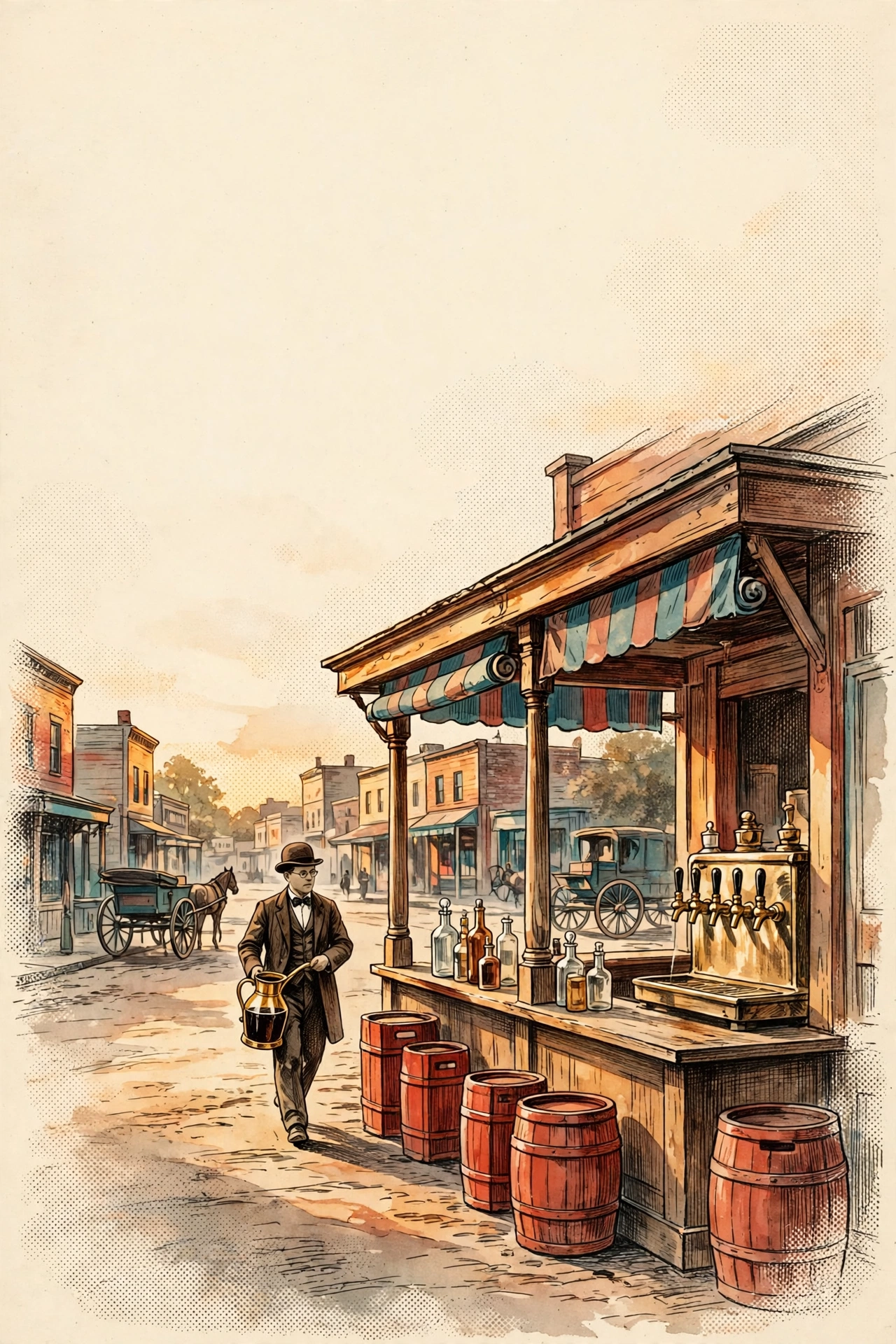
May 8, 1886, Jacobs' Pharmacy, Atlanta, Georgia. John Stith Pemberton, a pharmacist and Confederate veteran, carried a jug of dark syrup down the street to Jacobs' Pharmacy, where it was mixed with carbonated water at the soda fountain, pronounced "excellent," and placed on sale at five cents a glass (The Coca-Cola Company's own history; the Library of Congress carries the same date as the first serving). The drink was not Pemberton's first product. In 1885 he had introduced Pemberton's French Wine Coca, an alcoholic nerve tonic modeled on Europe's coca wines (Library of Congress, This Month in Business History). When Atlanta and Fulton County passed prohibition legislation in 1886, the wine had to go — Coca-Cola was the non-alcoholic answer, sold from the start as a temperance drink and a tonic for headaches and exhaustion.
The first year was a rounding error. Sales averaged nine drinks a day in year one (company history). Pemberton's partner and bookkeeper, Frank M. Robinson, supplied the two assets that outlasted the inventor: the name — Coca-Cola, for its coca-leaf and kola-nut ingredients — and the flowing Spencerian script, still the trademark, registered with the U.S. Patent Office on January 31, 1893. Pemberton, in poor health and addicted to the morphine he had first taken for a war wound, began selling pieces of the business almost immediately. He died on August 16, 1888, two years after the first glass, having sold rights to several parties — a fragmented ownership that the buyer who mattered spent three years cleaning up.
The founders and the founding capital
The signature number is $2,300 — the total cash outlay that bought the whole business. By 1891, Asa Griggs Candler, another Atlanta pharmacist and a successful patent-medicine manufacturer, had secured complete ownership of the Coca-Cola business for a total cash outlay of $2,300 and the exchange of some proprietary rights (Encyclopaedia Britannica, history of the Coca-Cola Company). In 2026 dollars that is roughly $85,000 (ESTIMATED, BLS CPI basis) — the price of a delivery truck, for what became the most valuable beverage trademark on earth. Candler incorporated The Coca-Cola Company in Georgia the following year, 1892, capitalized at $100,000 (Britannica) — roughly $3.6 million in 2026 dollars, ESTIMATED on the same basis. The essay prints both numbers because they are different kinds of capital: $2,300 is what the idea cost; $100,000 is what the company started with.
The two founders divide the credit the way the record divides it. Pemberton invented the product and proved almost nothing about selling it — nine drinks a day, and a rights structure so tangled that claimants were still surfacing decades later (in 1914, a co-owner of the original 1888 company came forward claiming her signature on the bill of sale had been forged; the dispute is part of the court and company record). Candler invented the business. He repositioned the drink from medicine to refreshment, gave syrup away to drugstores to seed fountains, flooded the region with free-drink coupons redeemable at those fountains, and spent on advertising at a scale patent-medicine men understood and soda men did not — by 1895 he could report Coca-Cola sold in every state and territory in the Union. The formula was Pemberton's. The machine was Candler's.
The machine
The machine is a contract: own the syrup, the secret, and the trademark — let other people own everything expensive. Coca-Cola's scaling system has three moving parts, and all three were in place by 1900.
Part one: sell concentrate, not beverages. A gallon of syrup is light, shelf-stable, and carries almost the entire value of the finished drink; the water, sugar, bottles, trucks, and local sales forces belong to somebody else. The financial signature is still visible in the modern filing: in fiscal 2025, concentrate operations were 59% of net operating revenues, and the company's gross margin was 61.6% on $47.941 billion of revenue — a margin structure no bottler has ever touched (Form 10-K FY2025). Syrup volume tells the early story in one line: 35,360 gallons in 1892 to 370,877 gallons in 1900, a tenfold rise in eight years (Kemp, God's Capitalist, via the Candler biographical record). The 1896 annual report — quoted a century later in Warren Buffett's 1996 shareholder letter — already shows the blueprint complete: sales of $148,000 on 116,492 gallons, and Candler announcing, in Buffett's summary, that the company had "not lagged in our efforts to go into all the world."
Part two: the bottling contract of July 21, 1899 — the original platform deal, priced at $1. Candler believed in fountains and doubted bottles. Two Chattanooga lawyers, Benjamin F. Thomas and Joseph B. Whitehead, disagreed, and on July 21, 1899 they signed a contract granting them the exclusive right to bottle and sell Coca-Cola across the United States except six New England states, Mississippi, and Texas (the contract as recited in Coca-Cola Bottling Co. v. Coca-Cola Co., 769 F. Supp. 671, D. Del. 1991). The consideration was a nominal $1 — a dollar Candler reportedly never collected, a point the myth ledger below verdicts carefully. The first commercial bottling had already happened without him: Joseph Biedenharn bottled Coca-Cola in Vicksburg, Mississippi, on March 12, 1894, to serve rural customers who had no fountain. Thomas and Whitehead subdivided their territory and licensed sub-bottlers — "parent bottlers," in the court record's term — who raised the local capital, built the plants, and put Coke within reach of every crossroads store in America. Coca-Cola got national physical distribution without spending national physical capital. It is the same trade Visa's bank-owners and McDonald's franchisees later made, written thirty years earlier: the center keeps the brand and the formula; the edge keeps the buildings and the risk.
Part three: the price of that trade was written into the same contract, in perpetuity. The 1899 contract obligated the company to sell the bottlers their syrup at a fixed price — amended to $1.00 per gallon, less a 10-cent rebate for labels and advertising matter (769 F. Supp. 671) — and it had no fixed duration. Bottles were to retail at five cents, and between the fixed syrup price and the nickel bottle, Coca-Cola's price to the drinker stayed at five cents from 1886 to 1959. Candler had sold the distribution system of the century for a dollar, and mortgaged the company's pricing power for sixty years to pay for it. Both halves of that sentence are the machine.
The numbers
- Founding capital, two figures, both sourced: $2,300 total cash outlay for complete ownership by 1891 (Britannica) — ≈$85,000 in 2026 dollars, ESTIMATED; and $100,000 capitalization at incorporation in 1892 (Britannica) — ≈$3.6 million in 2026 dollars, ESTIMATED.
- First documented revenue markers: nine drinks a day at five cents in the first year, 1886 (company history; Library of Congress). First full financial marker in the standard record: 1896 sales of $148,000 on 116,492 gallons of syrup (Coca-Cola's 1896 annual report, as quoted in Berkshire Hathaway's 1996 shareholder letter). Syrup volume: 35,360 gallons (1892) → 370,877 gallons (1900) (Kemp, God's Capitalist).
- The 1919 repricing: on September 12, 1919, the Candler family sold the company to a group led by Ernest Woodruff's Trust Company of Georgia for $25 million (Britannica; company record) — ≈$465 million in 2026 dollars, ESTIMATED — and the company offered 500,000 shares to the public at $40 a share.
- Peak scale (latest full filing): fiscal 2025 net operating revenues of $47.941 billion, operating income of $13.762 billion, net income attributable to shareowners of $13.107 billion, gross margin 61.6%, approximately 65,900 employees at December 31, 2025 — and more than 700,000 people across the company and its bottling partners combined; 33.8 billion unit cases sold in 2025, 84% of them outside the United States (Form 10-K FY2025).
- Peak value: market capitalization of roughly $428.5 billion on November 16, 2026 (market data) — the company's all-time high in the market-cap series carried in the dossier.
- Status: live — the world's largest non-alcoholic beverage company by revenue, selling in more than 200 countries and territories; the open question is sugar, not survival.
The near-death moment
Coca-Cola's near-death was not a product failure. It was the summer of 1920, when the $1 contract came due. The company the Woodruff group had just bought for $25 million was bound to sell syrup to its parent bottlers at a fixed price, in a contract with no end date — while its main ingredient whipsawed. Sugar spiked in the postwar shortage, then collapsed in the summer of 1920, leaving the company holding expensive sugar, a fixed selling price, and bottlers who refused to renegotiate. The federal court record states the sequence flatly: the company sought relief from the fixed-price contract and proposed a price that fluctuated with manufacturing cost; the parent bottlers refused; the company declared its contracts with the parent bottlers terminated as of May 1, 1920, and sued (769 F. Supp. 671, summarizing the 1920 litigation).
Consider what termination meant. The bottlers were not a channel Coca-Cola could replace; they were Coca-Cola in most of the country — the plants, the trucks, the store relationships. Declaring the contracts dead declared war on the company's own distribution system, eighteen months after going public. The litigation ended in the 1921 Consent Decrees, which settled the shape of the business for the rest of the century: the bottler contracts were perpetual, and syrup pricing was rebuilt on a formula indexed to the quarterly market price of sugar (the decrees as recited in Coca-Cola Bottling Co. v. Coca-Cola Co., 654 F. Supp. 1388, D. Del. 1986). President Samuel Dobbs — Candler's nephew, who had run the company into the fight — resigned in the crisis, and in 1923 Ernest Woodruff installed his son, Robert W. Woodruff, who ran Coca-Cola for the next three decades. The company survived its founding contract by litigating it into a truce. The lesson the decrees taught — never again sign away price, in perpetuity, for distribution — is one the company has now had a hundred years to remember, because the bottler relationship it created in 1899 is still, in its modern refranchised form, the business.
What endures
The concentrate model endures, almost unchanged in its economics. A company with 65,900 employees produces $47.941 billion of revenue — about $727,000 per employee — because the capital-intensive work sits on other companies' balance sheets, exactly as the 1899 contract arranged. What changed is ownership of the edge: after a century of buying bottlers in and refranchising them back out, the system's five largest bottling partners account for 44% of worldwide unit case volume (Form 10-K FY2025). The argument Candler started — who should own the trucks — is still the company's live strategic question, now run in both directions at once.
The other thing that endures is the attachment, and Coca-Cola measured it the hard way. On April 23, 1985, after nearly 200,000 blind taste tests preferred a sweeter formula, the company replaced the original Coke outright. Seventy-nine days later, on July 11, 1985, it brought the original back as Coca-Cola Classic, its president conceding that the research "could not measure or reveal the depth and abiding emotional attachment" to the original (company history). A syrup invented as a morphine substitute in 1886 had become, by 1985, something customers regarded as theirs. That is the asset the $2,300 actually bought — and it cannot be reformulated, which is precisely the point.
The operator's take
- Distribution you don't own is still distribution — price the option you are giving away. The $1 contract built Coca-Cola and capped its pricing for sixty years. When you trade exclusivity or a fixed price for reach, you are selling an option on your own future costs; the 1921 decrees are what it looks like to buy that option back, in court, at litigation prices. Write the escalator and the end date into the first contract, when you are grateful and they are cheap.
- Keep the asset that compounds; rent the asset that depreciates. Coca-Cola kept the formula, the trademark, and the concentrate margin, and let partners own plants and trucks. Fiscal 2025's 61.6% gross margin on 65,900 employees is that 1899 decision, still compounding. Operators should list their own assets in two columns — what gets more valuable with scale, and what just gets older — and be very careful which column they sell.
- Taste tests measure the sip, not the attachment. New Coke won the research and lost the customer in 79 days, because the tests measured preference between drinks and the market was defending a possession. Before replacing anything customers treat as theirs, test the removal, not just the replacement — the loss is the data point that decides.
The myth ledger
- "Candler sold the bottling rights for $1, and never even collected the dollar." — Contract DOCUMENTED; the uncollected dollar REPORTED, not proven. The July 21, 1899 contract, its exclusivity, its territory carve-outs, and its fixed syrup price are recited in federal court opinions (769 F. Supp. 671). The $1 was nominal consideration in the standard histories; that Candler never bothered to collect it is carried as report and company lore, not as a court-found fact — this essay prints it as reported.
- "The original Coca-Cola contained cocaine." — DOCUMENTED, with the dose and dates kept honest. The early formula used coca-leaf extract, the source of the name's first half; the cocaine alkaloid was removed around 1903, before the Pure Food and Drug Act of 1906 (New Georgia Encyclopedia timing: removal under Candler as addiction concerns grew, pre-1906), and a decocainized coca extract remained as flavoring. The 1886 drink was a patent-era tonic, not a modern soft drink — and not, on any sourced account, a meaningful dose.
- "Only two people know the formula, and they are never allowed to fly together." — EMBELLISHED. In a 1985 federal bottler lawsuit, the company's own evidence was that the formula was known by only two persons within the company and that it would not permit them to travel on the same aircraft (recorded in the Delaware court's opinions of that litigation). That documents what the company told a court in 1985 — a statement made while refusing to produce the formula. As a description of how the secret is actually kept today, it is unverifiable by design, which is rather the point of a trade secret.
- "New Coke was a deliberate ploy to revive the original." — LEGEND. The company has consistently denied it; its president said at the reversal, "we are not that dumb, and we are not that smart." Fact-checkers rate the ploy theory false, and Pendergrast's standard history documents a genuine blunder, expensively researched. The 79-day reversal was a retreat, not a trap.
- "Coca-Cola was discovered by accident, when carbonated water was mixed in by mistake." — LEGEND. Carbonated water was the standard medium of the soda fountain; Pemberton's syrup was made to be mixed with it, and the company's own first-serving account describes a deliberate sampling at Jacobs' fountain. The accident version is a later garnish on a documented, intentional launch.
Sources: The Coca-Cola Company, company history — the May 8, 1886 first serving at Jacobs' Pharmacy, five cents a glass, nine drinks a day in the first year, and the New Coke account (April 23 and July 11, 1985; ~200,000 taste tests; the Keough statement); Library of Congress, This Month in Business History — French Wine Coca (1885) and the first serving; Encyclopaedia Britannica, history of the Coca-Cola Company — Candler's complete ownership by 1891 for a total cash outlay of $2,300 plus proprietary rights, incorporation in 1892 capitalized at $100,000, the 1919 sale for $25 million; Coca-Cola Bottling Co. v. Coca-Cola Co., 769 F. Supp. 671 (D. Del. 1991) and 654 F. Supp. 1388 (D. Del. 1986) — the July 21, 1899 contract and its territory, the $1.00-per-gallon syrup price as amended, the May 1, 1920 termination and litigation, the 1921 Consent Decrees (perpetual contracts; sugar-indexed pricing), and the 1985 formula evidence; Kathryn W. Kemp, God's Capitalist: Asa Candler of Coca-Cola — syrup sales of 35,360 gallons (1892) to 370,877 gallons (1900) and the every-state-by-1895 expansion; Berkshire Hathaway 1996 shareholder letter — Coca-Cola's 1896 annual report ($148,000 of sales; 116,492 gallons); Mark Pendergrast, For God, Country & Coca-Cola — the 1920 crisis, the Dobbs resignation, and New Coke as a genuine blunder; The Coca-Cola Company, Form 10-K FY2025 — net operating revenues $47.941B, operating income $13.762B, net income $13.107B, gross margin 61.6%, concentrate operations 59% of revenues, 33.8 billion unit cases (84% outside the U.S.), ~65,900 employees, 700,000+ across the system; market data for the roughly $428.5 billion market capitalization of November 16, 2026. Dollar conversions to 2026 dollars are ESTIMATED on a BLS CPI basis and labeled as such in the text. This is essay #7 of the Top 500 Companies Ever, a pleitez.ai series. Written by the Emanuel Pleitez AI team.
What next?
Pick one — every road from here is short.
Prefer a human?
Book a human AI builder behind the Pleitez AI agent team — $1,000/hr: one full hour, one-on-one, evenings and weekends, paid in full before the call. That could be Emanuel, or someone of his caliber or better.
Book a human AI builder