$11⅜ and a $200 Billion Lesson: How Berkshire Hathaway Started as a Mistake
The founding moment
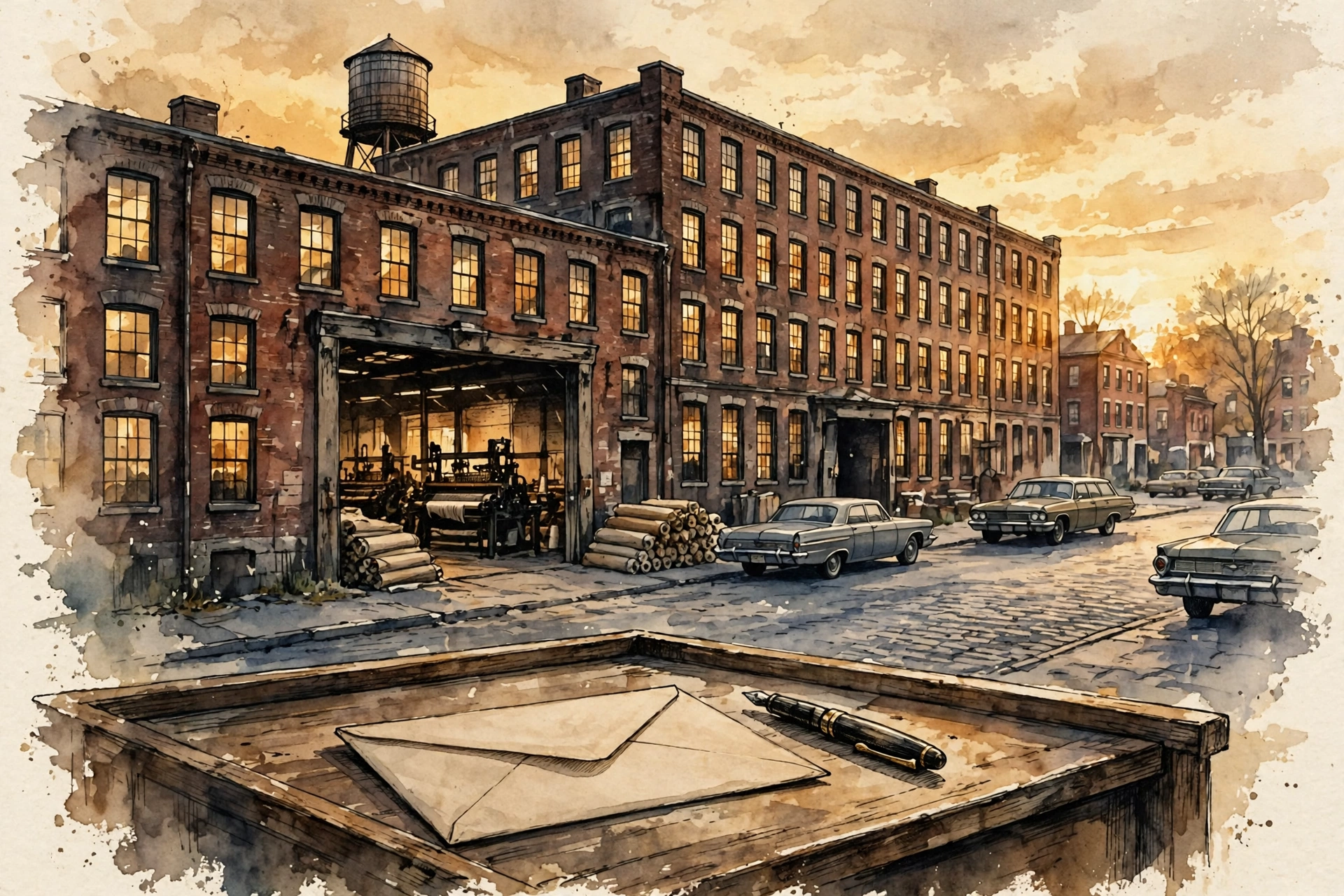
Berkshire Hathaway has two founding moments, 126 years apart, and the second one was an accident of temper. The first is 1839, in Valley Falls, Rhode Island, where Oliver Chace — who had worked for Samuel Slater, builder of America's first successful textile mill — founded the Valley Falls Company (company history; standard histories). That line runs through Berkshire Fine Spinning Associates, formed in 1929. The second ancestor, Hathaway Manufacturing, was founded in New Bedford, Massachusetts, in 1888 by Horatio Hathaway. In 1955 the two merged as Berkshire Hathaway: 15 plants, more than 12,000 workers, over $120 million in revenue, headquartered in New Bedford (company history; Berkshire's own 2014 shareholder letter puts the merged company at 14 plants and 10,000 employees — the counts vary by which plants are tallied, and the essay prints both records rather than choosing silently).
The merger was a combination of the weak. In the nine years after it, the merged company's aggregate sales of $530 million produced an aggregate loss of $10 million, and its net worth fell from about $51 million to $22 million (Buffett's 1985 shareholder letter, recounting the record). Northern mills were closing against lower-cost, largely non-union Southern competition. Berkshire Hathaway in 1962 was not a platform. It was a liquidation in slow motion.
That is when Warren Buffett entered — as a seller, not a buyer. Buffett, then running Buffett Partnership, Ltd. in Omaha, began buying Berkshire shares in 1962 at about $7.50 a share, against book value of about $19.46 a share at September 30, 1964 (1977 shareholder letter) and working capital of about $10.25. The trade was a classic Benjamin Graham "cigar butt": the company kept closing mills and using the proceeds to tender for its own stock, so a holder could buy cheap and sell back into each tender at a small profit. Buffett accumulated roughly 7% of the company by 1963 and a much larger position by 1964 (standard histories; Buffett's own accounts).
Then came the eighth of a point. In 1964 Buffett met Seabury Stanton, Berkshire's president, and agreed to tender his shares at $11.50 a share. Stanton said they had a deal — as Buffett told it, repeatedly and on the record, including in his 2014 shareholder letter and a 2010 CNBC interview with Becky Quick. Weeks later the written tender offer arrived, dated May 6, 1964, offering to buy 225,000 shares at $11⅜ — $11.375. "He chiseled me for an eighth," Buffett said. Angered, he did not tender. He bought more — aggressively — and by May 1965 Buffett Partnership controlled the company. Stanton and his son resigned. Buffett later called buying Berkshire "the dumbest stock I ever bought" and estimated the opportunity cost at roughly $200 billion: had the same capital gone directly into insurance instead of being anchored for twenty years to a dying textile business, he argued, Berkshire would be worth about twice as much (CNBC, October 2010). The greatest compounder in history begins, by its owner's own account, as a monumentally stupid decision made over 12.5 cents a share.
The founders and the founding capital
The signature number of this essay is $11.375 — the tender price that created modern Berkshire by failing to buy its largest shareholder out. There is no single founding-capital check for Berkshire the way there is for Ford or Amazon, because the company was not founded in 1965; it was captured. What can be stated with sources is the capital stack at the capture. When Buffett Partnership took control in 1965, Berkshire Hathaway had an accounting net worth of $22 million, all of it devoted to textiles (1985 shareholder letter). Its shares had traded at about $7.50 when Buffett began buying in 1962 — a market value for the whole company in the low tens of millions — against that $19.46 of book value per share, book value the 1985 letter warns "considerably" overstated intrinsic value, because the textile assets could not earn returns commensurate with their carrying value.
The deeper founding capital belongs to the textile ancestors, and the record is thinner. Oliver Chace's Valley Falls Company (1839) and Horatio Hathaway's New Bedford mill (1888) were capitalized in the ordinary way of 19th-century New England textiles — local merchant money subscribed against mill buildings, water power, and machinery — but no single founding subscription figure survives in the standard histories with the two-source support this series requires, so none is printed here. The honest founding-capital story of Berkshire is therefore the 1965 one: a $22 million net-worth textile company, bought below book by a partnership whose manager had intended, until an eighth of a point intervened, to sell and leave.
What that $22 million bought Buffett was not a business. It was a corporate shell with cash-generating habits. The mills, run after 1965 by Ken Chace — a long-time Berkshire employee Buffett installed as president, and, by Buffett's account, an excellent manager — threw off cash in decent years. In early 1967, cash generated by the textile operation, from earnings and from shrinking textile inventories, receivables, and fixed assets, funded Berkshire's entry into insurance: the purchase of National Indemnity Company and National Fire & Marine for $8.6 million (1985 shareholder letter; contemporary accounts). The dying business paid for the machine that replaced it. That is the founding transaction of the modern company, and it cost less than half the textile operation's book net worth.
The machine
Berkshire's machine is insurance float funding permanent capital, allocated by one office, into wholly owned businesses and marketable securities — and its genius is a cost-of-capital trick, not a stock-picking trick. An insurer collects premiums today and pays claims later. The money held in between — float — belongs to policyholders, but the insurer invests it and keeps the return. If underwriting breaks even, float is free leverage: no interest, no maturity date, no margin call, and it grows as premiums grow. If underwriting is profitable, the insurer is paid to borrow. Buffett stated the test himself in the 1996 shareholder letter: an insurance business has value if its cost of float over time is less than the cost of obtaining funds elsewhere; it is an albatross if the cost is higher.
National Indemnity was the proof of concept, bought for a price that still reads as a misprint. Berkshire paid $8.6 million in March 1967 for National Indemnity and its smaller sister. The acquired companies carried tangible net worth of about $6.7 million — so the premium for the business itself was about $1.9 million — and with them came about $19.4 million of float to invest (Motley Fool's reconstruction from Buffett's letters; the float figure is carried in Berkshire's own float history). Berkshire's total insurance float was about $39 million in 1970. By the end of 2025 it was about $176 billion (Form 10-K FY2025) — a pool of other people's money, accumulated at a cost that has run at or below zero in most years because Berkshire's insurers, GEICO most of all in recent years, have usually underwritten at a profit. In fiscal 2025 GEICO alone earned $6.824 billion of pre-tax underwriting profit (Form 10-K FY2025).
The second half of the machine is what the float — and later, the retained earnings of the acquired businesses — gets allocated into, and on what terms. Beginning with See's Candies in 1972 (bought for $25 million with Charlie Munger, the purchase Buffett credits with teaching him to pay up for quality), Berkshire bought whole businesses for cash, left their managers alone, took no synergies, imposed no headquarters bureaucracy to speak of, and swept their earnings back to Omaha for redeployment. The roster became the American economy in miniature: GEICO (taken whole in 1996), General Re (1998), BNSF Railway (2010, the largest acquisition), Berkshire Hathaway Energy, Clayton Homes, McLane, Precision Castparts, Pilot — plus a concentrated portfolio of marketable securities. The structure compounds for three mechanical reasons an operator should notice. First, permanent capital: Berkshire never has to sell, so it can buy when sellers are desperate and hold through drawdowns that force leveraged owners out. Second, decentralization as a talent price: sellers of good family businesses accept Berkshire's offer over higher private-equity bids because Berkshire promises autonomy and permanence — the machine buys deal flow with a reputation, which lowers its effective purchase prices. Third, tax and friction drag near zero: no dividend, minimal turnover, earnings retained and redeployed inside one balance sheet for sixty years.
The output of the machine is the most audited performance record in business. From 1965 to 2025, Berkshire's per-share market value compounded at 19.7% a year, against 10.5% for the S&P 500 with dividends — an overall gain of 6,099,294%, against 46,061% for the index (2025 shareholder letter performance table, February 28, 2026; the 2024 letter's table through 2024 reads 19.9% and 5,502,284%). A gap of about nine points a year sounds like a rounding difference. Sustained for sixty-one years, it is the difference between $1 becoming about $462 in the index and about $60,994 in Berkshire. The machine is not a secret. Its inputs — float, permanence, decentralization, patience — have been described by its owner in free annual letters since 1965. It has still never been replicated, because every input requires declining money or glory in the short term, indefinitely.
The numbers
- Founding capital (modern Berkshire): $22 million accounting net worth at Buffett Partnership's takeover in 1965, all in textiles (1985 shareholder letter); shares first bought 1962 at about $7.50 against $19.46 book value per share (September 30, 1964; 1977 letter). Textile ancestors: Valley Falls Company, 1839; Hathaway Manufacturing, 1888; merged 1955 with over $120 million of revenue and more than 12,000 employees (company history). No two-source founding subscription figure survives for 1839 or 1888, so none is printed.
- First documented revenue: over $120 million for the merged Berkshire Hathaway in 1955 (company history); the merged company's 1955–64 aggregate was $530 million of sales producing a $10 million aggregate loss (1985 shareholder letter). First machine transaction: National Indemnity + National Fire & Marine, $8.6 million, March 1967, carrying about $19.4 million of float.
- Peak value: ≈$1.19 trillion — market-cap peak, May 3, 2025 (market data; trillion-dollar company record). Berkshire first passed $1 trillion on August 28, 2024 — the first U.S. company outside technology to do so.
- Peak scale (fiscal 2025, the latest full year): total revenues $371.444 billion, operating earnings $44.486 billion, net earnings attributable to shareholders $66.968 billion; insurance float about $176 billion; approximately 387,800 employees (Form 10-K FY2025). Insurance group revenue was $104.212 billion of the total.
- The compounding record: per-share market value +19.7% compounded, 1965–2025, vs. +10.5% for the S&P 500 with dividends; overall gain 6,099,294% vs. 46,061% (2025 shareholder letter).
- Status: live — the largest non-technology company in America by market value, in its first year under CEO Greg Abel (succeeded Buffett January 1, 2026; Buffett remains chairman). The textile business whose name it carries closed in 1985.
The near-death moment
Berkshire's near-death was not a single quarter. It was the twenty-year textile anchor itself — and, inside the modern company, the 2001 insurance crisis that proved the machine could break its own rules. Take the anchor first. From 1965 to 1985 Buffett kept the New Bedford mills running under excellent managers, with cooperative labor, through repeated rounds of capital investment that each looked justified and collectively changed nothing: cotton fabric is a commodity, buyers purchase on price alone, and New England costs could not meet Southern, then foreign, competition. In July 1985 he closed the operation. The 1985 letter's verdict is the near-death's autopsy in advance: aggregate post-merger sales of $530 million had produced a $10 million loss before he arrived, the business "never became a good earner, not even in cyclical upturns," and — in the sentence Buffett aimed at himself — when a management with a reputation for brilliance tackles a business with a reputation for bad economics, it is the reputation of the business that remains intact. He later priced the delay at roughly $200 billion of foregone compounding (CNBC, 2010). A lesser balance sheet, carrying a business that consumed cash and attention for two decades, does not survive to tell that story as a lesson. Berkshire survived it only because insurance arrived in 1967.
The second near-death tested the insurance machine directly. Berkshire bought General Re in 1998 for about $22 billion in stock. In the 2001 shareholder letter Buffett confessed that General Re had broken all three of his underwriting rules — it had accepted risks it could not evaluate, mis-reserved, and, critically, written coverage that included terrorist acts without charging for them. On September 11, 2001, that error came due: Berkshire took a $2.275 billion pre-tax charge for the attack, about $1.7 billion of it at General Re (Buffett's November 2001 letter to shareholders). Berkshire's net worth fell $3.77 billion in 2001, per-share book value dropped 6.2%, and the cost of Berkshire's float spiked to its worst level since 1984 (2001 shareholder letter). Buffett's own summary was an ark-builder's mea culpa: "Predicting rain doesn't count; building arks does." The machine did not nearly die of a bad investment. It nearly damaged itself at its core discipline — pricing risk — and was repaired, under new General Re management, by restoring exactly that discipline. Float is only cheap if underwriting is honest; 2001 is the year Berkshire printed the proof in its own loss column.
What endures / the autopsy
The textile company is dead; the name is the largest monument in American business to a mistake admitted in writing. The mills closed in 1985 and the machinery was auctioned in early 1986 for a fraction of its carrying value — equipment that had occupied 750,000 square feet and cost about $13 million, including $2 million spent as late as 1980–84, sold for scrap-level prices (1985 letter and subsequent accounts). Cause of death, checked against the timeline: not bad management (Buffett rated Ken Chace the equal of his best managers), not labor, not underinvestment. Structural commodity economics against lower-cost producers, visible in the numbers by 1964 — nine years, $530 million of sales, $10 million lost — a full two decades before the closure. The certificate usually names 1985. The disease was diagnosed in the 1955 merger's own first decade.
What endures is the open question every Berkshire holder now owns: whether the machine survives its allocator. The system — float, permanence, decentralization — is structural and transfers with the balance sheet: about $176 billion of float, hundreds of billions in cash and Treasury bills, and operating businesses that ran $44.5 billion of operating earnings in fiscal 2025 do not depend on one man's stock picks for next year's result. What does not transfer automatically is the judgment that priced National Indemnity at $8.6 million, See's at $25 million, and BNSF at roughly $34 billion, and the reputation that made sellers call Omaha first. Greg Abel, a Berkshire operating manager since 2000, took over as CEO on January 1, 2026, with Buffett remaining chairman — the succession the letters had telegraphed for years. The founding machine's final test is the one its founder designed it for and cannot run himself: compounding without him.
The operator's take
- Price the eighth of a point before it prices you. The most expensive decision in this story was emotional: a 12.5-cent slight converted a profitable exit into a twenty-year anchor, at a self-estimated $200 billion of opportunity cost. An operator's rule follows directly — no capital decision gets made in the meeting where the insult landed. Buffett turned the error into an empire anyway; the lesson is that he is the exception who could, and he still calls it his dumbest trade.
- Find your float — financing that pays you, tied to a discipline you control. Berkshire is not "a great investor." It is a great financing structure with great investing attached: premiums held at negative cost, permanently, because underwriting stayed disciplined (and 2001 shows the cost when it didn't). Every business has a version of the question: what liability, deposit, subscription, or prepayment do customers hand you before you deliver — and are you pricing the risk in it honestly enough to invest the gap?
- Buy the business, not the turnaround. Sixty years of letters reduce to the 1985 sentence: brilliant management does not repeal bad industry economics. Ken Chace was excellent and textiles still lost. When both branches of the decision tree lose — invest and earn nothing, or don't invest and fall behind — leave the tree early. Buffett's regret was not buying a bad business; cigar butts were a legitimate trade. It was staying twenty years. Exit discipline, not entry genius, is the transferable skill.
The myth ledger
- "Buffett bought Berkshire because he saw a great company." — LEGEND. He bought a statistically cheap cigar butt to sell back into tenders, took control out of anger over an eighth of a point, and called it the dumbest stock he ever bought (CNBC, 2010; 2014 letter). The greatness was built inside the shell afterward.
- "Stanton chiseled Buffett for an eighth." — DOCUMENTED as Buffett told it. The May 6, 1964 tender at $11⅜ for 225,000 shares is a matter of record; the prior oral agreement at $11.50 rests on Buffett's consistent telling (2014 letter; CNBC, 2010), uncontradicted by Stanton's side in the standard histories. The price is documented; the word "chiseled" is Buffett's.
- "The $200 billion mistake." — DOCUMENTED as Buffett's estimate, not a measurement. It is his counterfactual — insurance-first compounding from 1965 — stated on CNBC in 2010 when Berkshire was worth about $200 billion in total. It prints here as his judgment on his own decision, not as an audited figure.
- "Berkshire was founded in 1839." — DOCUMENTED, with the merger caveat. The Valley Falls line dates to 1839; the company named Berkshire Hathaway dates to the 1955 merger. Both dates are true; which one a telling uses reveals whether it is selling heritage or history.
- "Buffett is a stock picker; Berkshire is a fund." — EMBELLISHED. The majority of Berkshire's value and earnings now come from wholly owned operating businesses and insurance underwriting, funded by float; the securities portfolio is the machine's second output, not the machine (Form 10-K FY2025 segment record).
- "The textile mills failed because Buffett neglected them." — LEGEND. The 1985 letter records excellent management, cooperative labor, and repeated capital investment over twenty years. The economics failed; the people, on the owner's own testimony, did not.
Sources: Berkshire Hathaway shareholder letters — 1977 (book value $19.46 per share at September 30, 1964), 1985 (the textile history: $22 million net worth at takeover, $530 million of aggregate post-merger sales producing a $10 million loss, the July 1985 closure, Ken Chace's management, National Indemnity funded from textile cash in early 1967), 1996 (the cost-of-float test), 2001 (the $3.77 billion net-worth loss, General Re's broken underwriting rules), the November 9, 2001 letter (the $2.275 billion September 11 charge, about $1.7 billion at General Re), 2014 (the Stanton tender as Buffett told it), 2024 (19.9% compounded 1965–2024; 5,502,284% overall gain) and 2025 (19.7% compounded 1965–2025; 6,099,294% overall gain; letter dated February 28, 2026); Form 10-K FY2025 (total revenues $371.444 billion, operating earnings $44.486 billion, net earnings $66.968 billion, insurance group revenue $104.212 billion, GEICO pre-tax underwriting profit $6.824 billion, float about $176 billion, approximately 387,800 employees); CNBC, Squawk Box interview with Warren Buffett (October 2010) — "the dumbest stock I ever bought," the eighth-of-a-point account, and the roughly $200 billion opportunity-cost estimate, as Buffett stated them; Motley Fool (2019), reconstructing the National Indemnity acquisition from the letters — $8.6 million paid, about $6.7 million of tangible net worth, about $19.4 million of float acquired, float of about $39 million in 1970; company history and standard histories — Valley Falls Company (1839, Oliver Chace), Hathaway Manufacturing (1888, Horatio Hathaway), the 1955 merger (15 plants, over 12,000 workers, over $120 million of revenue; the 2014 letter's 14-plant/10,000-employee count is noted in the text), Buffett's 1962 purchases at about $7.50 and roughly 7% ownership by 1963; market data — the ≈$1.19 trillion market-cap peak of May 3, 2025 and the first $1 trillion crossing on August 28, 2024. This is essay #12 of the Top 500 Companies Ever, a pleitez.ai series. Written by the Emanuel Pleitez AI team.
What next?
Pick one — every road from here is short.
Prefer a human?
Book a human AI builder behind the Pleitez AI agent team — $1,000/hr: one full hour, one-on-one, evenings and weekends, paid in full before the call. That could be Emanuel, or someone of his caliber or better.
Book a human AI builder