What location does to a business's value
Everyone assumes where a business sits changes what it sells for — here is what the 2025 closed-sale data actually says, market by market.
The Silicon Valley correction
The assumption: a business in the Bay Area must sell at a premium. Buyers there are richer, the thinking goes, and everything in Silicon Valley costs more, so a business there should too.
The data says otherwise. In full-year 2025, San Francisco businesses sold at an average cash-flow multiple of 2.43× across 131 reported sales, and San Jose at 2.27× across 76. Both sit at or below Dallas–Fort Worth at 2.54× (328 reported sales), New York at 2.52× (472), Los Angeles at 2.51× (445), and Chicago at 2.49× (194).
The Bay Area premium is real in venture capital valuations of startups. It does not show up in Main Street sale prices. Money chasing a startup is pricing a chance at an enormous outcome; money buying a working business is pricing its cash flow, and cash flow gets priced much the same way everywhere.
Zoom out and the pattern holds: across all 26 major markets in the table below, average cash-flow multiples in 2025 fell between 2.14× and 3.42×. That is a real spread, but a narrow one — nothing like the gap between one trade and another.
The 26 markets, in the data
Every figure below is an all-industry figure for that market: every kind of business that sold there in full-year 2025, combined. Read a row as the weather in that market, not as the price of any one trade in it.
| Market | Reported sales 2025 | Average cash-flow multiple | Median sale price | Sold at (avg % of asking) | Median days on market |
|---|---|---|---|---|---|
| Tampa–St. Petersburg, FLTampa-St. Petersburg-Clearwater, FL | 556 | 3.19× | $700,000 | 98% | 86 |
| New York, NYNew York-Northern New Jersey-Long Island, NY-NJ-PA | 472 | 2.52× | $360,000 | 91% | 159 |
| Miami–Fort Lauderdale, FLMiami-Fort Lauderdale-Miami Beach, FL | 447 | 2.38× | $291,000 | 90% | 164 |
| Los Angeles, CALos Angeles-Long Beach-Santa Ana, CA | 445 | 2.51× | $300,000 | 91% | 170 |
| Dallas–Fort Worth, TXDallas-Fort Worth-Arlington, TX | 328 | 2.54× | $305,000 | 98% | 135 |
| Phoenix, AZPhoenix-Mesa-Scottsdale, AZ | 324 | 2.43× | $340,000 | 96% | 129 |
| Seattle, WASeattle-Tacoma-Bellevue, WA | 253 | 2.65× | $395,000 | 94% | 147 |
| Atlanta, GAAtlanta-Sandy Springs-Marietta, GA | 252 | 2.33× | $250,000 | 92% | 149 |
| New JerseyNew Jersey | 220 | 2.56× | $312,500 | 90% | 161 |
| Houston, TXHouston-Sugar Land-Baytown, TX | 219 | 2.27× | $180,500 | 92% | 164 |
| Denver, CODenver-Aurora, CO | 210 | 2.58× | $365,000 | 101% | 169 |
| Orlando, FLOrlando-Kissimmee, FL | 202 | 2.37× | $273,750 | 93% | 166 |
| Chicago, ILChicago-Naperville-Joliet, IL-IN-WI | 194 | 2.49× | $265,590 | 89% | 179 |
| Washington, DCWashington-Arlington-Alexandria, DC-VA-MD-WV | 177 | 2.45× | $299,750 | 92% | 197 |
| Orange County, CAOrange County, CA | 176 | 2.37× | $297,500 | 91% | 170 |
| Boston, MABoston-Cambridge-Quincy, MA-NH | 159 | 2.44× | $347,500 | 95% | 203 |
| Philadelphia, PAPhiladelphia-Camden-Wilmington, PA-NJ-DE-MD | 150 | 2.61× | $349,000 | 95% | 204 |
| Minneapolis–St. Paul, MNMinneapolis-St. Paul-Bloomington, MN-WI | 131 | 3.42× | $625,000 | 104% | 172 |
| San Francisco, CASan Francisco-Oakland-Fremont, CA | 131 | 2.43× | $240,000 | 88% | 182 |
| Riverside–San Bernardino, CARiverside-San Bernardino-Ontario, CA | 127 | 2.14× | $194,500 | 90% | 173 |
| Portland, ORPortland-Vancouver-Beaverton, OR-WA | 113 | 2.31× | $230,000 | 87% | 185 |
| San Diego, CASan Diego-Carlsbad-San Marcos, CA | 111 | 2.20× | $277,500 | 87% | 159 |
| Las Vegas, NVLas Vegas-Paradise, NV | 107 | 2.18× | $235,000 | 87% | 142 |
| Detroit, MIDetroit-Warren-Livonia, MI | 106 | 2.49× | $238,737 | 93% | 191 |
| Nashville, TNNashville-Davidson--Murfreesboro, TN | 105 | 2.46× | $275,000 | 87% | 209 |
| San Jose, CASan Jose-Sunnyvale-Santa Clara, CA | 76 | 2.27× | $267,500 | 89% | 194 |
Bay Area combined: San Francisco + San Jose = 207 reported sales. BizBuySell reports the two markets separately, so we show them separately — we do not blend their multiples into a number nobody published.
Source: BizBuySell Insight Report, full-year 2025 closed sales (all industries, market by market). BizBuySell Insight Report data tables
Business valuation by country
Every rated country, with its own published bridge from the U.S. multiple: Australia · Austria · Bahrain · Bangladesh · Belgium · Bolivia · Brazil · Cambodia · Canada · Chile · China · Colombia · Costa Rica · Croatia · Cyprus · Czech Republic · Denmark · Dominican Republic · Ecuador · Egypt · El Salvador · Estonia · Finland · France · Germany · Ghana · Greece · Guatemala · Honduras · Hungary · Iceland · India · Indonesia · Iraq · Ireland · Israel · Italy · Jamaica · Japan · Jordan · Kazakhstan · Kenya · Kuwait · Latvia · Lithuania · Luxembourg · Malaysia · Malta · Mexico · Morocco · Netherlands · New Zealand · Nicaragua · Nigeria · Norway · Oman · Pakistan · Panama · Paraguay · Peru · Philippines · Poland · Portugal · Qatar · Romania · Saudi Arabia · Singapore · Slovakia · Slovenia · South Africa · South Korea · Spain · Sri Lanka · Sweden · Switzerland · Taiwan · Thailand · Ukraine · United Arab Emirates · United Kingdom · Uruguay · Vietnam.
The full map, honestly. The calculator above covers the United States and 82 rated countries, each with a published, checkable number. Twelve more countries get a methodology page instead of a number, because the anchor — a sovereign rating with a published country risk premium — does not exist there, or cannot yet carry an estimate: Afghanistan · Argentina · Cuba · Haiti · Iran · Lebanon · Russia · Somalia · Sudan · Syria · Venezuela · Yemen. Turkey joins the rated map at the January refresh of the country tables.
What happened to Kodak?
In 1976, Eastman Kodak sold 90% of the film and 85% of the film cameras bought in the United States. Film was a near-perfect business: cheap to make, bought again and again, and Kodak controlled it end to end.
At its peak the company employed 145,300 people, in 1988. In Rochester, New York — the city Kodak built — it employed 60,400 people in 1982. Revenue peaked at $16.2 billion in 1996, and in 1997 the stock market valued Kodak at $30 billion.
The technology that killed film was invented inside Kodak. In 1975, Kodak engineer Steven Sasson built the first self-contained digital camera: 8 pounds, a 100-by-100-pixel sensor, black-and-white pictures recorded onto a cassette tape, 23 seconds per photo. It worked. It also threatened the film business that paid for everything else.
So Kodak protected film. Through the 1990s it invested in digital but stayed reluctant to ease its reliance on lucrative film sales, and rivals Canon and Sony took the digital market instead. Within a decade, filmless photography had largely erased the business Kodak was protecting.
On January 19, 2012, Kodak filed for Chapter 11 bankruptcy. It emerged in September 2013 as a much smaller company focused on commercial printing, with expected revenue of $2.5 billion — about a sixth of its peak. Rochester employment had fallen to 7,100. Rochester still sells businesses today: 27 reported sales in 2025, at an average of 2.13 times cash flow.
Sources: PetaPixel — a brief history of Kodak · Wikipedia — Steven Sasson · Associated Press — Kodak files for Chapter 11 (via Manufacturing.net) · Reuters — Kodak emerges from bankruptcy (2013) · BizBuySell Insight Report — full-year 2025 sales data
The Traitorous Eight: eight resignations that built Silicon Valley
In September 1957, eight young engineers and physicists resigned from Shockley Semiconductor Laboratory in Mountain View on the same day. Their boss, William Shockley, had co-invented the transistor and won the Nobel Prize in Physics the year before. His management was authoritarian and unpopular — and when the eight asked Beckman Instruments to replace him and were refused, they all walked.
The eight were Julius Blank, Victor Grinich, Jean Hoerni, Eugene Kleiner, Jay Last, Gordon Moore, Robert Noyce, and Sheldon Roberts. Banker Arthur Rock had shopped the group to 41 companies before Sherman Fairchild agreed to back them; Fairchild Camera and Instrument provided a $1.38 million loan, and Fairchild Semiconductor opened about a mile from the lab they had just left.
Fairchild's people then built the industry. Noyce and Moore left in 1968 to found Intel. In 1969, Jerry Sanders — Fairchild's director of marketing — founded Advanced Micro Devices (AMD) with seven Fairchild colleagues. In 1972, Kleiner co-founded the venture firm Kleiner Perkins. A 2014 study counted more than 30 spin-off companies from Fairchild in its first 12 years, and traced 92 publicly traded companies, then worth about $2.1 trillion combined, back to Fairchild's founders and employees.
History remembers them as the Traitorous Eight — and remembers Fairchild itself less for its chips than for the companies its people went on to build.
Sources: Wikipedia — Traitorous eight · Computer History Museum — Beckman Instruments · Intel — Intel's founding (company history) · Wikipedia — Advanced Micro Devices · TechCrunch — the first trillion-dollar startup (Endeavor Insight study)
What happened to ExxonMobil?
For years, ExxonMobil was the world's largest publicly traded company. At the end of 2007, the stock market valued it at $504 billion — the peak of the oil era, with crude high and climbing.
The catch was that the number was never fully Exxon's. It belonged to the oil price. When oil fell, the earnings fell with it: net income dropped from $32.5 billion in 2014 to $7.8 billion in 2016. The business underneath had not changed; the price of what it sells had.
In 2020, the pandemic crushed oil demand. ExxonMobil lost $22.4 billion — its first annual loss as a public company — and announced about 14,000 job cuts, roughly 15% of its workforce, including 1,900 in the United States, mainly in the Houston area.
On August 31, 2020, ExxonMobil was removed from the Dow Jones Industrial Average. Its predecessor, Standard Oil of New Jersey, had been in the index since 1928 — 92 years — and Exxon was its oldest member. Chevron remained as the only energy company in the Dow.
The top spot did not stay empty. In July 2025, Nvidia became the first company in history valued at $4 trillion — a company almost nobody would have picked as the world's largest twenty years earlier.
Sources: ExxonMobil — financial highlights (company report) · Wikipedia — ExxonMobil · Reuters — ExxonMobil's first annual loss (via OE Digital) · Reuters — Exxon to cut 14,000 jobs (via OE Digital) · NPR — Exxon Mobil exits the Dow (via WUGA) · Reuters — Nvidia reaches $4 trillion (via 94.3 Jack FM)
How Sam Walton lost the best store in six states

In 1945, Sam Walton had $25,000 to his name: $5,000 of his own savings and $20,000 borrowed from his father-in-law. With it he bought a struggling Ben Franklin variety store in Newport, Arkansas. He was 27.
He was good at it: low prices, thin margins, longer hours, and buying direct from wholesalers to cut out the markup in between. Within five years, his store led the Ben Franklin chain across a six-state region — the best store in the region, built on a borrowed stake.
Then he lost it — not to a competitor, but to a clause he had never negotiated. His lease had no renewal protection. In 1950, his landlord, P.K. Holmes, declined to renew: he wanted the thriving store for his own son. Holmes bought the fixtures and inventory for $50,000, and Walton walked away from the best store in the region.
He started over in Bentonville, a smaller town, with Walton's 5 & 10 — and a 99-year lease. With his brother Bud he built sixteen variety stores by 1962, the largest independent chain of its kind in the country. On July 2, 1962, at 44, he opened the first Walmart in Rogers, Arkansas — the same year Kmart and Target opened theirs — in the small towns the big chains ignored.
In 1990, Walmart passed Sears and Kmart to become America's largest retailer. Sam Walton died on April 5, 1992.
Sources: Wikipedia — Sam Walton · Encyclopedia of Arkansas — Sam Walton (1918–1992) · Walmart — our history
The banker who lent on a handshake
Amadeo Giannini founded the Bank of Italy on October 17, 1904, in a converted San Francisco saloon, after quitting the board of a savings-and-loan that would not lend to working people. His bank was built for the little fellow — immigrants, fishermen, grocers, the borrowers other banks turned away. Deposits on the first day came to $8,780; within a year they passed $700,000.
Then came the story everyone tells. On April 18, 1906, the earthquake hit and the fires started. The story goes that Giannini loaded his bank's gold and records into wagons, hid them under produce, and hauled them to safety; that days later he reopened on the wharf, behind a plank laid across two barrels under a hand-lettered sign; and that he lent to anyone rebuilding, on a handshake — and every loan was repaid. It is a wonderful story. Here is what the record supports, and what it does not.
What's documented
- The rescue was real: before the fires reached the bank, he got its cash and records out of the city, to his home in San Mateo, about 18 miles away — about $80,000, by the bank's own account.
- The wharf desk was real: he reopened within days on the Washington Street wharf, at a plank across two barrels, taking deposits and making loans while the established banks stayed shut.
- His speed had a structural reason, not just nerve: the fires had heated the big banks' vaults so hot that opening them risked igniting the contents, so many stayed sealed for weeks. His cash was never in a vault at all.
- The lending was real, and it was underwriting: loans on character plus a signature — a signed note from a borrower he judged, often with no collateral. He could do it because he knew this community personally; the local knowledge was the credit model.
- The aftermath is in the record: branch banking from 1909 (the first branch was in his hometown, San Jose), and in 1930 the Bank of Italy became Bank of America — by the mid-1940s, the largest bank in the world.
What's legend
- The wagon keeps changing: produce wagons under orange crates in one telling, a garbage wagon in another, fruit and vegetables in a third. The hiding is consistent in every version; the vehicle is not. That variance is the fingerprint of a true story polished by decades of retelling.
- 'On a handshake,' with no paper at all: the better-attested version is character and a signature — a signed note. The pure-handshake version erases both the paperwork and the knowledge that made the loans safe.
- 'Every loan was repaid': Giannini's own claim, retold with pride for years afterward. No loan-by-loan ledger or independent audit has ever been produced. It may be true; it is his word, not a record.
Sources: Wikipedia — Amadeo Giannini · Entrepreneur — how A.P. Giannini built the Bank of Italy · RISMedia — leadership lessons from A.P. Giannini · Our American Stories — A.P. Giannini, the banker who bet on everyday Americans
The raise that wasn't generosity
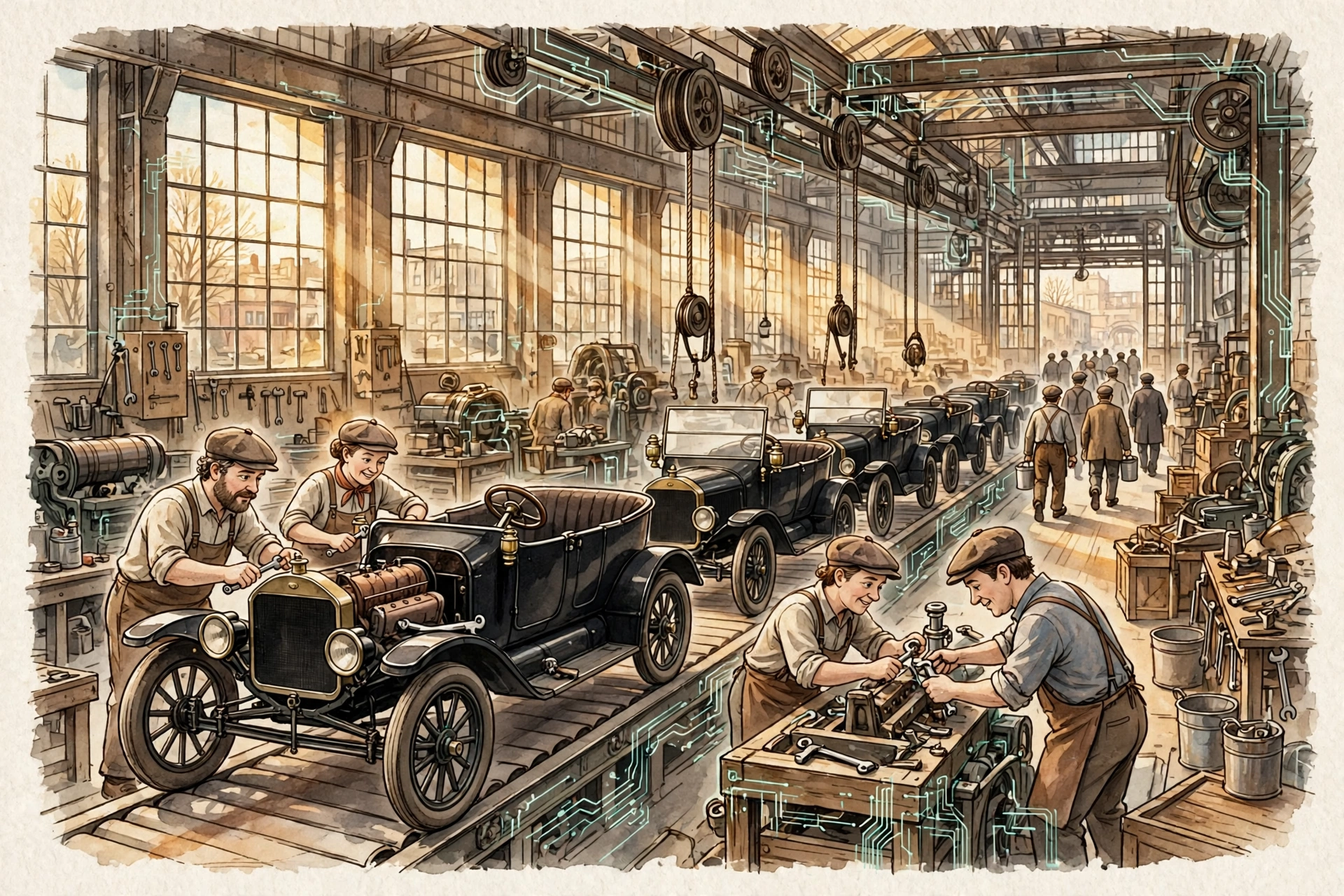
On January 5, 1914, Ford announced the $5 day: the workday cut from nine hours to eight, and pay roughly doubled from $2.34 a day. Newspapers called it philanthropy. Rival manufacturers called it madness. A century later it is still told the same way: the carmaker who paid his workers enough to buy his cars, inventing the middle class out of generosity.
Underneath it was a number: 370%. That was Ford's worker turnover in 1913. The new moving assembly line at Highland Park built cars faster than anyone ever had — and the work was so punishing that, by Ford's own account, the company hired about 53,000 men that year to keep 14,000 jobs filled. Some of the $5 story is documented. Some of it is legend. We checked which is which.
What's documented
- The $5 was not a straight raise. The base wage stayed at $2.34 a day; the rest was a profit-sharing bonus on top — a raise with conditions attached, not a new wage.
- The conditions were personal: no drinking, a clean home, money in savings, no boarders taken in at home. Ford's Sociological Department sent fifty investigators into workers' homes with a 150-question checklist to decide who qualified.
- It did not cover everyone on the floor: the announcement applied to men 22 and older, and workers who failed the checklist stayed at the base wage until they qualified.
- The motive in the record is retention. Ford's own corporate historian summarizes the $5 day as a move made 'mainly to stabilize the workforce' — the line was losing trained men faster than it could replace them.
- And it worked: turnover plunged, the hiring crisis ended, and thousands of applicants lined up outside Highland Park. Ford could suddenly choose the steadiest workers in Detroit instead of begging for them.
What's legend
- 'He paid them enough to buy his cars.' The famous explanation, repeated ever since — by Ford himself among others. The 1914 record points somewhere else: the raise answered a hiring crisis, not a sales plan. The generosity story came afterward.
- 'An act of pure philanthropy.' That was the newspapers' word, not Ford's ledger. A giveaway does not usually arrive with home inspections; the bonus was an instrument, and it bought the attendance and steadiness the line required.
- 'Every Ford worker earned $5 a day.' Many did not, at first: younger workers, and anyone the Sociological Department turned down, remained at $2.34. The $5 day was a target men qualified for, not a floor under everyone.
Sources: Wikipedia — Henry Ford · NPR — the middle class took off 100 years ago, thanks to Henry Ford? · The Detroit Bureau — $5 a day: how Henry Ford kick-started the American middle class
What location actually moves
Compare the spreads. The gap between metros above runs from 2.14× to 3.42×. Our per-industry guides show realized multiples from under 2× to nearly 5× depending on the trade. What a business does moves its multiple far more than where it does it.
Location works through the profit line instead. Local wages, rent, demand, and customer density decide how much seller's discretionary earnings (SDE) a business can produce in a place. Value follows the earnings: the same kind of business, earning more in a stronger market, sells for more — at roughly the same multiplier everywhere.
Same business, different city: the multiple barely moves; the achievable profit does. That is why the honest way to use location in a valuation is to get the local profit right, not to add a city premium to the multiple.
Outside the major metros
Outside the major metros there are fewer buyers, fewer reported sales, and typically longer timelines. A good business in a small market can wait a long time for the right buyer to even hear about it, and brokers there work harder to reach buyers beyond the local pool.
The honest starting point is the same one this site uses everywhere: the national industry math, applied to your real, documented profit. Documented profit travels — it is what lets a buyer from outside your area underwrite your business at all.
What we don't do
No public source publishes an industry-by-market cross-tab — what plumbers specifically sold for in Dallas, for example. That data exists behind paywalls and in brokers' private files, not in anything published that we can check. So we don't print one, and we don't invent a city premium to fill the gap.
If a broker quotes you a city premium, ask to see their sold comparables (comps). Real comparables have addresses, dates, and prices. A premium that cannot show its comps is a sales line, not data.
What next?
Pick one — every road from here is short.
Prefer a human?
Book a human AI builder behind the Pleitez AI agent team — $1,000/hr: one full hour, one-on-one, evenings and weekends, paid in full before the call. That could be Emanuel, or someone of his caliber or better.
Book a human AI builder